Monday, February 19, 2007

Icon #1

Icon #1, May 1993, DC Comics/Milestone Media
Writer: Dwayne McDuffie
Penciller: M.D. Bright
Inker: Mike Gustovich
Letterer: Steve Dutro
Colorists: Racelle Menashe, James Sherman, Noelle Giddings


During Black History Month, I’ve read a quite a few comic books that star icons of African-American culture: Mr. T, Black Lightning, O.J. Simpson (for better and for worse, eh?) – but I’ve have yet to read of a character that so boasted the title as, well, Icon. One part Superman, one part Cliff Huxtable, Icon is an earthbound alien refugee that has adopted the persona of a black man since 1839, and although one would assume that he might sympathize with the civil rights plight, he has earned an upper class lifestyle and believes that “those who suffer under [impoverished] conditions must have brought them upon themselves.” Despite, his invulnerability and ability to fly, as Augutus Freeman IV he has resigned himself to a rather terrestrial lifestyle . . .

Until a gang of black youth break into his home. Big screen television in hand, when the youth bump into Augustus, they assume that he’s the butler and call upon their “brotherhood” for a pass. “Ain’t no white man’s stuff worth you getting killed over,” one of the thugs asserts, but they underestimate Augustus in more ways than one. When Freeman reveals that the gang is in his home, the thug shoots him, and although Augustus drops, he surprisingly springs back up and spends the following four pages in an aerial ballet of heroism, capturing the kids and wantonly displaying his abilities in a scene that reveals how a super-powered person would really act if they didn’t have a secret identity to worry about. This sequence is rather fantastic and the only real action-oriented scene in the entire issue, but by far not the least believable . . .

Considering that, one of the kids, aspiring writer Toni Morrison, pursues Freeman at his law office and beseeches him to become a superhero, and of course she’d be his sidekick. Asserting that folks don’t need a heroic example to live by, Toni blurts, “It’s a lot easier to pull yourself up by your bootstraps, Mr. Man, if you already know how to fly!” (It’s a scrap of dialogue that must’ve impressed Icon’s creators, because they repeat it in the issue’s marketing materials, as well.) Inspired, Augustus uses Toni’s drawings and creates superhero outfits for them – a move that comes too fast considering that Freeman has been set in his earthen ways for one hundred and fifty years, but again, the creators seem eager to launch Icon’s controversial mission as a black superhero. When Icon spots a disturbance at City Hall, Toni surprisingly supposes, “You think the cops are sitting around waiting for a flying nigger to drop out of the sky and do their job for them?” Her question proves its validity when Icon does just that – drops in to lend a hand – and finds their guns turned toward him. To be continued.

While this issue was rapidly paced (an “Ultimate Icon” series would’ve dragged these twenty-seven pages into five issues worth of material, as writer Dwayne McDuffie creates enough subtext for an entire arc’s worth of narrative), some moments truly capture the spirit of the creative team’s intent to use the superhero genre to explore racial contexts. For example, in one scene, Toni quotes W.E.B. DuBois, while Augustus retorts with a preference for Booker T. Washington. The scene in Freeman’s home, contrasting high society with the lower class, reminded me of the issues presented in Eclipse’s Strike!, a parallel made more apparent when Toni dropped the “n” word. I presume that McDuffie means to present the breadth of the black experience, blending such slang with the likes of DuBois, but the dialogue seems too forced to make the impression completely effective. As a reader, the writer’s motives were more apparent to me than the characters’ dynamics – that may be what the term “preachy” means. Still, the inherent arguments didn’t overpower the iconic adventure, and in the end, we’re treated to the beginnings of a meaningful superhero epic. McDuffie always does that well.

The last few pages of this issue preview Static, Static Shock’s first ongoing series. Later this month, I intend to review an issue of Static Shock from his DC Comics relaunch, following the success of his animated series, I think. Indeed, Static is another of those black characters that has resonated with everyone, that has experienced universal success. Perhaps, in the future, when “black history” is so naturally integrated into America’s mainstream that every month is as much Black History Month as it is everyone’s, characters like Icon will get another chance, too.

One can only hope.

Sunday, February 18, 2007

Nextwave: Agents of Hate #12

Nextwave: Agents of Hate #12, March 2007, Marvel Comics
writer: Warren Ellis
penciller: Stuart Immonen
inker: Wade von Grawbadger
colorist: Dave McCaig
letterer: VC’s Joe Caramagna
assistant editor: Sean Ryan
editor: Nick Lowe
EIC: Joe Quesada

When A Comic A Day began, I frequently lamented my draw to “number ones,” although these first issues were usually ascribed to defunct series that were inarguably more accessible than titles that had achieved triple-digit status and decades’ worth of continuity. Fortunately, long-running series don’t have to last hundred of issues, evidenced by yesterday’s review of The Rocketeer Adventure Magazine #3 – and today’s review of Nextwave #12, the last issue in Marvel’s year-long team book of B-listers. By today’s standards, a year is a long time for any creative team to remain dedicated to a series, let alone produce consistently entertaining results.

Indeed, from its first raucous issue, the Ellis/Immonen/von Grawbadger collaboration via Nextwave has been the superhero id unleashed, exploiting the obscurities of the Marvel Universe and twisting them into a modern romp of energy-dispersing, robot vs. monster secret-agent adventure. Recruiting a quintet of obscure characters from the various Marvel teams, Nextwave was a special ops outfit funded by the Highest Ant-Terrorism Effort, until they discovered that H.A.T.E. and its parent organization the Beyond Corp were ironically funded by a mysterious terrorist outfit. Until this final arc, I assumed that Ellis used this concept as a means to tell these seemingly stream of consciousness stories, as the Nextwave group leapfrogged from bouts with “Broccoli Men” to alien spores and back again, but for this last issue, he reveals some method to his madness and still saves room for a few Marvel oddities – all just to prove he actually knew what he was doing. Turns out, the Beyond Corporation was facilitated by a baby M.O.D.O.K., who was in turn a henchman for the original Devil Dinosaur. Yes. Dust off your Official Handbook of the Marvel Universe for that one.

In short, Warren Ellis is a master of the obscure one-liner, and of the unnecessarily melodramatic, and while his loyal fanbase will thoroughly enjoy the gems riddled throughout this issue, I insist that Immonen and von Grawbadger’s art have maintained the integrity of this series from beginning to end. They’ve managed to ground all of Ellis’s crazy ideas into a standard sequential format while still retaining that distinctiveness that sets this series apart from the rest. With its pseudo-sciences of cosmic proportions, and its idiosyncratic team dynamic, Nextwave best resembles Grant Morrison’s JLA on acid, but the artists kept the material terrestrial, easy on the eyes to behold and understand. Although I’ll miss the strange subject material, I’ll miss looking at it a bit more.

I always admired The Dick Van Dyke Show for its move to end before its rating faltered, capitalizing on that old entertainment adage to “leave them wanting more.” While many comic books outstay their welcome on the stands, some series remember this strategy; most of the Vertigo books I’ve loved, like Preacher and Ellis’s Transmetropolitan, wrapped at under 100 issues, and the critically acclaimed Y: The Last Man is set to do the same. Nextwave barely waded into double-digit status, but a solid year’s worth of entertainment is commendable, especially with a finale that adds a touch of closure like this one. Nextwave has been a consistently unique, entertaining product that is appropriately ending before its quirkiness becomes cliché. After all, this series couldn’t be a next wave is it became old, right?

Saturday, February 17, 2007

The Rocketeer Adventure Magazine #3

The Rocketeer Adventure Magazine #3, January 1995, Dark Horse Comics
by Dave Stevens

I’ve been waiting a week to read and review The Rocketeer Adventure Magazine #3. Last weekend, my girlfriend and I swung by a local hobby store that carries a variety of older, potentially obscure back issues, a compilation that has fueled A Comic A Day on occasion, and to my fortunate, these books were on sale during my visit. I immediately sought his thin Rocketeer section; I’ve always been a fan of the character by way of the Disney film, but the rarity and infrequency of his comic book appearances have prevented me from experiencing him any other way. I eagerly snatched every issue in the Rocketeer section, which seems to be all but the first three installments of the Rocketeer’s saga. I read all but today’s issue that night, and had this week not been reserved for the issues I had planned for Valentine’s Day, I would’ve read it as early as last Monday. So, how does that saying go about what comes to those who wait?

No one understands that old cliché better than Rocketeer fans. Five years passed between The Rocketeer Adventure Magazine #2 and #3, which is a jaw-dropping four more than between #1 and #2 – not that one year isn’t a long time between issues, but compared to half a decade? Indeed, the five Rocketeer comics I scored last weekend essentially tell a single story yet were released sparsely between twelve years and four publishers. If Stevens’ stories weren’t so excellently told, if each panel didn’t betray his attention to detail and unduly effort to entertain, I imagine that the character wouldn’t have lasted as long, let alone warranted a feature film adaptation. Further, had Dark Horse not been as established by ’95, I wonder if it would’ve published this issue, since the Rocketeer saw both Pacific Comics, Eclipse Comics, and Comico go under. Fortunately, it did, so old fans could finally achieve the closure they deserved, and by then new fans could see the Rocketeer in his native medium – a treat by both accounts, I insist.

As a side note, here is a list of the other issues I acquired last weekend, listed with their publication date and original cover price (I got ‘em each for $1! Again, good things come . . .) for the sake of comparison. Remember, these issues each faithfully feature the “next” chapter of the Rocketeer’s story, in order, despite the gaps of time between them

Pacific Presents #2, April 1983, Pacific Comics, $1.00
The Rocketeer Special Edition #1, Eclipse Comics, November 1984, $1.50
The Rocketeer Adventure Magazine #1, July 1988, Comico, $2.00
The Rocketeer Adventure Magazine #2, July 1989, Comico, $2.75

By Rocketeer Adventure Magazine #3, originally $2.95, fans experienced a nearly 200% increase in cover price, yet, remarkably, the quality of Stevens’ work hardly changes, which is high compliment as each issue is incredibly entertaining, well-paced and beautifully illustrated with a pulp fervor that fits the raw industrial era of the Rocketeer’s adventures. In this issue, Cliff Secord has pursued his model girlfriend to New York, only to leave her to her high culture lifestyle, and is now in pursuit of a former fellow circus performer, who is systematically killing the members of their old troop. The brute, the inspiration for (and dead ringer likeness to) the towering thug on Secord’s trail in the film, is seeking retribution for the female midget performer that died filling in for Cliff in a circus stunt, a broad bittersweet stroke from his cinematic incarnation but that unfortunately meets a similarly fatal fate. Interestingly, throughout this New York adventure, a mysterious benefactor helps the Rocketeer achieve success – an eccentric that can only be the Shadow. Worlds apart, these characters still have this era of American history and a certain mysterious intrigue in common, and the collision is brilliant marketing and awesome storytelling. While the Rocketeer movie is a bit more tidy in its resolutions (which scriptwriters had to invent for the character, as the resolution to Secord’s original comic book epic wasn’t even over yet), the readers can rest assured that the hero saves the day and gets the girl – after a few days’ worth of adventure told in over twelve years’ time!

Yes, I have to keep mentioning the timeframe! You thought All-Star Batman and Robin was running late . . .!

Anyone that loves the Rocketeer will tell you, it’s all about that helmet. Dave Stevens has a solid art style that can best be described as shades of Alan Davis and Art Adams – who apparently helped with some of this issue’s pencils, implying that even five years wasn’t enough for Stevens to finish this issue on his own! His characters are fluid, natural, and expressive, matching his non-stop storytelling fittingly. Based on this work, I’d be interested in seeing what else Stevens has published. A quick visit to his website reveals his obsession with illustrating beautiful women, foreshadowed by the knockout pin-up poses of Betty almost every time she appeared on the page, who is incidentally an absolute look-alike of Betty Page. Pardon my ignorance of her career, but is Stevens implying that Secord dated Page (just as real life icon Howard Hughes makes a critical appearance), or is he just paying homage? Either way, the guy is obviously a student of any subject he pursues, evidenced by the essays on aviation that supplement early issues. The Rocketeer was always heady material – like I said, it’s all about that awesome helmet.

One final note: Aside from Eclipse’s special, this is the only issue from the batch that exclusively stars the Rocketeer; the other issues featured back-up stories by the likes of Steve Ditko and Mike Kaluta, each highly respected artists, as well. The Rocketeer’s first appearances were apparently as back-ups in other Pacific comics, including a series by Kaluta, so my search for the character’s comic appearances isn’t complete yet. I can live with that, if it means that someday I’ll get to discover the work anew. For a character that flues high, the Rocketeer is one that has remained under the radar for far too long.

In fact, referencing yesterday’s Judge Dredd review, I insist that the Rocketeer is worthy of an action figure in Marvel Toys’ upcoming line of toys inspired by indie heroes. In fact, I plan on pursuing the point further . . .

After all, if anything can be learned from the Rocketeer experience, from Stevens’ dedication to the character to Secord’s tenacity in his adventures to finding said adventures in the first place, it’s that perseverance pays off.

Friday, February 16, 2007

Judge Dredd #8

Judge Dredd #8 (vol.2), July 1987, Quality Comics
writer: John Wagner
artists: Ian Gibson & Cam Kennedy
letterer: Tom Frame
art assistant: Vanessa Morgan
editor: Peter Hogan

Before Judge Judy, or Judge Joe Brown, the judges of Mega-City One stood up for justice against even the most minuscule of offenses, and rightfully so, to preserve the safety of the 800 million citizens dwelling in his futuristic uber-metropolis. ("Futuristic?" Didn't I say before Judge Judy? How old is she?) Leading the charge is Judge Dredd, the by-the-book tough guy whose first and only love is the law, as he makes abundantly clear in this issue, appropriately dedicated to tale of romance (however begotten) -- a fitting end to my short run of romantically inclined comics corresponding with Valentine's Day. Yes, days later, love is still in the air, but in Mega-City One, it's much more than a mere social trespass.

It's a criminal one. Particularly in the first issue, when a rescued damsel pursues Dredd, consequently "wasting his time," which is an arrestable offense. "I'm putting you away, creep!" Dredd bellows, as if he were barking at some dumbstruck gangster. No, Bella Bagley was only lovestruck, demonstrating an obsession akin to Harley Quinn's, if I don't have the latest issue of Batman still rattling around in my brain to explain the comparison. (The text-intensive issue, masterfully penned by Grant Morrison, is another interesting tribute to St. Valentine, and I recommend you swipe it off the new release shelf today lest you settle for its inevitable second printing!) This first story is a short one, but it draws a Dredd-novice like me in for more. I enjoyed Ian Gibson's art as much as I dug Wagner's quirky character study, but on the last page, the ink work becomes inexplicably muddy. The colors bleed . . . unlike Dredd's heart for the hopeless romantic that merely desires his affection. But I don't think the creators intended such a parallel.

The second story is the real show stopper, starring a rogue judge that has fallen in love with a citizen and who is willing to cover his tracks -- thus preserving his job in law enforcement -- at any cost. This tale begins with a simple mugging, but amidst their spoils the thugs find a cassette, evidence of the jaded judge's indiscretions. Turns out, the victim is our lady love's jealous ex-husband who has bugged his betrothed's apartment. When the thugs try to blackmail the rogue judge, he attempts to pop them off, until Dredd saves the ringleader and gets the whole story. "The Price of Love" balances serious criminal noir with light-hearted satire, to wit, the judge's corny pre-smooth pick-up line: "You're in serious trouble citizen . . . The charge is theft. Item: one heart. Mine." Wagner's script seems more focused than this issue's initial offering, and Cam Kennedy's art is more solid, more fluid and expressionist. Frankly, I'm surprised by how taken I am by this issue, overall. It's true, what they say: love will find a way.

I don't know if Judge Dredd is still around today as prominently as he was in the late '80s. His cinematic treatment at the hands of Sly Stallone might be a contributing factor to the character's hiatus, unless I'm completely missing him on the stands. Still, with Marvel Toys producing a Dredd action figure this year, in their line of notable indie comic book heroes, perhaps our future has naught to fear. Judge Judy may be a tough lady, but the law is just her day job. If Valentine's Day has taught us anything, it's that love cannot be confined by time. Romance is a lifestyle, if you do it right.

Thursday, February 15, 2007

Midnight Sun #3

Midnight Sun #3, February 2007, SLG Publishing
by Ben Towle

This week is an eventful one for comics. Ghost Rider blazes into theaters, Grant Morrison returns to Batman, Spider-man is "back in black" (an obvious ploy to prepare general audiences for the upcoming Venom vehicle Spider-man 3), and as usual, Civil War and 52 staggers toward their inevitable conclusions. Further, for fans looking a little deeper than the mainstream superhero titles, Marvel's B-list team book NextWave concludes with its twelfth issue this week, which was, according to writer Warren Ellis, "the only comic released by Marvel in the last year that is in fact inside the Marvel Universe's official continuity" (a comment made in his e-newsletter Bad Signal, which I would recommend to anyone interested in witnessing the daily peculiarities of an author at work). Still, despite these notable hallmarks, my inner fanboy is drawn to Slave Labor Graphics' Midnight Sun. Its cover is striking enough to catch anyone's attention, whether they've vowed to read a different comic book every day -- three of which must not be published by DC or Marvel to assure a variety of material -- or not.

Unfortunately, in the mainstream marketplace, eye catching, emotion-evoking art is not as exciting as a leather-clad flaming skeleton riding a motorcycle . . .

Nor is it especially action-packed. Midnight Sun is best explained by this blurb from Slave Labor's website: "The year is 1928 and an Italian airship expedition to the North Pole has mysteriously disappeared. Excitement changes to uncertainty when the Italia and her international crew reach the pole, issue a celebratory radio communiqué, and are never heard from again. As a worldwide search effort gears up, a down on his luck American newspaper reporter is dispatched to the top of the Earth to cover the event." This issue tells two sides of this potentially perilous tale: at the North Pole, where the Italia's crew is stranded, a faction of the crew has decided to venture off on their own, in fear that their ice floe is drifting away from solid land, despite the protests of their hopeful and seemingly naive commanding officer. Meanwhile, our bookish reporter has apparently fallen for one of the other reporters on board, who is coincidentally betrothed to one of the stranded crewmen. When the two sides of this story collide, the captain of the rescue vessel decides to find the ice-barren group first, leaving the men on land to watch their only hope for recovery drift away. "Poor saps," our hapless reporter mutters in a remarkable unsympathetic gesture. It's a simple issue, and while not as adventurous as an expedition to the North Pole might imply, it makes up the difference in character dynamics.

Surely, Towle's Eisner Award nomination is attributed to his ability to capture and elaborate upon the base emotions of man, and, in this case, applying them to a unique series of circumstances. While the lead character isn't the most likable, we can understand his motives, first to secure a solid news story and thus his job, then to nab the girl, if he's so lucky. Leaving the men adrift is a means to both ends -- and if we've learned anything from the recent Anna Nicole Smith coverage, it's that the media are merely glorified vultures in wait for tragedies like this to glamorize -- and eventually pulverize into mindless airtime fodder. But I digress. In the '20s, print was the primary media, so a newspaper man's aspirations for stardom, by hitching a ride on a naval rescue vessel for who know how long, is an interesting contrast to today's 24 hour news cycle. The climax of this issue is Zappi's dream of an eloquent banquet -- Zappi is one of the lost crew and presumably the female reporter's fiancee -- which is both chuckle-worthy in its complexity yet thought-provoking in consideration of its simplicity. The guy just wants something to eat. How many of us have been in such a desperate position, that we're dreaming of food? Therein, the cover of this issue is doubly effective as a minimalist eye-catcher and an instigation for introspection. So, arguably, Midnight Sun is about two men striving to survive, in totally different but equally important ways.

Funny how reviewing a comic book can completely alter one's initial impression. Here I was, thinking Towle had at best produced a meagerly drawn talking heads book. I didn't suspect to take a look at my very soul. Aren't we all adrift on an iceberg, when you think about it?

Heh. Not really. On Wednesday, fans clamored into their local comic book stores to pick up their favorite titles, most likely some of the issues I mentioned earlier. Tonight, geeks aplenty will huddle in line together just to see Nicolage Cage turn into a skeleton on fire. Oh, and riding a motorcycle. These are indeed exciting times for the comic book collector, foreshadowing an even more eventful summer, but we shouldn't forget that even the not-so-eventful times usually offer underrated gems like these. The sun is still shining at midnight, even if we aren't looking at it.

Wednesday, February 14, 2007

Spider-man Loves Mary Jane #1

Spider-man Loves Mary Jane #1 (from Target’s Spider-man Loves Mary Jane: Super Crush), 2006, Marvel Comics
writer: Sean McKeever
artist: Takeshi Miyazawa
colorist: Christina Strain
letterer: Dave Sharpe
assistant editor: Nate Cosby
editors: MacKenzie Cadenhead with Mark Paniccia

The comic book has had surprisingly few enduring romances. Superman and Lois Lane. Reed Richards and Sue Storm. Archie and Betty . . . and Veronica. Okay, bad example. My point is, for a medium that often and rightfully boasts the staying power of its characters, its heroes just can’t seem to commit. I mean, Batman nearly has as many lost loves as rogues, if the chick isn’t the daughter of one of his enemies in the first place. Then again, those heroes that can succumb to love get all weird about it; look at behold the Man of Steel’s possessive spying in Superman Returns, or Wolverine’s whimpering at the mere sight of Cyclops and Jean Grey grabbing a sandwich together, or something. Truly, love is the Kryptonite of any color.

In a romantic context, Peter Parker is truly a conundrum. While his relationship and subsequent marriage to Mary Jane Watson is among those few long-standing love affairs in comics, its success contradicts the original nature of Parker’s “puny” character. In fact, while Stan Lee went to great lengths to establish Parker as an unpopular, awkward nerd in his civilian identity, Spidey was never without an ironically reciprocal love interest, from Betty Brant to Gwen Stacy to the Black Cat . . . you’d think Parker’s ex-girlfriends would team up to form “The Sexy Six,” if some of them weren’t dead or on the lam. Indeed, for all of the emphasis placed on Mary Jane in recent years, thanks in part her dominant role in Spider-man’s successful film franchise, it’s Gwen Stacy that first captured Peter’s heart completely. In re-launches like Ultimate Spider-man or Spider-man Loves Mary Jane, Gwen is usually injected into continuity after Peter and MJ’s initial spark, as a shock-value monkey wrench if nothing else, but I dare say that her death is the best thing to ever happen to Spidey’s romantic affairs. His devotion to Mary Jane following such a tragedy proves that his heart is as strong as his superpowers, that, although she knows how he felt about Gwen, MJ can love Peter enough to overlook his heartbreak and give him the support and dedication he needs. Sure, Parker is a geek and therefore seemingly unworthy of a supermodel’s affections, but above all else Stan Lee simply sought to make him human, relatable to young readers, so such a realistic vulnerability to love only makes perfect sense.

Spider-man Loves Mary Jane spins their classic relationship on its ear, taking them back to high school in a contemporary context, not unlike Ultimate Spider-man, except this story is told through MJ’s perspective, in essence establishing this series as Ultimate Mary Jane, if Marvel were so bold. Unfortunately, while Stan Lee’s Mary Jane was a hip party chick that set the trends as much as she lived by them, this incarnation keeps her nose in the books, either via algebra tutoring with a certain spider bit bookworm or the upcoming school play’s script – not that the vibrancy of the character is lost, but rather replaced with an obsessive compulsion to date Spider-man. A far cry from the “Tiger, you just hit the jackpot” confidence that exuded from Mary Jane proper, and in fact more true to Lois Lane’s investigative paradigm. Still, it makes for a good, all ages read with a tinge of humor, as in this first issue MJ vows to track down the Webhead just to ask him out. She triangulates his sightings, figures he’s commuting from Queens (where Aunt May lives!), and actually finds him on a few occasions. Yet, as we know, with Peter’s crush on the future actress in full swing, his masked persona vows to remain hands-off . . . for now. Yes, I read this issue in its Target Super Crush packaging (probably still on sale at a Target near you), so I was able to peek at upcoming issues. I never thought I’d use this word to describe a comic book but . . . it was cute. In a good way. Ugh.

Takeshi Miyazawa’s art is perfect for this title’s overall packaging, as a romantic book intended for not only for all ages, but both genders. His style is borderline manga but retains a western sensibility, which appeals to today’s younger readers, all of whom seem to have a volume of Naruto in their backpacks – girls included. While enough Spidey action remains in this first issue to keep a boy’s attention, the girls would undoubtedly dig Mary Jane and Liz’s gift for gab. Yeah, they’re like a couple of Gilmore Girls, those two. It’s an easy, almost cartoony flow, and while this reproduction appeared to blow up the pages for a larger format so much so that the ink work seemed distorted, it’s otherwise clean and visually attractive. Just like the stars of this show. Very fitting.

Generally, while superheroes have had a hard time retaining relationships, all of them have experienced love at some point in their careers. Even the Thing’s tough hide isn’t invulnerable to Cupid’s arrow. I wonder if this phenomenon speaks to these heroes’ fans, as well. Are we geeks really just romantics at heart? It takes some semblance of commitment to buy comics every month, that’s for sure. So, while the comic book may not have featured many enduring affairs, in a significant, it’s always been one. Happy Valentine’s Day.

Tuesday, February 13, 2007

The Question #26


The Question #26, March 1989, DC Comics
writer: Dennis O'Neil
penciller: Bill Wray
inker: Malcolm Jones III
letterer: Willie Schubert
colorist: Tatjana Wood
editor: Mike Gold

When it comes to Cupid's arrow, no one is safe. Even Superman suffers from a case of the smittens, what with his undying devotion to Lois Lane . . . so the Riddler is by no means an exception to this puzzling rule, even if Mr. Nigma is a self-styled master of the mysterious. Still, the cover of The Question #26 is peculiar, if not blatantly chuckle-worthy, as the sight of a lovestruck supervillain isn't common fodder for such iconic imagery.

I've always assumed that Denny O'Neil would be one of my favorite writers if I actually pursued his work more; instead, as a Batman fan with a casual collector's compulsion in comparison to the volumes of material available about the Dark Knight, I've only encountered O'Neil's work a handful of times, most notably in reprints featuring the few appearance of Ra's Al Ghul, and the villain's beautifully painted (bu Norm Breyfogle), long overdue origin story Birth of the Demon. I fondly remember Denny's editorial diatribes at the end of the lettercols in Batman's monthly books during the '90s; his briefs snippets of wisdom varied from whimsical to weighty, but always significant. Translate such stoicism into a comic book, and you're reading something special. Enter The Question #26.

Obviously starring the Riddler, who longs for Batman to confront him in another exaggerated, perilous adventure (shades of Hush, perhaps?), Nigma is released from police custody on a technicality, but, in a scene that I'm surprised hasn't appeared more frequently in the modern "real world" take of the superhero, Commissioner Gordon first befriends the "minor-leaguer with a gimmick" and beseeches him to give up crime. The sequence is one of many underrated moments that boasts the complexities of Jim Gordon's character; for all intents and purposes, this scene is a supervillain intervention, a demonstration of tough love from a crimefighter that has every reason to hate the Riddler, sans the fact that the guy really is just some desperate, puny fellow human being, whose mind happens to rival that of the World's Greatest Detective, if only in the beginnings of each caper. This first act sets up the dynamics for the rest of the issue and, in my opinion, is must see for any Batman fan, albeit its place now buried in the back issues of another series.

So, the Riddler actually seems to consider the Commish's advice and hops a train out of town -- the same train the Question and his mentor take on their way out of town for a weekend of respite -- where he meets Sphinx Scromulski, a machine gun carrying psycho chick that drags Eddie into a hostage situation not unlike Speed. The "master plan": Eddie asks a passenger a riddle, and if he doesn't get it right, Sphinx blows him away. It's a simple plan made unexpectedly complex when the Question ironically asks the Sphinx (whose name is purely, metaphorically intentional, a transparent literary element almost indicative of O'Neil's canon) a bombastic bombardment of potentially unanswerable inquiries:


What a fitting climax, and frankly, a long overdue confrontation.

As a superhero fan, I thoroughly enjoyed this issue. I've never read The Question before, and am only familiar with the character via his pedestrian roles in other stories, but if Mr. Sage is as deep as Denny makes him out to be, I'd be interested in more. For a guy without a face, the Question is obscenely detail-oriented, specifically in his quest to find the sheer order of the universe. Who would've thought that a confrontation with an arguably B-list baddie (I rank the Riddler a bit higher in Batman's rogues hierarchy) on the verge of reform would've offered such cosmic insight? The Question #26 is the reason why I love comics in the first place. It's like a little Valentine . . . to me.

Alternate last line: It's like, for Valentine's Day, comics actually took me aside for a few memorable moments to pop The Question. I never expected it.

Monday, February 12, 2007

Sonic Disruptors #3

Sonic Disruptors #3, February 1988, DC Comics
writer: Mike Baron
penciller: Barry Crain
inker: John Nyberg
letterer: Steve Haynie
colorist: Lovern Kindzierski
editor: Mike Gold

I've been saving Sonic Disruptors #3 for today, Lincoln's birthday, for obvious reasons:


However, at the time of purchase, I didn't think that the guitar in Lincoln's lap would be just as appropriate as the very President's presence, if not more so, but with last night's Grammy Awards, the stars have aligned. For the next few days, the music industry will be on the lips of anyone enthralled with pop culture , and, ironically, Sonic Disruptors is about the suppression of all things music, reducing the otherwise dominating medium to an underground commodity at best. (Yes, I said dominating medium; all broadcast media, from radio to television to movies, depends on music for its success, and even communications technology like cellular phones and e-mail have incorporated the persuasive effects of music into their mass marketing scheme. Music is everywhere, plain and simple. But I digress.) Thus, I like the concept behind this comic book, but I'm not to fond of its implementation. Here's why.

First of all, writing a comic book about the music industry is akin to Howard Stern describing the hot model joining him in his studio -- as much as he compliments her bust size, his subject matter is in direct contrast to his chosen medium. Look at the page four of this issue. The artists can draw large amps and vein-popping rock stars all they want, the letterer can up the size of his SFX until they nearly obscure the page, but we readers can still only comprehend the material on a figurative level at best. This phenomenon handicaps "the comic book" as much as it compliments it; sure, we can't hear the music, but we know what we should be hearing, thanks to the use of some universally recognizable imagery and linguistic trickery. While I wonder why a writer would utilize the comic book medium to tell a story about the music industry, I can completely understand why an eager artist -- eager to tests his bounds -- would embrace it.


As for the story itself, as I read this issue I searched every scrap of dialogue to find some semblance of continuity to grasp, some clear idea of the circumstances in this bold future that resulted in the ban of rock 'n roll music as we know it. I know that guitars are contraband, that the Secretary of Defense has lost this daughter to the underground movement, and that deejays and musicians alike seek refuge at an undisclosed location called "the Republic of Rock." While I was trying to get a grasp on this future, suddenly one of the key characters transports us to his past with an origin flashback. The plot was interesting enough, but I encountered some layer of resistance that simply didn't completely invest me. Perhaps if I picked up issue #1 instead of #3 . . .


Lincoln didn't have the luxury of starting at the beginning, either. We often mistake old Abe as one of our nation's founding fathers, what with his likeness on our currency and his birthday so close to Washington's, but if we remember the context of his famous Gettysburg Address, Lincoln himself implies his burden of our country's short but challenging history: "Four score and seven years ago . . ." He was only the sixteenth President, but already he was cleaning up the mess his predecessors left behind. If Sonic Disruptors is in any way accurate, our nation is destined to encounter such blunder every hundred years or so. Fortunately, guys like Lincoln often pop up to save the day. These heroes march to the beat of a different drummer . . . even if music isn't allowed.

Sunday, February 11, 2007

Shotgun Wedding #1

Shotgun Wedding #1, September 2005, Speakeasy Comics
writer: Marc Bryant
illustrator: Jason King

Valentine's Day is just a few days away, this year appropriately landing on a "Hump Day," and while women across America are eagerly anticipating what their sweethearts have planned, their men are fervently procrastinating said planning, undoubtedly relying on our country's tireless department stores to aid their quest to satiate their significant others' impossibly high romantic standards for at least another year. That Valentine's Day so quickly follows Superbowl Sunday is no coincidence; while men have managed to secure an entire day during which their coveted "watching the game" is not only appropriate but a pop culture necessity, women made sure Valentine's Day crept up speedily afterward to remind them who's still boss. It's a conspiracy that may date back to Julius Caesar's first draft of the modern calendar, though I haven't done my research. Yet.

Speakeasy Comics' Shotgun Wedding tackles a different angle of the Mars/Venus rivalry entirely. Enter Cameron Benante and Julia Carbone, the great-grandchildren of former associates-turned-rival mob bosses, who families proclaim a truce in the face of a mutual enemy by arranging their marriage, lest their respective allowances suddenly cease. Of course, Cameron and Julia aren't crazy about the idea, and they're even less nuts about each other, evidenced by a Mr. and Mrs. Smith-like brawl in their honeymoon suite that dominates most of this issue. In the end, they resolve to work together in an attempt to make their families regret the arrangement, a resolution that I assume dominates the series and results in an inevitable romance that ironically secures their union, despite their families' remorse. Hopefully, this series isn't so predictable, but if the characters actually achieve their goal, the title is over, right? Could Shotgun Wedding write itself into a corner and inadvertently shoot itself in the foot?


While Bryant's writing is engaging enough to drive this high concept (the Speakeasy comics I've read seem to embrace this lofty material, offering a nice alternative to the potentially intimidating Vertigo fare out there), Jason King's art is worth analysing, if only for its uncanny ability to pop off the page. Initially, his use of color reminds me of a conservative take on the Supermarket style we experienced last week, with less neon and more realistic tones, but while Kristian's line work was notably hand drawn, I wonder if King's pages were exclusively computer-produced. His lines are too perfect in their varying thickness, and in some cases, the linework is completely washed out by color; while the style has a pop appeal, in many ways it strikes me as too rigid to express any necessary fluidity, especially when the characters are in action. The fight scene entertained me, but also consistently reminded me that I was reading a comic book, not engaging in the plight of two people to whom I should have been able to relate. The mechanics of the page were simply too noticeable. Is this the direction of Shatter, the computer-generated book of the '80s? Call me a purist, but I prefer the hand drawn stuff. Comics to me have always been the marriage of words and pictures, but when everything is generated on the computer, from script to finished page, it seems . . . too arranged.

Perhaps a comic book about two people that have to be together isn't very fitting for Valentine's Day, but this story is as much about obligation as it is about romance, and for the cynic, so is February 14th. Yes, if one if truly in love, every day should include at least a moment of romance and affection as a natural extension of one's lifestyle. Valentine's Day is an affront to this effort, requiring romance in the context of commercialism, almost implying that the effort need not be daily if someone can pull off this one day effectively. It's another forced arrangement with potentially disastrous consequences. It's no wonder we men put it off. No one likes being caught in the crosshairs, even if they're Cupid's.

Saturday, February 10, 2007

The Middle Man #3

The Middle Man #3, September 2005, Viper Comics
writer: Javier Grillo-Marxuach
illustrator: Les McClaine
cover colorist: Dean Trippe

The Middle Man is Men in Black meets Tom Strong, combining the ne’er-do-wrong innocence of Alan Moore’s global adventurer with the MIB’s paranormal intrigue, not to mention that certain aura of oddness that permeates any story that features talking monkeys.

The Middleman is indeed a paranormal investigator, heretofore solo in his mission until his recent recruitment of one Wendy Watson, an aimless twenty-something that provides the voice of the every man in contrast to their cases’ peculiar circumstances. In this issue, cleverly titled “The Experimental Simian Identity,” the Middleman is investigating the murders of the criminal underworld’s major players, and when his research leads him and Wendy to Simionics Animal Research Laboratories, the mafia movie-lovin’ talking chimp isn’t far behind, having escaped the facility and secured himself leadership of the city’s mob. Unfortunately, the monkey escapes into a local zoo, leaving the Middleman a next issue’s worth of work ahead of him.

The Middle Man (I’m not sure why the character is granted his moniker as a compound word, whereas the comic’s title separates the term to two words, but I attribute the distinction to the other typos in the inside cover’s “previous issue” blurb) was a fun read with a well-paced, beautifully illustrated story. Writer Grillo-Marxuach captures the essence of the paranormal genre enthusiastically, and while the Middleman/Wendy relationship risks the trappings of The X-Files’ Mulder and Scully, the focus is more on the craziness of the case than the quirkiness of the characters, sans the necessary origin-like explanation of the Middleman’s background in the Navy Seals. How else could a guy that refuses to swear (“Profanity cheapens the soul and weakens the mind,” he says!) kick so much butt? I was most impressed with the creators’ ability to integrate a few genuinely chuckle-worthy sight gags into the story, a tough to feat to pull off for quite a few reasons, but these guys fit the bill. A little too heavy on the zipatone in some cases, but a choice that can be forgiven in the context of the Middleman’s entertainment value.

Sure, The Middle Man piggybacks a few concepts previously established in sci-fi/adventure, but it also establishes a few ideas all its own, in a well-rounded, pleasing package that so delivers its content that it, ironically, cuts out the middle man.

Friday, February 09, 2007

GloomCookie #28

GloomCookie #28, October 2006, SLG Publishing
writer: Serena Valentino
artist: Vincent Batignole
letterer: Joshua Archer
editor: Jennifer de Guzman

Although I was initially discouraged by this issue's "Previously in GloomCookie" blurb, which seemed to entrenched in goth soap opera continuity to attract new readers like me, I was surprised by the ease with which I succumbed subsequent story. GloomCookie #28 is a fairly linear tale about a melodramatic, broken-hearted eccentric whose poetry attracts a vampire sect to recruit him, and who in turn unwittingly bites the psycho-chick stalking him, so they can "be together for eternity!" Obviously, a ghoulish consequence for an already devilish lifestyle, but such is love, I presume. Indeed, with Valentine's Day right around the corner, this issue presented an interesting introduction to my brief series reviewing romantic comics -- comics which are traditionally appealing to a generally feminine audience, but in this case, targets a niche crowd. Indeed, I was reminded of Serenity Rose, another "goth comic" that implemented heavy black and white contrast in its interior art, perhaps for effect as much as budgetary restrictions. Still, I enjoyed this issue a tad more, as its characters, while dark in nature, didn't take themselves so seriously as to alienate casual readers like me. In fact, the very combination of the words "gloom" and cookie" imply something dark, but contrastingly easy to swallow. The author's supplemental essay reveals that this is the last ongoing issue of the title, which explains is climactic sense of self-enclosure. Indeed, I had nothing to fear from the context of GloomCookie; all romances, after all, have their respective baggage. Has that ever stopped us from butting in before?

Thursday, February 08, 2007

Ghost Rider: Trail of Tears #1

Ghost Rider: Trail of Tears #1, April 2007, Marvel Comics
writer: Garth Ennis
artist: Clayton Crain
letterer: VC's Joe Caramagna
assistant editor: Daniel Ketchum
editors: Warren Simons & Axel Alonso

(Blogger's note: You can also check out this review at Geek in the City, complete with images!)

In my fifteen years of comic book collecting, I've never purchased an issue of Ghost Rider. My young peers may have bought the flaming skull shtick, but I dismissed the hype as a shallow (albeit cool) visual gimmick. What kind of depth can a comic book about a motorcycle-riding "spirit of vengeance" offer with so many other superhero books mining the deep complexities of superheroics? Ghost Rider . . . a cool idea for a tattoo turned into a comic book, that's what I thought. Still, as a fan of the medium as a whole, I'm grateful that ol' Skull-head is worthy of his own feature film, as the consequences could only entail greater exposure for the industry overall. So, in anticipation for next week's Ghost Rider release, I caved in and picked up this week's Ghost Rider: Trail of Tears #1.

Which is exactly what Marvel wanted me to do . . .

The Mighty Marvel Marketing Machine is not without method to its madness. Ever since Tim Burton's first Batman film in '89, the publishers have been coordinating the release of supplemental issues to profit from the characters' plunge into the mainstream, and in some cases, like the origin-clarifying Batman: The Killing Joke, obviously intended to secure the Joker's roots within the confines of the comic's continuity, the results are surprisingly worthwhile. (DC made similar efforts with the sequels' villains, as well, providing Scott McDaniel's first take on the Dark Knight and a Paul Dini Mr. Freeze origin akin to his beginnings in Batman: The Animated Series, but nothing beats Alan Moore/Brian Bolland's psychological thriller. Looking at the Joker's past offered bold moves for the future, including the crippling of Barbara Gordon . . . but I digress.) Trail of Tears definitely falls within this "worthwhile" category, at least based on its first issue. Garth Ennis, in his infinite wisdom, strives to discredit my adolescent assumptions that Ghost Rider is merely a glorified special effect, specifically by writing a first issue in which the flaming one doesn't appear, at least not in any traditional sense. I've avoided ol' Skull-head for over a decade, but after a mere twenty-two pages, I found myself asking, "Where the heck is Ghost Rider?!"

Trail of Tears begins at the height of the Civil War, on a bloody battlefield ruled by swords, muskets, and a desperate attempt to preserve the noble reputation of a young country suddenly divided by itself. When a soldier, Travis Parham, tries to save a wounded compatriot, he too is injured and, when the battle is long over, recovered by Caleb, a hard-working black man that bought his freedom years before the war began. Parham lives with Caleb and his family for two years, pontificating about the war, its origins, and the future of America -- with a foresight that can only be explained by a writer coining such a tale some one hundred and fifty years later. When Parham expresses a desire to travel west and pursue his "manifest destiny," Caleb warns, "You gonna go out west an' it gonna be just like the war. You gonna kill or be killed. Comes to the Injuns, you gonna do a mess o' killin' -- 'cause that how it been in this country since the beginnin'." I confess some ignorance to this critical period in our nation's history, but how would a former slave that probably hasn't seen too much of America's then-unexplored countryside know about the Native Americans' claim to the land? Either Ennis unwittingly stepped atop his soapbox here, or he's implying a bit of omniscience on Caleb's part . . . a result of the flaming skulls on the outskirts of his property, perhaps?

Oh, I didn't mention the flaming skulls? While Travis was tilling some land, he stumbled upon a makeshift shrine which incited a vision of everyone's favorite burning bones, sans motorcycle gear. Caleb explained away the specter as his father's watchful spirit, but hinted at something more -- something Ennis will undoubtedly explore next issue, especially with those white-hooded fellows spying on the farm from afar.

If Ennis' plot wasn't deep enough, Clayton Crain's stirring visuals add a texture of expressive storytelling unexpected from a title about "mere special effects." Since Alex Ross's impact on the medium, any comic book with painted interiors instantly boasts a tad more clout as a "legitimate" work of art -- Ross' pages have been sold at auction for various charities -- but Crain's work, and more specifically its historical context, carry a relevance that elevates Trial of Tears to near required reading, and not just because its star has his own film soon to sweep the box office. Crain manipulated each panel to appear like an old Civil War photograph, as if each scene weren't an image from a comic book but an old remembrance from a soldier's scrapbook, and although this effect is lost in the last act of the story, its impression remains long after the read is over. Could old Skull-head precede Cap as America's first wartime hero?

So, in short, Ennis and Crain use the Ghost Rider as a vehicle to tell a story about our country's humble beginnings, steeped in violence and racism, but also smoldering with the promise of nobility and heroism. Who knew? Of course, I'm not expecting such depth from the forthcoming Ghost Rider movie, as its previews promise a one-liner ridden action romp rife with, you guessed it, special effects. Still, I'm grateful that Marvel tricked me into experiencing another side of this often misunderstood hero. For a character in such a tireless pursuit for justice, he's been due some in his own right for awhile.

Wednesday, February 07, 2007

Bye-Bye, Harvey: A Gun Theory Short Story

Bye-Bye, Harvey: A Gun Theory Short Story, July 2006, Bad Press
writer: Daniel Way
artists: Jon Proctor & Ken Knudson

I made the mistake of judging this comic book by its cover. The silhouetted man holding a gun over a bloody, freshly slain body told me I should expect a pulpy murder mystery. Even the title, Bye-Bye, Harvey, implied a sense of the melodramatic, the self-depreciating introspection characteristic of a gumshoe whose best friends are his sidearm, his latest case, and the bottle of whiskey stashed in his desk. What else does the cast shadow of drawn blinds behind a backlit, gun-wielding mystery man elicit in the mind?

Instead, Bye-Bye, Harvey is merely its creators’ chance to indulge their adolescent, violent fantasies, a makeshift role-play rife with unlikely stereotypes and confusing, derivative visuals. Harvey is a hard-traveling nobody that has piggybacked the escapist whims of a hot bartender from his hometown, and although the motivations behind their getaway may be interesting enough, these details are simply a set-up for the ensuing ten pages of “suspense,” as some barfly gropes Harvey’s girl, meets the raw end of his fist, and pulls a gun before Harv can finish the job. I assume the gunslinger’s supervillain-like rant is meant to impress the reader with its reckless abandon, with its wanton, casual conveyance of unnecessary violence, but in the end, its pointless page-filler leading up to an unfortunately predictable conclusion. See, the comic begins with Harvey recounting this tale, so despite the issue’s title, we know he isn’t shot. Instead, the gunslinger slips on a spilled drink, shoots himself in the gut, and when Harvey picks up his gun, takes another fatal slug in the head. The real twist is when Harvey shoots his meal ticket, that bartender, too, now well on his way to, as he puts it, “becomin’ a ghost.” I don’t sympathize with Harvey, nor do I really like him, and my dislike of him isn’t compelling enough to get me to want to know anything more about him. Daniel Way, acclaimed writer of Wolverine: Origins and Ghost Rider, lost me.

Now, to his credit, Jon Proctor’s cover drew me to this issue in the first place, but as I explained, its unique imagery clashed with his imitative style inside. The first few pages, heavy on the black-and-white contrast, were reminiscent of Tony Harris, although the parallels undoubtedly weren’t as deliberate as the final few pages, which were so similar to Eduardo Risso’s style they were darn near plagiaristic. The style wasn’t out of place, as the everyman-with-a-gun concept is what gave Risso his well-earned fame in the DC/Vertigo series 100 Bullets, but “homage” certainly isn’t the word for this rip-off. I’m curious if Proctor has a style all his own, or if he merely mimics the ways of artists that have produced similar work, with similar subject matter. I hope he does; the way he lays out a page shows promise. His floating heads gave this tale the pulp it needed to remain readable.

The real interest of this issue was the ten-page preview of another comic book series, Heavier Than God, about a rock star that is murdered, goes to Heaven, and is met by his idol, a Mick Jagger-like guide that destroys the Queen’s English and our perceptions of what the afterlife might really be like. I mean, the guys hop in a car and pull up to a service station, implying that death may be a lot like life, if that’s how our mind can comprehend it. Although this preview stuttered in its pacing from time to time, Daniel Way shows off more impressive chops with this effort, potentially creating a new subgenre by combining religious overtones with a rock ‘n roll subtext. I’m reminded of Phil Hester’s wrestling superhero The Holy Terror, and its successful synthesis of two genres to create an entertaining product. Knudtsen’s art needs work; again, the image on the back cover drew me in, but his inks weren’t nearly solid enough to do his composition justice. He has potential – thusly, this excerpt was a potential preview of things to come in more ways than one.

So, in anticipation of a pulpy mystery, I instead digest a light sampler platter, mere tastes of main courses that I don’t think jive with my palette anyway. It was the covers, man. Bad Press knew what they were doing when they topped off their liver and onions with a dollop of whipped cream, you know? By the time you get past that short supply of sweetness, you’re already committed. Now I know what those self-pitying gumshoes feel like.

Not to mix metaphors.

Tuesday, February 06, 2007

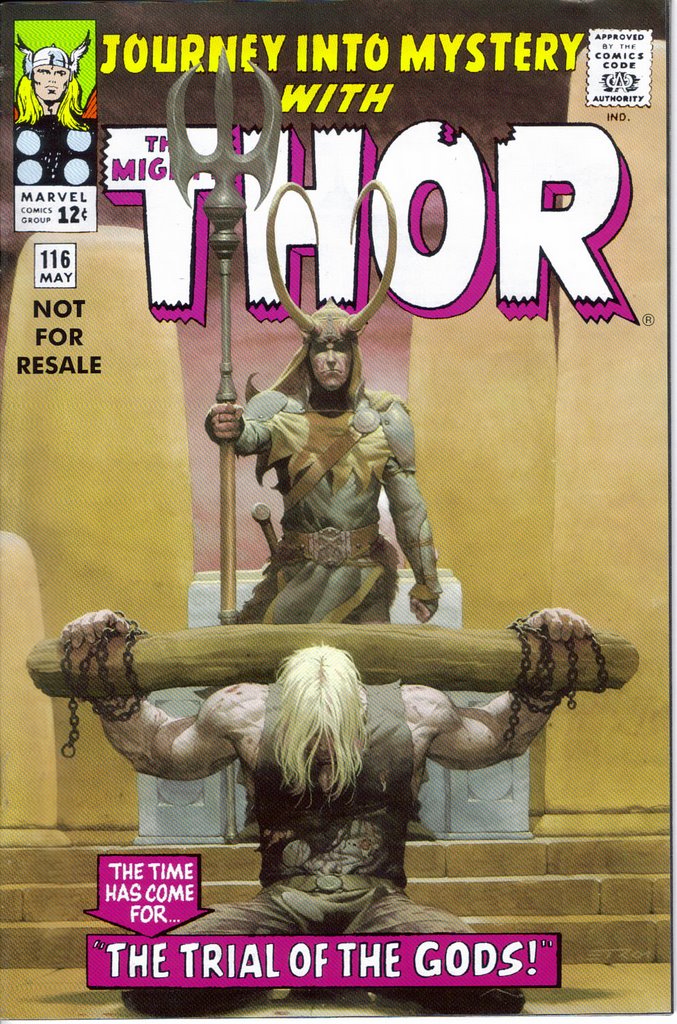
Journey Into Mystery #116

Journey Into Mystery #116, May 1965, Marvel Comics
writer: Stan Lee
penciller: Jack Kirby
inker: Vince Colletta
letterer: Artie Simek

Aide from the dates of their initial distribution some forty years ago, the original works of Stan Lee – the hundreds of Silver Age comic books that founded the Marvel Universe – have never been more available. The first dozen issues of The Amazing Spider-man have been repackaged and freely distributed through the Sunday editions of the Orange County Register, in a makeshift marketing countdown to the release of Spider-man 3. Bookstores boast volumes of inexpensive “essential” compilations, offering old and new readers alike a chance to get on the ground floor of their favorite titles or characters. Still other classic comics are packaged with the action figures they’ve spawned, as was this issue of Journey Into Mystery #116. While some characters came with more recent stories, I can understand the consensus behind including an old classic with Toy Biz’s Loki action figure. After all, what mature fan could deny a Stan Lee classic, albeit a reprint, and what child – they are still buying toys, too, aren’t they – wouldn’t read such a seemingly timeless tale with wide-eyed wonder?


Indeed, for a story written forty years ago, the simplicity of “The Trials of the Gods!” best captures the essence of its starring characters, i.e. the nobility of Thor and the converse trickery of Loki. Again, through the eyes of a child whose parents purchased Loki on a whim, Journey Into Mystery is a valiant introduction into the world of Asgard, and in fact, only leaves its readers (of any age) wanting more. Thor and Loki are plummeted to the deadly realm of Skornheim, having potentially offended their father Odin, and the first to return from its trenches will be cleared of his crimes. While Thor gives up his legendary hammer to face Skornheim’s carnivorous plants and blistering boulder-roads, Loki smuggles some ancient gems into the realm, which both bestow him with the abilities to overcome the treacherous land’s obstacles and distract Thor by simultaneously tormenting his lady love on Earth! Although other Asgardian champions come to Thor’s lady’s aid, Loki still beats the Thunder God to the interdimensional doorway, which, according to the next issue blurb, may not be all that it seems! Leave it to stammering Stan Lee to mislead us into expecting such a prompt conclusion.

Seriously, reading a Lee/Kirby classic for review is like a Christian reading the Bible for a book club – it’s an unexpected treat every time despite the material’s frequent repackaging. And, yes, these old comics can be found everywhere, if one looks hard enough, from the toy aisles to CD-ROM anthologies, overcoming the potential dangers of constant regeneration to preserve the original raw spirit their masters intended. Such bold, melodramatic narrative coupled with dynamically choreographed visuals may seem dated to some, but it’s still charming and energetic, the relevant foundation of a whole new era of comic book storytelling.


In fact, Lee and Kirby’s characteristic campiness is what makes this old content so historical complex; while these stories were retrospectively groundbreaking and then adult-friendly, they are in truth suitable for all ages, the first mainstream sequential art that father and son alike could mutually enjoy. Journey Into Mystery is the natural result of the industry’s journey out of the Comics Code controversy, when superheroes turned too juvenile to be taken seriously and the horror genre went too underground to be easily available for a general audience. Lee, Kirby, and their peers combined these qualities into an acceptable compromise for all. Like Thor, these pioneers entered the depths unarmed, but also like Loki, they certainly smuggled in a few tricks up their sleeve. It’s a journey we’re still taking, with an old but reliable roadmap.

Monday, February 05, 2007

Black Lightning #1

Black Lightning #1, February 1995, DC Comics
writer: Tony Isabella
penciller: Eddy Newell
inker: Ron McCain
colorist: Matt Hollingsworth
letterer: Albert de Guzman
assistant editor: Keri Kowalski
editors: Brian Augustyn, Mike Carlin, & Pat Garrahy

Black Lightning is a comic book of contradictions. Racially epithets aside, the very title implies a contrast of darkness and light, of an electric interlude in an otherwise barren, depressing gloom. Further, consider the backdrop of this issue – an urban wasteland that houses a desperate majority, the frequent subject of scrutinizing news coverage, yet ruled by a small but powerful band of drug lords, who could be easily defeated by either their community or the media if their assertions of intimidation didn’t fuel their delusions of grandeur. Finally, there’s Black Lightning himself, a hero that has admittedly worked side by side with Superman and Batman, that is an active member of the Outsiders, yet who acts as a mystery in his own neighborhood, a force of nature unrecognized by his targets until it’s too late. These characteristics are familiar in any comic book context – a colorful name, the shroud of urban myth, the noble motivations – but Black Lightning combines them in a redundant but compelling context. Again, it’s a comic book of contradictions.

For all intents and purposes, we shouldn’t like Black Lightning, especially this first issue of his “contemporary” re-launch. A decade too late to justify a fresh, post-Crisis continuity, five years too late to respond relevantly to the ‘80s’ “War on Drugs,” Black Lightning merely utilizes all of those conventions of superheroism to tell a story we’ve all heard before. Jeff Pierce is a hard-working teacher that helps the elderly and attends church every Sunday morning – the epitome of meekness, if he didn’t moonlight as an electricity-wielding force against the drug trade. His nemeses are jive-talking crack dealers, and their dialogue is as awkward on paper as it would sound in real life, if “urban youth” still actually talked like that: “You crazy mutha! We got two hundred grand in cash, coke, and name-brand appliances stashed in this crib, an’ about a dozen homeboys who’ll smoke your spandex butt just to break up the day!” Perhaps these gangsters are really former Chronos henchmen, transported from the late ‘70s and trapped in a modern ghetto. Seriously, even Pierce’s red and blue costume begs to be mocked by villain and reader alike . . .

. . . but we cannot help but ride the Lightning. Sure, Black Lightning hasn’t successfully carried his own title for any significant amount of time, and his only influence in the mainstream media is best summed up by the old “Funeral for Superman” SNL skit starring Sinbad (a clip worth finding if it’s on the web somewhere). Still, the character has remained a staple in the DC Universe since his inception in the ‘70s, fighting in the Outsiders and appearing in various titles, including Grant Morrison’s JLA, most notably as the guy that powered the projectors that enabled the population of Earth to defeat the Maggedon war machine. Even now, Black Lightning is becoming an active and pivotal member in the latest incarnation of the Justice League, and of all of the black heroes in DC’s stable, something about Pierce’s role in that title drives the reader to believe he deserves the opportunity most. Perhaps therein lies the secret to Black Lightning’s success; while most black heroes wear their race on their sleeve, only to lose its relevance when their popularity is secured (I’m looking at you, John Stewart Green Lantern!), Black Lightning has always worn his identity on his sleeve. For all of the cosmic threats he has stared in the eye alongside his fellow heroes, this issue proves that his first priority has always been the safety of the kids in his neighborhood. Like a bolt of lightning across a stormy night sky, Black Lightning embodies hope in a world where supermen defeat alien despots and mad scientists on a daily basis, but can’t free their kids from the grip of drugs and violence. Contradictions, indeed.

Isabella’s love for his old character is contagious, and Newell’s art, though too sketchy at times, exudes a vibrancy as shocking as its material. Obviously, this review is intended to join the others in my Black History Month themed posts, but Black Lightning also stands apart as the first superhero title of the series, and his creators instill an integrity such a distinction deserves. This comic depicts three types of black stereotypes: the youthful criminal element, the older, helpless citizens caught in the crossfire and too confused by modern times to combat it, and someone willing to defend them both against themselves. Although Black Lightning is a one-man force in this issue, he tells one of his wide-eyed targets, “Welcome to the Revolution.” Revolutions are rarely solo missions; Black Lightning is summoning his very community to fight alongside him, to fight for their future. So, while this series is effectively a relaunch, Mr. Pierce is trying to teach us – lightning shouldn’t have to strike twice.

Sunday, February 04, 2007

DC Special Blue Ribbon Digest, vol. 2, no. 13: Strange Sports Stories

DC Special Blue Ribbon Digest, vol. 2, no. 13: Strange Sports Stories
various contributors

In many ways, Superbowl Sunday epitomizes the antithesis of geek culture. On a shallow, stereotypical level, the geek and the athlete have been mortal enemies as long as the distinction has been made – at least as far back as 1955, to reference the classic McFly/Tannen confrontation in the Hill Valley High parking lot. Further, while the Superbowl itself is akin to a Justice League vs. the Avengers epic, as two accomplished teams from different spectrums of the same domain collide (DC/Marvel in comicdom, and the eastern/western divisions of the NFL), for the sports fan, their heroes are real. So, yes, we geeks are jealous, and, to my final point, our minds cannot absorb the entirety of knowledge necessary to completely comprehend and enjoy the Superbowl event, as our brains are already brimming with the stats and battles of make-believe characters on a cosmic level. We would never know that the Colts’ coach is only the third to win the Superbowl as both a coach and a player had we not watched the event, nor would any jock know that Hal Jordan has had two distinct tours of duty as the official Green Lantern of Earth. The human mind cannot retain both fields of expertise, and since we geeks value the strength of our mind, thusly Superbowl Sunday is the antithesis of our culture.

Still, as a pseudo-holiday that has inspired its own traditions in millions of homes throughout the world, and as a pop culture phenomenon that has garnered millions of dollars to influence the airwaves for nearly twenty-four hours of coverage, we geeks are drawn to event with as much fervor as anyone else, if not more so. In the past, geek culture has attempted to infiltrate “Super Sunday” (which often drops the “bowl” in an attempt to piggyback the success of a certain Last Son of Krypton, I assume), with significant commercials teasing upcoming films like Hulk and Batman Begins or blatantly starring a stable of heroes promoting VISA credit cards or some such. Yes, comics and sports can share the same forums, but the former usually extends its hand to the latter, and rarely the other way around. Comic book stores tend to carry sports cards (my friends at Geek in the City share my opinion about these “combo shops”), but hardly does a hardcore sports memorabilia store boast a comic book rack. Marvel staged Spidey and Mary Jane’s wedding at the Mets’ stadium back in the late eighties, a huge draw for the community, I’m sure, but I don’t recall any athlete making an appearance at the Comic Con to refute claims of steroid use, a media circus that would do nothing but heighten the Con’s exposure. Finally, and most notably, DC even dedicated an entire series of comics to “strange sports stories,” and does the athletic community create a sport inspired by geekdom? Not even a patriotic shield-throwing tournament! It’s no wonder Thor didn’t help any damsels find their lost debit cards this year.

This issue of DC Special Blue Ribbon Digest is similar to the digest-sized Best of DC anthology I read on Christmas Day; in fact, the format is so similar, I risk breaking A Comic A Day rules by failing to research if these issues are from the same series, merely re-titled with every volume, as comics were prone to do back in the day. Still, just as Christmas with the Superheroes begged to be read on Christmas, Strange Sports Stories cannot be denied on the day when, strangely, all else halts in the wake of athletic splendor and competition. This issue is a proverbial decathlon of tales, featuring nine comic shorts and an entertaining behind-the-scenes essay, each of which will be best served by their own synopses and brief reviews. So, like an onslaught of Coke and careerbuilder.com commercials, here we go:

“The Great Super-Star Game” – Like the Superbowl and its touchdown inside of the first fourteen seconds, this Blue Ribbon Digest starts with a bang, with a story starring DC’s pantheon of heroes unwillingly pitted against their biggest baddies in a baseball game to settle an argument between the Huntress and Sportsmaster. If the good guys win, Huntress vows to joint their ranks, but the heroes’ loss means she remains by the evil Sportsmaster’s side. Of course, the good guys win, as the villains’ cheating attempts to use their powers fail. This reprinted tale represents the fun lost in modern comics; for Superman, Batman, Robin, Kid Flash, Uncle Sam, Black Canary, the Huntress, and Plastic Man to team up for such frivolity without the burden of continuity of pre-establishing in-fighting for in-fighting’s sake is impossible with today’s “shake things up” status quo. I enjoyed the respite, but unfortunately, the following yarns didn’t retain such familiarity. Self-contained “strange tales” in their own right . . .

“Challenge of the Faceless Five” stars a quintet of unbeatable basketball brawlers, whose coach receives a prophecy that their expertise leads to world domination at the hands of an alien race. Yes, the boys so master their athletic skills, the U.N. recruits them as an elite squad for special missions, and their cockiness handicaps them in the face of intergalactic invasion, which enslaves, and erases the faces of, humanity! Fortunately, the boys’ faceless sons arrive from the future to humble their fathers in a pick-up game, presumably changing their fate. Talk about saving face.

“Man with the Golden Gloves” reminded me of a young Matt Murdock story, as a boy rebukes his father for his boxing vocation just before the old man dies of a violent alleyway stabbing. The boy accepts his father’s good luck charm, two small golden boxing gloves, but rediscovers them in his adulthood as an established detective. When his father’s old rivals become his, and they capture the cop and outfit him with 50-pound “gloves” in a makeshift ring, the old charm transforms the weights so the apple doesn’t fall far from the tree and wallops his attackers! The guy, and thus the reader, never knows if he was too punch-drunk to remember the bout accurately, but blind rage always does a boxing story good.

In “Volley of Death,” an orphan adopted to become a champion tennis player faces his trial by fire by playing a match with a live grenade. Fortunately, the champ realizes that his opponent hasn’t broken a sweat during their hours-long match and must be a robot, delivering a serve that blows up the bomb and effectively ends the match in his favor. I’m grateful my high school P.E. teacher didn’t take tennis so seriously.

“A Tall Tale of Tenpins” has the meek, peculiarly named Ripley Van Wynne fleeing from a bad date at a bowling alley in a local forest, where he meets the specters of Henry Hudson (of Hudson River fame) and his crew during a ghostly reunion over a game of ten-pin. Assuming Rip to be a descendant of their old pal Rip Van Winkle (which bears no other significance to the story unless I’m missing some critical historical context or mythology), they teach him the skills of the game but warn that humility is most important. When Rip returns to the alley to show off his new skills, an ashamed, spectral Hudson denies the lad a perfect 300 game. Why they would endure the effort to teach him but deny the kid any reward is beyond me. Perhaps Rip’s intentions to score with his date meant his mind was too in the gutter for Hudson – if he only knew that’s what his namesake would become.

The “Man Who Leaped Over the Earth” is merely a time-traveling pole-vaulter temporarily trapped in what history ends up calling “The Age of Excess,” i.e. the twentieth century! With the iPhone right around the corner, I can only imagine what history calls the twenty-first century . . .

The “Hockey-Mask of Death” stars a lumberjack that moonlights as a local superstar hockey player whose father was apparently accused of killing his partner years ago. The lumberjack fulfills his pop’s legacy and does the same, only to face an odd helmet-wearing foe on the ice later that night. When the ice beneath their feet breaks and the two fatally plummet down a waterfall, the specter reveals itself as dear ol’ dad’s murdered partner that achieves revenge and can finally rest in piece. Of all the trees to chop down, that’s one family tree the world won’t miss.

“Warrior of the Weightless World” is the only tale in this bunch that features a made-up sport: Spaceball, basketball/billiards hybrid, sans gravity. The star of this story is a three-time champ in Spaceball, using his league as a cover to fund his efforts to attend medical school, but when an intergalactic war erupts, he determines that the army could use his expertise before any hospital would hire him. Alas, the military recruits him merely as a Spaceball competitor, but the guy figures his skills in weightlessness would be an asset in a well-planned attack on their enemies’ gravity-free homeworld. Surely, his plans works and his team achieves their dreams, not to mention a healthy dose of celebrity. This story best represents my argument about the contrasting worlds of athletics and geekdom, yet in this case, brains and brawn work in concert to save the universe. Perhaps we can learn from this one . . .

. . . as well as “Gridiron Knightmare,” a story about a college of bookworms unwillingly recruited for the football team. However, when Merlin travels to the future to research new sports that will amuse the King, he equips the geeks with knights’ armor to defeat the brutish, championship team. See, reading is fundamental.

Whew. Yes, that was a long review, a veritable Olympic effort. I read 100 pages of comic book goodness today, between cleaning the apartment for our guests and wondering how any company could justify five million dollars for the commercials I beheld . . . I didn’t don any football gear, but I’m beat. Alas, therein lies another connection sports fans and comic book fans share; as fans, we are by nature fanatic, often tireless in the pursuit of our respective hobbies. All I’m saying is, I give up a day of my life every year to respect their compulsions. You find a jock reading an issue Space Beaver, I’ll reconsider my position. Until then, I want our super back. I think we had it first. Go call your bowl something else.
Saturday, February 03, 2007

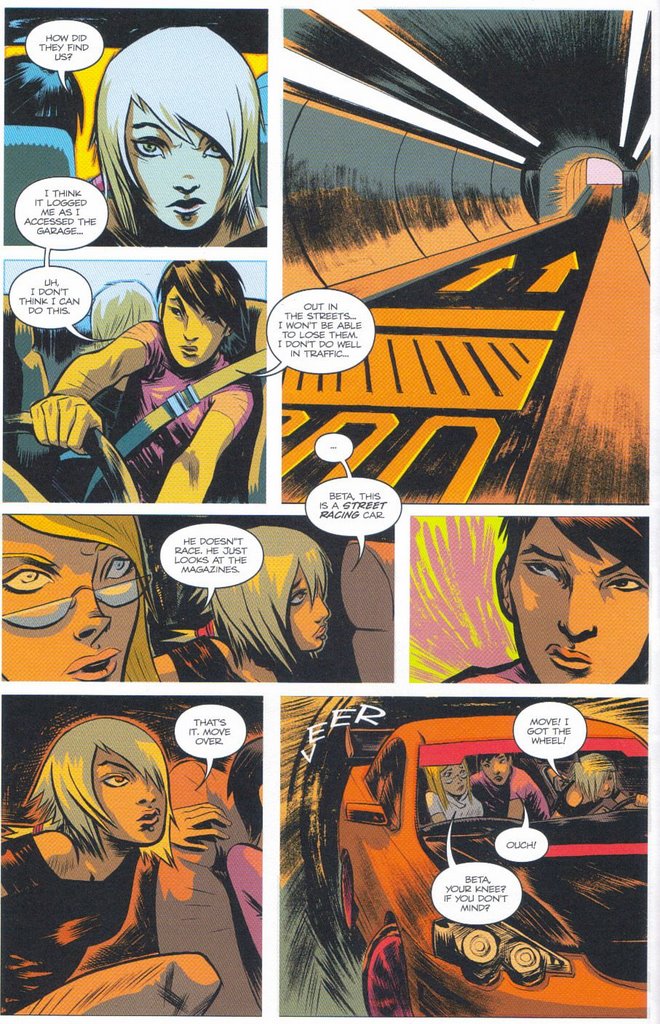
Supermarket #4

Supermarket #4, June 2006, IDW Publishing
writer: Brian Wood
artist: Kristian
letterer: Robbie Robbins
editor: Chris Ryall

I've never understood the stock market. I don't know if my high school economics teacher didn't explain well enough, or if I'm too fiscally irresponsible to wrap my head around it (I'm leaning toward the latter), but my three-letter code is definitely "SOL" on any network's tickertape. Heck, I hardly comprehend the faux stocks on G4's Star Trek 2.0, and I'm most vested in that market than any other! Still, despite my naivete, I can completely understand the probably of an urban stock market takeover -- the total integration of our most sacred cows via stocks, bonds, and corporate investment. We often debate the disasters indicative of a stock market crash, but what if circumstances swing the other way? If our economic stability depends upon that of the market, couldn't its boom consume us, too?

Brian Wood's Supermarket explores such a dark future in which all is run by economics, although Kristian's vibrant visuals are definitively anything but dark. With a style from the Paul Pope school of techno-youth culture, Kristian's art is blanketed with bright neon hues that pop off the page, capturing the essence of a rich corporate future expertly. Unfortunately, by issue's end, the novelty wears off as Kristian's colors become more mainstream, more confined by their lines, but still, the overall package leaves a favorable impression. I'd like to read more from the Kristian library, if Supermarket is any indication of what else he or she has to offer. Yes, "he or she." That "K" throws everything off.


Brian Wood is another case entirely. I picked up his Channel Zero on a whim several years ago and enjoyed it immensely. I was determined to follow his work as I thought it bucked the conventions of the industry, as I thought his voice was one of a few daring to look at the future sans the goggles of streamlined technology, akin to the utopian Earth of The Jetsons or Star Trek lore. Alas, Supermarket, published a decade later, is indicative of the harsh truth of Wood's success: he's a one-trick pony. Here's a single sentence synopsis: Apathetic urban youth in a criminally corporate future go counter-culture to preserve freedom for all. Now, am I summarizing Channel Zero, with its Jennie 2.0 versus the sanctified media of the Religious Right, or Supermarket, with its Pella Suzuki versus the corporation of all-consuming criminal economics? I've successfully described them both, and, with a little minor variation, all of the comics I've read by Brian Wood. I won't deny the guy's specific, visually appealing artistic vision, as many of his collaborating artists have a beautiful style, but I wonder if he doesn't simply piggyback these associates' efforts. Still, I dubbed this "harsh truth" a success, as Wood has a tireless fanbase that keeps him active in the industry and a celebrity at the Con circuit. I can't blame them; I was almost one of them.

I enjoyed Supermarket for its stand-out status ,and if I hadn't pulled it from a four-for-a-dollar box, I probably would've pulled from the new release shelf a year ago, had I seen it. It probably sold out pretty quickly in the shops I frequent, those that favor the indie scene and ranks talent like Wood's and Kristian's right up there with Stan, Jim, and Jae Lees'. However, with a $3.99 pricetag, I'm grateful I found it for a quarter. For a comic about the root of all evil, I feel like purchasing it so cheaply does its spirit a service. My way of fending off the future.

Friday, February 02, 2007

Sam Slade: Robo-Hunter #12

Sam Slade: Robo-Hunter #12, Quality Comics
writers: Alan Grant, Tom Tully
artists: Ian Gibson, Dave Gibbons
letterers: Steve Potter, Dave Gibbons

Another Alan Grant classic from the United Kingdom, Sam Slade is an entertaining synthesis of the pulp and sci-fi genres, which is a surprisingly natural combination considering that the two categories are inspired by the same basic human emotion: dissatisfaction. Most pulp heroes are little more than whiny tough guys that wax poetic about their rugged looks, damp offices, or poor finances as much as they trade blows with the worst scum the city can spawn. In short, they’re dissatisfied. Similarly, the technological advances characteristic of science fiction is the embodiment of humanity’s struggle toward effortless convenience. Why walk down a hallway when a conveyer belt can carry you there? Why drive to work in bumper-to-bumper traffic when a simply hover-conversion will help your fly there? Why cook your own meal when a replicator can do it for you, or at least your robotic maid? Until mankind doesn’t consider mere existence a necessary workload, we’ll be dissatisfied. Therein, Sam Slade is born.

Sam Slade is poor, futuristic bounty hunter that can lament is inability to pay the rent on one panel yet berate his absent-minded robotic assistant the next. I’m sure robotic assistants go for a rent-worthy closing bid on eBay, but I digress. Even Slade’s robo-cigarette is sentient, proving that the guy may be down on his luck, but he’ll never be lonely. However, Slade’s fortunate experiences a shake-up when his former pilot Jason Kidd, whose body had regressed to that of a one-year-old, seeks his aid as a bodyguard at ten thousands creds a day. Kidd capitalized on his infantile image by becoming a television star, and between the eccentrically arrogant way he treated his co-stars, his mother, and the general public at large, the source of the assassination attempts against him were a veritable This is Your Life. Not that Slade would want them stop at ten-thou a day; alas, our hero’s inherent nobility nabs the perpetrator before any harm permanently befalls Kidd . . . or so we think until the final page, wherein the proverbial Baby Herman rehires Slade when the assassination attempts to continue. With a title like “Robo-Hunter,” I was perplexed as to why Grant would pit him against some jealously jilted human. Ah, this story’s “to be continued” could only imply a more convoluted mystery on the horizon. Indeed, science fiction has never been so pulpy.

Interestingly, this issue’s back-up story, Harlem Heroes, would make an excellent addition to my series of Black History Month comic reviews. Featuring an “all-black” team of Aeroball champions – Aeroball is “football, boxing, kung-fu, and basketball all rolled into one,” plus jetpacks – this tale, illustrated by the acclaimed Watchmen artist Dave Gibbons, takes us on a roller coaster of the Heroes’ fall and reemergence. When three of their teammates are killed in an unprecedented plane crash, and yet another survived by only his living brain, the team recruits a gangster, a retiree, and two reserve players to round their ranks, much to the public’s judgment. I enjoyed the scene when the guys scoured the streets for fresh blood, as so many “urban youth” pray for the moments their skills are “discovered” by scouts or celebrities that fled the ghetto. Also, A Comic A Day hasn’t experienced a sports comic yet, and Harlem Heroes is a fitting introduction to the Super Bowl weekend. Stay tuned for more pigskin particulars . . .

Despite that each of its stories had nothing to do with each other aside from a weak foundation in sci-fi/fantasy, Sam Slade: Robo-Hunter was a satisfying read, even if its characters weren’t. I would’ve appreciated some connection between the two tales, even if Slade simply placed a quick bet on an Aeroball game to pay the rent or something, but I guess these shortcomings are what make the future so highly anticipated. There’s always room to grow, and sometimes, even the strangest associations can happen.

Thursday, February 01, 2007

Pieces for Mom: A Tale of the Undead

Pieces for Mom: A Tale of the Undead, January 2007, Image Comics
writer: Steve Niles
artist: Andrew Ritchie
letterer: Jason Hanley

(Blogger's Note: You can also find this review at Geek in the City, complete with images!)

How far would you go for your mother? Would you murder a man to protect her? Would you drag your victim's carcass home to your mother for dinner? This week's Pieces for Mom one-shot from Image tackles this unlikely predicament with a frighteningly macabre yet childishly charming tale of a future rife with flesh-hungry zombies, mob-mentality scavengers, and one boy that just wants to take care of his mom.

And some of us won't even take out the trash . . .

A Comic A Day has beheld the work of Steve Niles before, particularly during October's run of Halloween-oriented issues, and despite his penchant for violence and gore, each of his issues I've read seem infused with a poignancy that refutes any offense one might take with such blatant grotesqueness. Pieces for Mom is the epitome of this dichotomy. In a post-apocalyptic world where zombies and scavengers freely roam the streets to survive, a backdrop we geeks have seen in many different stories in just as many different media, Niles chooses to tell this story from the perspective of a strong-willed child whose father is presumed dead and whose undead mother is tied to a chair in the bedroom, lest her hunger for flesh consume her, and consequently her sons. When mom runs out of fresh flesh, Mike's bean-loving brutish older brother sends him out for a new supply, and without hesitation, Mike, no older than eleven I'd presume, takes to the streets, shotgun in hand. Niles drives the reader to wonder which is worse: the circumstances of this haunted world, or the desensitization of the children that must survive in it.

If you're planning on reading this issue, skip this paragraph, as I'm leaking a few spoilers to offer my opinion of this issue's unexpected conclusion. Actually, the term "spoiler" is a disclaimer, as much of this one-shot is spent merely exploring the innocence of a kid in contrast to this world's horror and brutality. Still, as I asserted, Niles is at his peak here, with much thanks to Andrew Ritchie's grossly detailed depictions of the undead, combining the zombie sub-genre with a charming character study of a child. Niles simply had an idea and he turned it into a comic book. However, in this issue's final pages, his concept shows signs of a plot when (here's the spoiler) the boys' father emerges with another family, one he presumably preferred when the going really got tough. Mike confronts his father, but Niles spares us the sympathies of our Dr. Phil generation; Mike kills the family, his father included, and provides his mother with three months' worth of flesh. "Explain it to mom," he says to Dad, like some action movie star. But Mike isn't saving the entire world. He's just preserving his. His mother.

I should also add, as a geek that scours department stores for the latest action figures every weekend, I was amused by Derek's demand that Mike "see if there are any games at Target" while he's out hunting for flesh. "The Target is wiped out of everything. And there's no way in hell I'm going all the way to Orange County to the other one," Mike retorts. Ha. I live in Orange County and I know of four Targets in my town alone. This future really is a terrible place.

Pieces for Mom: A Tale of the Undead is an excellent comic book for fans of horror in any medium, and for fans that believe in the human spirit in the face of intense (and bloody) adversity. In fact, as a self-contained issue with a reasonable $3.99 pricetag, Pieces is the perfect comic to hand to a friend that hasn't really read comics before -- well, perfect in the "strong stomach required" sense. Sure, rotting flesh, maggot-infested eyeball sockets, and exposed guts abound, but the real challenge is the aftertaste of this issue's concept. What would you do for mother?

I really should give her a call . . .