
Monday, March 2, is Read Across America Day, a nationwide educational celebration of Dr. Seuss's birthday. As an advocate for youth by day and a comic book geek by night, I've often tried to reconcile these two passions by introducing kids to comics, since they know many of the medium's iconic characters from television and film anyway. Unfortunately, the likes of Batman and Spider-man are usually too mired in continuity for younger readers. Can you imagine trying to explain Spidey's "Character Assassination" or Batman's "R.I.P." to a seven-year-old? I know that DC and Marvel produce one-shots or child-friendly series free of these stories' bonds, but I regret that today's youth can't pick up any issue featuring their favorite superhero and find instant entertainment, like I did as a kid.
Enter: Jinn, Raymond, and Robert -- the Scrapyard Detectives. I've reviewed The Scrapyard Detectives twice before and was quoted on the back of the series' first trade paperback, so it isn't hard to guess that I really like this book. Creator/artist Bill Galvan has kept in touch over the years and was kind enough to send me complimentary copies of this latest issue for the students in my after school program. This kindness is indicative of the spirit of his series -- getting entertaining comics into the hands of kids, no strings attached. While Jinn, Raymond, and Robert certainly have an ongoing story with their own respective character dynamics, the series' rotating writers assure that each issue is its own reward, including previous tales' themes and relationships while avoiding the loose ends that dissuade new readers. In short, I can think of no better way to encourage reading than by handing a child The Scrapyard Detectives #4.
Further, an appreciation for reading is only half of what this series strives to instill in children. This fourth issue, written by none other than J.M. DeMatteis, takes place on the two-year anniversary of the accident that left Jinn in a wheelchair, and while she copes with the young driver's hope for forgiveness, her teammates deal with the adoration of their biggest fan, Raymond's little cousin Katie. These two plots collide when the Detectives individually shun the people that want their attention the most, inadvertently bringing them together in a climatic moment of revelation and resolution. I won't spoil this issue's ending, because a mere synopsis would stifle the last page's emotional impact and I'd really like everybody reading this review to attain the issue themselves, but needless to say DeMatteis gives readers of all ages a reason to examine their attitudes toward friends and foes alike.
Enter: Jinn, Raymond, and Robert -- the Scrapyard Detectives. I've reviewed The Scrapyard Detectives twice before and was quoted on the back of the series' first trade paperback, so it isn't hard to guess that I really like this book. Creator/artist Bill Galvan has kept in touch over the years and was kind enough to send me complimentary copies of this latest issue for the students in my after school program. This kindness is indicative of the spirit of his series -- getting entertaining comics into the hands of kids, no strings attached. While Jinn, Raymond, and Robert certainly have an ongoing story with their own respective character dynamics, the series' rotating writers assure that each issue is its own reward, including previous tales' themes and relationships while avoiding the loose ends that dissuade new readers. In short, I can think of no better way to encourage reading than by handing a child The Scrapyard Detectives #4.
Further, an appreciation for reading is only half of what this series strives to instill in children. This fourth issue, written by none other than J.M. DeMatteis, takes place on the two-year anniversary of the accident that left Jinn in a wheelchair, and while she copes with the young driver's hope for forgiveness, her teammates deal with the adoration of their biggest fan, Raymond's little cousin Katie. These two plots collide when the Detectives individually shun the people that want their attention the most, inadvertently bringing them together in a climatic moment of revelation and resolution. I won't spoil this issue's ending, because a mere synopsis would stifle the last page's emotional impact and I'd really like everybody reading this review to attain the issue themselves, but needless to say DeMatteis gives readers of all ages a reason to examine their attitudes toward friends and foes alike.

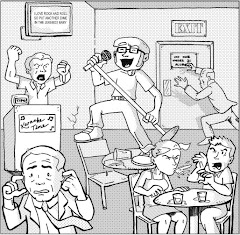
What I like most about The Scrapyard Detectives is its realistic depiction of youth. Its three protagonists aren't perfect. Just like any kid, their tender friendships are just as vulnerable to rash anger and bullying, to emotional outbursts and name calling. Still, these characters remain fictional role models because of their ability to deal with these feelings in time. Also, as this is a youth-oriented detective series, writer DeMatteis tips the proverbial hat to the Hardy Boys and Nancy Drew, acknowledging the roots of the genre while maintaining a sense of humor about itself. Of course, Bill's illustrations are the consistent spirit of this book, and I'm grateful that his kids look like kids. Too many comic book artists are snared by their inclinations to exaggerate musculature and unwittingly draw children like little adults; Galvan's style keeps things simple and expressive. His attention to detail is admirable, too; this might sound silly, but I like that his depictions of suburbia include power lines. When I look at the Scrapyard Detectives' neighborhood in the background of the main story, I see the cul-de-sac from my childhood. In every way, Jinn, Robert, and Raymond could be the kids next door.
Finally, The Scrapyard Detectives is an unapologetic example of a comic book first. Unlike many other nonprofit or special interest groups that use the comic book format to convey a message, thus producing a sub par product, Diversity Ink seems determined to offer a quality package, from cover to cover. Consider that this issue has three variant covers, one by the legendary Joe Staton, the other by the talented Shawn McManus, not to mention the fun pin-up by J.J. Harrison. Consider the inherent pride that comes with this issue's branding by the Comic Code Authority. Consider its appeal for letters and artwork, and its rewarding said efforts with an exclusive "Secret Case Files" issue. (Bill, does this count as a letter? I want that comic!) The excerpt from the Detectives' forthcoming novel proves that any character with a firm foundation in comics can transcend the medium -- that the power of words and pictures put together make other storytelling efforts want to rise to the occasion, too.
Sometimes I wonder what I'd read on a regular basis if I wasn't such an avid fan of comic books. Would I have developed more appreciation for novels, or nonfiction? Would I read historical texts, or plays? I wonder, would I even really read at all? For me, the comic book has been a gateway medium, instilling an appreciation for the sequential nature of theater, for the vivid imagery of poetry, for the economy of words necessary in short fiction. Today's kids aren't much different. While television, film, and video games offer a basic understanding of plot, the thrill of a comic book can still excite the imagination and inspire new heights of interaction with literature. If society is lucky enough, the right kids get their hands on comics like The Scrapyard Detectives #4 -- the kinds of comics that teach the integrity of good storytelling right alongside the value of having integrity as a person, too.
For more information about The Scrapyard Detectives, please visit The Diversity Foundation's website.
The Scrapyard Detectives #4 was published by the Diversity Foundation, written by J.M. DeMatteis, illustrated by Bill Galvan and Rob Hawkins, and lettered by Dave Lanphear.