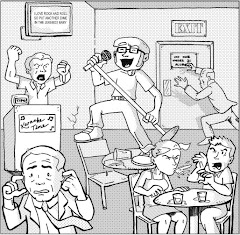
Nobody #1, November 1998, Oni Press
writers: Alex Amado & Sharon Cho
artist: Charlie Adlard
letterer: Sean Konot
editors: Bob Shreck & Jamie S. Rich
Blogger’s note: Entry for Sunday, March 30, 2008.
I was sitting in a local café when I wrote Saturday’s review of Superheroes Battle Super-Gorillas #1. I’d ordered a vanilla latte, and the barista (I assume they’re called baristas anywhere they work) told me that the espresso machine needed a few minutes to warm up. A few minutes turned into twenty, and as more customers came in and received their frozen yogurt before I received my order, I wondered if the guy even remembered that I was there. Several times, I was the only customer in the store, and he was in the back, presumably prepping for the day. I stood at the counter a few moments to no avail. I began to wonder if I was even there.
Of course, finally, the guy apologetically whipped up my drink and throughout the rest of my hour-long visit tried to smooth things over by showering me with offers of free samples. I went from feeling like a nobody to feeling like a somebody again.
This example is a rather mundane (albeit recent!), definitely spoiled instance of feeling like a nobody. Thousands, if not millions of similar instances plague our planet every day, ranging from the dull to the dire, and it seems Oni’s Nobody wants to explore them all. Based on this first issue, Nobody is a spy thriller starring a shape-shifter that infiltrates a Satanic sacrifice and stumbles onto a supernatural conspiracy. Yet, based on writer Sharon Cho’s supplemental essay at the end of this inaugural chapter, this series’ concept is much more than that. The Nobody identity adapted by its shape-shifting protagonist is actually a grander exploitation of colloquialisms attached to that anonymous identity. Cho asks, “What is ‘nobody’ wants to die? What if ‘nobody’ can do the impossible? What if you trusted ‘nobody’?”
In short, what if every time you said “nobody this” or “nobody that,” you were actually talking about somebody?
Assuming Nobody explores the bottomless theme of identity confusion, I will proactively pursue it -- I’ve enjoyed this subtext in comics ever since I read Vertigo’s Human Target series a few years ago. (You know, J.M. DeMatteis’ “Shrieking” story arc in Amazing Spider-man was actually my first exposure to the depths comics could explore regarding identity confusion and frustration. “Shrieking” is a dark story, wedged between Aunt May’s eventual death and the Clone Saga, but it’s worth a peak if only for DeMatteis’ exposition and Mark Bagley’s pre-Ultimate take on the ol’ Webhead.) Artist Charlie Adlard’s art is big draw, too (pardon the pun). His balance of thin, finely detailed pen work and stark dark/light contrast truly utilize the black and white format to the fullest, also complementing the suspense and supernaturalism of this issue’s opening sequences.
So, with its fair share of spy intrigue, mysticism, and character introspection, Nobody should have a little something for everybody.
Showing posts with label Bob Shreck. Show all posts
Showing posts with label Bob Shreck. Show all posts
Tuesday, April 01, 2008


Friday, March 07, 2008
All-Star Batman & Robin, the Boy Wonder #9
All-Star Batman & Robin, the Boy Wonder #9, April 2008, DC Comics
writer: Frank Miller
penciller: Jim Lee
inker: Scott Williams
colorist: Alex Sinclair
letterer: Jared K. Fletcher
assistant editor: Brandon Montclair
editor: Bob Shreck
Blogger's note: Entry for Thursday, March 6, 2008.
I’ve been on the fence about reviewing All-Star Batman & Robin, the Boy Wonder #9, just as I’ve been on the fence about whether or not I’ve enjoyed this series thus far. Well, I must be enjoying it, because I’ve faithfully bought every issue, though I’d be lying if I said each purchase was without hesitation. I’ve finally begun to understand the method to writer Frank Miller’s madness; his success with 1986’s The Dark Knight Returns hinged on his presenting the caped crusader in a way previously unimagined. Then, decades later, when his impression of Batman saturated every facet of the character and he had the chance to revisit the Dark Knight, he abandoned his previous conventions, including DKR’s distinctive sixteen-panel page layouts, for a more pervasive perspective, incorporating many of DC’s enduring heroes and villains. Miller’s subtle political commentary became blatant satire and his art style became more erratic (“with all the confidence of an arrogant teenager,” to paraphrase a review I’ve read), but he retained an unavoidable focus on attitude-ridden adventure.
So, it makes sense that All Star Batman & Robin, the Boys Wonder would go to some lengths to abandon those concepts for yet another initially unrecognizable incarnation of the Dark Knight.
While DKR and The Dark Knight Strikes Again wove several subplots into an overarching adventure about vigilantism in a superhero’s world, ASBR stretches the limits of what passes as a plot in favor of the relationships that result from a twenty-something, eccentric, masked crime-fighter adopted a twelve-year-old as a sidekick. For the first few issues, little actually happens behind our hero’s gritty narrative. Further, Batman’s mental instability can easily be explained as the result of his incredible intellect at war with his emotionally handicapped need for/fear of family. Bruce Wayne’s kinship with Dick Grayson is undeniable, but Batman has nothing in common with a child that hasn’t donned a secret identity. Enter Robin. Of course the superhero community would respond with outrage; even if they trusted Batman’s skill as a surrogate parent, they could never condone his willingness to put a child in danger, at least as long as society rejects the concept, too. So, while some might disagree with Miller’s depiction of Superman or Green Lantern as ranting nitwits, I can easily understand this direction in the context that sidekicks have yet to exist in the All-Star Batman & Robin universe.
Sounds like I have a pretty solid handle on this series, right? So what’s my problem, right?
My problem is, I don’t know if any of my interpretation is even close to what Frank Miller has intended.
If Miller’s extremely gradual development of these characters is the result of his wanting to thoroughly explore the ramifications of inviting a child into one’s vengeance-driven life of heretofore loneliness, All-Star Batman & Robin is the best modern interpretation of the Dark Knight to date. On the other hand, if he’s flying by the seat of his pants here, writing with the vigor of an aimless adolescent, I feel like a fool for dropping thirty bucks into this wet dream of a superhero comic. ASBR #9 is the closest hope I have for this series’ focus on the former, not the latter.
In ASBR #9, Green Lantern confronts Batman on his crime-fighting philosophy and technique, but obviously the Dark Knight chose the forum for their discussion, since the room, not to mention Batman and Robin themselves, are dripping from a fresh coat of yellow paint. I’ve read fellow fans’ impressions of The Yellow Room on various message boards and have learned that I must’ve been the only one that didn’t laugh out loud -- not to say that I wasn’t amused by the idea, but I really simply digested it as a natural precaution this no nonsense Batman would take. Also, painting the room is the perfect test of his new sidekick’s patience, similar to Mr. Miyagi’s wax on/wax off exercise. What ensues for the majority of this issue is an insightful debate on the nature of super-heroics in a world where alien invasions are just as common as rape or murder, and Batman’s opinion seems relatively simply: the brightly dressed superheroes can handle the multicolored problems, while he’ll use fear and vigilantism to combat the evils that stalk and terrorize the common man. (My summary is a little more sophisticated than their argument, and I’ve spared you a few offers of lemonade. Yeah, don’t ask.) Batman might’ve gotten away with his perspective had he not involved a child, so while Hal Jordan comes off as a doofus, he actually a valiant point.
Then he throws an angry punch and ruins everything.
First of all, I think a Batman/Green Lantern confrontation makes perfect sense. While Superman is usually hailed Batman’s polar opposite, GL’s origins are closer to Batman’s, in that both are regular men. One worked his entire life to achieve a modicum of humanity’s utmost power and influence, while the other was merely bequeathed a cosmic weapon that can seemingly do anything. I mean, if Abin Sur gave a young Bruce Wayne that power ring, and Hal Jordan’s parents were murdered before his very eyes, wouldn’t their situations be exactly reversed? Alas, take Hal’s ring away, and he’s just a guy in tights . . . that almost chokes to death by the skilled but unrelenting hands of a child. Yeah, if you haven’t read this issue, beware this spoiler: Robin almost kills Green Lantern. In the moments Batman and Robin share trying to save Jordan’s life, and in the rainy hours that follow, they emotionally connect in way Miller took eight issues to avoid. Batman takes Robin to the Graysons’ graves to say good-bye, and they share an unspoken determination never to behold death again.
If only Batman had said that, perhaps Green Lantern would’ve been more sympathetic.
Enough about the plot -- How does this issue look, eh? Well, while Miller is an unpredictable storyteller, shifting between sarcastic and tender moods, Jim Lee is always Jim Lee, with beautifully rendered if not sometimes overly stylized page layouts and character designs. Unfortunately, ASBR has basically been Jim Lee drawing Frank Miller’s DCU, so we haven’t seen him really cut lose with any of his own ideas, but I’m hoping a more complicated confrontation or battle sequence with either another Justice Leaguer or even the Joker will give Lee the room he needs to show off his real chops. At this point in his career, though, he’s like a “reliable dog,” to quote Simon Cowell. No, though, I won’t say he can draw the phone book and I’d buy it, but you get the point.
Now, if Miller resumes the slow-paced, arrogantly narrated tone from issues one through eight in the next issue, number ten, I’ll feel like the perfect patsy. If Batman hasn’t realized that his standoffish approach with Robin has been the greatest failure of his crime-fighting career to date, and if he hasn’t adopted a more sympathetic approach if not in tone than at least in body language, then I won’t know what to make of the whole thing. I mean, will Batman always be at odds with the other superheroes in this All-Star universe? If so, I think he’ll always be a little at odds with me, as well.
writer: Frank Miller
penciller: Jim Lee
inker: Scott Williams
colorist: Alex Sinclair
letterer: Jared K. Fletcher
assistant editor: Brandon Montclair
editor: Bob Shreck
Blogger's note: Entry for Thursday, March 6, 2008.
I’ve been on the fence about reviewing All-Star Batman & Robin, the Boy Wonder #9, just as I’ve been on the fence about whether or not I’ve enjoyed this series thus far. Well, I must be enjoying it, because I’ve faithfully bought every issue, though I’d be lying if I said each purchase was without hesitation. I’ve finally begun to understand the method to writer Frank Miller’s madness; his success with 1986’s The Dark Knight Returns hinged on his presenting the caped crusader in a way previously unimagined. Then, decades later, when his impression of Batman saturated every facet of the character and he had the chance to revisit the Dark Knight, he abandoned his previous conventions, including DKR’s distinctive sixteen-panel page layouts, for a more pervasive perspective, incorporating many of DC’s enduring heroes and villains. Miller’s subtle political commentary became blatant satire and his art style became more erratic (“with all the confidence of an arrogant teenager,” to paraphrase a review I’ve read), but he retained an unavoidable focus on attitude-ridden adventure.
So, it makes sense that All Star Batman & Robin, the Boys Wonder would go to some lengths to abandon those concepts for yet another initially unrecognizable incarnation of the Dark Knight.
While DKR and The Dark Knight Strikes Again wove several subplots into an overarching adventure about vigilantism in a superhero’s world, ASBR stretches the limits of what passes as a plot in favor of the relationships that result from a twenty-something, eccentric, masked crime-fighter adopted a twelve-year-old as a sidekick. For the first few issues, little actually happens behind our hero’s gritty narrative. Further, Batman’s mental instability can easily be explained as the result of his incredible intellect at war with his emotionally handicapped need for/fear of family. Bruce Wayne’s kinship with Dick Grayson is undeniable, but Batman has nothing in common with a child that hasn’t donned a secret identity. Enter Robin. Of course the superhero community would respond with outrage; even if they trusted Batman’s skill as a surrogate parent, they could never condone his willingness to put a child in danger, at least as long as society rejects the concept, too. So, while some might disagree with Miller’s depiction of Superman or Green Lantern as ranting nitwits, I can easily understand this direction in the context that sidekicks have yet to exist in the All-Star Batman & Robin universe.
Sounds like I have a pretty solid handle on this series, right? So what’s my problem, right?
My problem is, I don’t know if any of my interpretation is even close to what Frank Miller has intended.
If Miller’s extremely gradual development of these characters is the result of his wanting to thoroughly explore the ramifications of inviting a child into one’s vengeance-driven life of heretofore loneliness, All-Star Batman & Robin is the best modern interpretation of the Dark Knight to date. On the other hand, if he’s flying by the seat of his pants here, writing with the vigor of an aimless adolescent, I feel like a fool for dropping thirty bucks into this wet dream of a superhero comic. ASBR #9 is the closest hope I have for this series’ focus on the former, not the latter.
In ASBR #9, Green Lantern confronts Batman on his crime-fighting philosophy and technique, but obviously the Dark Knight chose the forum for their discussion, since the room, not to mention Batman and Robin themselves, are dripping from a fresh coat of yellow paint. I’ve read fellow fans’ impressions of The Yellow Room on various message boards and have learned that I must’ve been the only one that didn’t laugh out loud -- not to say that I wasn’t amused by the idea, but I really simply digested it as a natural precaution this no nonsense Batman would take. Also, painting the room is the perfect test of his new sidekick’s patience, similar to Mr. Miyagi’s wax on/wax off exercise. What ensues for the majority of this issue is an insightful debate on the nature of super-heroics in a world where alien invasions are just as common as rape or murder, and Batman’s opinion seems relatively simply: the brightly dressed superheroes can handle the multicolored problems, while he’ll use fear and vigilantism to combat the evils that stalk and terrorize the common man. (My summary is a little more sophisticated than their argument, and I’ve spared you a few offers of lemonade. Yeah, don’t ask.) Batman might’ve gotten away with his perspective had he not involved a child, so while Hal Jordan comes off as a doofus, he actually a valiant point.
Then he throws an angry punch and ruins everything.
First of all, I think a Batman/Green Lantern confrontation makes perfect sense. While Superman is usually hailed Batman’s polar opposite, GL’s origins are closer to Batman’s, in that both are regular men. One worked his entire life to achieve a modicum of humanity’s utmost power and influence, while the other was merely bequeathed a cosmic weapon that can seemingly do anything. I mean, if Abin Sur gave a young Bruce Wayne that power ring, and Hal Jordan’s parents were murdered before his very eyes, wouldn’t their situations be exactly reversed? Alas, take Hal’s ring away, and he’s just a guy in tights . . . that almost chokes to death by the skilled but unrelenting hands of a child. Yeah, if you haven’t read this issue, beware this spoiler: Robin almost kills Green Lantern. In the moments Batman and Robin share trying to save Jordan’s life, and in the rainy hours that follow, they emotionally connect in way Miller took eight issues to avoid. Batman takes Robin to the Graysons’ graves to say good-bye, and they share an unspoken determination never to behold death again.
If only Batman had said that, perhaps Green Lantern would’ve been more sympathetic.
Enough about the plot -- How does this issue look, eh? Well, while Miller is an unpredictable storyteller, shifting between sarcastic and tender moods, Jim Lee is always Jim Lee, with beautifully rendered if not sometimes overly stylized page layouts and character designs. Unfortunately, ASBR has basically been Jim Lee drawing Frank Miller’s DCU, so we haven’t seen him really cut lose with any of his own ideas, but I’m hoping a more complicated confrontation or battle sequence with either another Justice Leaguer or even the Joker will give Lee the room he needs to show off his real chops. At this point in his career, though, he’s like a “reliable dog,” to quote Simon Cowell. No, though, I won’t say he can draw the phone book and I’d buy it, but you get the point.
Now, if Miller resumes the slow-paced, arrogantly narrated tone from issues one through eight in the next issue, number ten, I’ll feel like the perfect patsy. If Batman hasn’t realized that his standoffish approach with Robin has been the greatest failure of his crime-fighting career to date, and if he hasn’t adopted a more sympathetic approach if not in tone than at least in body language, then I won’t know what to make of the whole thing. I mean, will Batman always be at odds with the other superheroes in this All-Star universe? If so, I think he’ll always be a little at odds with me, as well.
Subscribe to:
Posts (Atom)