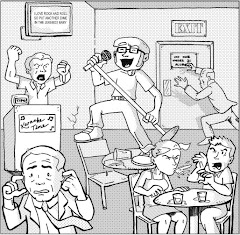
Teen-age Love #30, February 1963, Charlton Comics
Blogger's note: Entry for Friday, February 15, 2008.
Dion and the Belmonts captured in song a question every man and woman asks themselves at that critical period of life: "Why must I be a teenager in love?" I envy the teenagers of the '50s and '60s; music, television, and comic books were downright therapeutic regarding issues of adolescent romance. I mean, the lyric, "One day I feel so happy/Next day I feel so sad/I guess I'll learn/To take the good with the bad?" Is there a verse that describes those emotionally tumultuous years better than that? What does today's youth have? Gossip Girl and R. Kelly's "Real Talk?" No wonder divorce rates rise with every passing generation.
I wonder if a comic book like Teen-age Love would make a difference nowadays. Based on the two stories in this issue, Teen-age Love didn't skirt the hard-hitting anxieties about teenage love, nor did it dodge the socially weighty topics that usually surround such matters of the heart. Consider this issue's lead story, "Beyond My Years," in which Jane falls for her middle-aged biology teacher who coincidentally begins to date her aunt. Jane, convinced that she had first dibs, tries to win Mr. Weeks' affections by pointing out her aunt's old age, and later by faking her own drowning at the beach. Mr. Weeks comes to her rescue but is disgusted by the false alarm. He resolves the situation by introducing Jane to his eligible nephew, who seems to share his irresistibility, but thankfully lacks the awkward years between Weeks' and Jane's ages.
Now, while Jane's mother dismisses her daughter's love as a harmless crush, Jane isn't really deterred by Mr. Weeks' age until the end of the story, when she's introduced to the wrinkle-free charms of his nephew. Had the shoe been on the other foot, and Mr. Weeks had admitted an affection for Jane, surely Chris Hansen would've made a cameo appearance in this issue (even if he hadn't been born yet). I mean, if Jane could fall for her beloved's nephew, why couldn't Weeks fall for his lady's niece? Ah, but age elicits clear-mindedness, and Mr. Weeks traded up in the family! See, Teen-age Love addressed the tough issues, and offered solutions that perfectly, not pervertedly, justified. For every pedophile that pursues a child, simply introduce him to the kid's aunt (or uncle, depending) -- and Dateline will have more time to pursue on-line identity thieves instead!
The second story in Teen-age Love #30 is a simple exercise in social class warfare and adolescent inadequacy. Jim Holden, teenaged mechanic, falls in love with Joan but doesn't want to pursue a relationship with her, afraid that her family wouldn't accept the lowbrow life of a self-taught greasemonkey. The joke's on him, though, when Joan's dad introduces himself as a renowned racecar driver, and the two get along swimmingly. The moral isn't so much "believe in yourself," as it is "cross your fingers and hope the girl you like has a family that already understands your potential for social inadequacy." If only my girlfriend's dad hosting a blog server or ran a comic book shop . . .
Alas, the lesson throughout Teen-age Love is relatively simple: when one is a teenager, one's biggest obstacle in finding and keeping love is usually oneself. As quick as an adolescent is to discover romance, he or she is usually just as quick to create some degree of drama between the discovery and the desired result. That's the difference between the kids in Teen-age Love and a 'tween-oriented television series like Gossip Girl; the kids in Teen-age Love couldn't live longer than just a few pages before finding a happy ending, whereas the kids on Gossip Girl are seemingly happy to endure a whole season of hardship before settling for a resolution. Kids today aren't living for the finale -- they're living for the cliffhanger. No wonder it's called falling in love, eh?
Showing posts with label Charlton Comics. Show all posts
Showing posts with label Charlton Comics. Show all posts
Monday, February 18, 2008


Friday, February 15, 2008
WWWednesday: Last Kiss
WWWednesday: Last Kiss
website: http://www.lastkiss.us/
by John Lustig
When I signed up for John Lustig's Last Kiss e-mail newsletter at the San Diego Comic Con two years ago, I didn't know what I was getting myself into. At the time, I was accumulating a variety of comics, and the clean, "traditional" art style of Last Kiss appealed to my Silver Age sensibilities. Of course, when I opened that first e-mail a few days later and discovered some such woman lamenting about her sex life, I knew the weekly strip would be more than I bargained for. This week, with Valentines' Day a veritable specter of romance looming over everyone's shoulder, Last Kiss is really the perfect web comic to review, if only as a reminder that love can be laughing matter, too.
Since Lustig faithfully e-mails his strip freely every week, so I don't think he'd mind if I posted the latest example:
 .
.
website: http://www.lastkiss.us/
by John Lustig
When I signed up for John Lustig's Last Kiss e-mail newsletter at the San Diego Comic Con two years ago, I didn't know what I was getting myself into. At the time, I was accumulating a variety of comics, and the clean, "traditional" art style of Last Kiss appealed to my Silver Age sensibilities. Of course, when I opened that first e-mail a few days later and discovered some such woman lamenting about her sex life, I knew the weekly strip would be more than I bargained for. This week, with Valentines' Day a veritable specter of romance looming over everyone's shoulder, Last Kiss is really the perfect web comic to review, if only as a reminder that love can be laughing matter, too.
Since Lustig faithfully e-mails his strip freely every week, so I don't think he'd mind if I posted the latest example:
 .
.As you can see, the strength of Last Kiss is the power of contrast. Now, I'm not about to go all Joe Piscopo explained the art of stand-up comedy to Commander Data from Star Trek: The Next Generation on you, but needless to say we comic book fanboys understand the inherent reverence attached to the clean art style of the '50s and '60s, particularly native to war and romance titles. Romance comics in particular were usually little morality tales about the importance of patience, faithfulness, and communication in relationships; really, they were the Dr. Phil of '50s, as countless 'tween girls turned to those pulpy pages for stories to which they could relate or aspire. Yesterday's Falling in Love is a perfect example; in each of those three stories, despite the female characters' respective insecurities, the male figure is the one at fault for each couples' challenges. The innocence of these heartstring pluckers oozes off of the page, epitomizing the romance genre but also betraying the sheltered mentality of an entire generation.
Enter Last Kiss. Imagine these very same images, these classically rendered panels by the likes of legends Dick Giordiano and Jim Aparo, suddenly perverted by contemporary, sexually charged quips and punchlines. Yes, it's like putting Sarah Silverman in a Sally Worth strip, and the result truly is charming -- in a chilling kind of way. Browsing Lustig's website, I learned that these images are really old Charlton Comics panels; apparently, in 1987, the rights to Charlton’s entire library were for sale, and by the time Lustig found out, the good stuff was gone. Undaunted, he bought the forty issue Last Kiss series, which, he says, loaded with “shlock!” Still, the enduring quality of that old style, coupled with the liberal sensibilities of a new generation of readers, created a chemistry Lustig obviously couldn’t avoid. The result is a proverbial Pleasantville of sluts, horn-dogs, and unbridled desperation. And I get it in my inbox every week.
Last Kiss is definitely an acquired taste, with a fair amount of shock value and toilet humor. Still, after reading some of the strips I’ve missed and learning of the series’ real roots in classic comics, I’m grateful for its weekly embrace. Taking these comics that took themselves so seriously not so seriously has ironically preserved them for at least another decade, propelling the comic reader’s torrid romance with all things “classic” to dizzying new heights. I wonder, when Lustig has had his way with the seemingly unending content of those forty issues and decides to sell them himself, what will the next buyer have in store for us? When will Last Kiss truly be its last? I’m broken up just thinking about it.
Subscribe to:
Posts (Atom)