Tuesday, December 05, 2006

Mora #4

Mora #4, October 2005, Image Comics
by Paul Harmon

Nearly six months later, the A Comic A Day project’s greatest nemesis hasn’t been variability in comics, or the availability of variability in comics, so much as it has been plain old fatigue – case in point, last night’s brief review of Pigtale, a comic that deserves more than a single line worth of commentary, the shortest entry in this blog’s almost-half-a-year history. Fortunately, to the credit of the medium’s artistic integrity, whenever I’ve offered a regrettably feeble review, the next day’s read allows for some compensation to make up for the phoned in effort . . . some window to revisit the material, either in the context of a contrast or a comparison. A flip test may impress that Mora #4 and Pigtale #4 are vastly different literary experiences, but for my selfish reasons, I find a connection. See . . . the good guy always bests the nemesis.

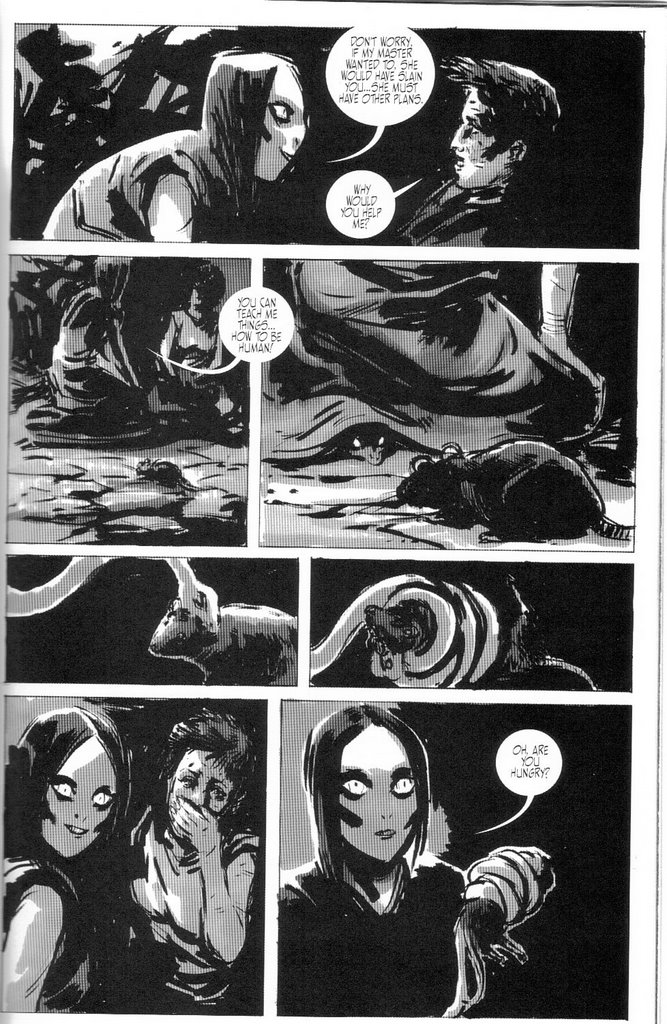
First of all, and most notably, Pigtale and Mora both star talking animals. Pigtale’s take of bestial personification is rooted in science and reinforced by dry wit; Mira’s talking animals are seeped in pure magic. Further, Pigtale is more pedestrian, while Mira seems quite ethereal. I should confess that I purchased Pigtale #1 when it first hit the shelves, and although I was attracted to Ovi Nedelcu’s story and art, I didn’t pursue the rest of the miniseries until I happened across this final issue in a quarter bin. So, I vaguely remember how the story began, and now that I am aware of its conclusion, I assume this pig really is the other white meat, as this action-packed installment is all climax with little real story. I couldn’t really place the circumstances, then again, I haven’t revisited Pigtale #1 since its original release. Mora, on the other hand, is pure narrative, with a grandiose verbiage that implies universal consequences, as if the very sanctity of the world is a stake through the paranormal clash of these purely earthly creatures (sans the Medusa wanna-be in the page sampled above). The issue wasn’t as easy to follow, especially since I didn’t have a previous impression to rely on, but still just as compelling. Talking animals have that effect on people, I suppose.

Secondly, both of these Image books were created by a singular artist, a virtual no-name (at least by my pedestrian standards) that receive cover credit and that implement a black and white format differently, and masterfully. Pigtale strikes me as pure Micron pen, with computerized gray scales, each panel effectively expressing the characters’ actions and emotions, and page pulling the eye from one panel to the next with a sense of suspense and anticipation. Featuring a rhinoceros henchmen and a Hulk-like pig transformation, Nedelcu illustrates his bestial characters with limbs that could crack a tree in half; the sheer girth of these characters’ proportions express their power with little exhibition necessary, although we get plenty of that, too. Mora’s heavy inks imply the use of the ink and brush, and its characters appear nimble and agile, a fluidity that speaks to the magical and natural elements in this tale. The bat creatures at the beginning of this issue come to mind, as well as the images in the page below– sleek, shadowy, and intriguingly demanding to the eye. The inclusion of a small sketchbook section in the back of both of these issues is appropriate, and as a new reader to both creators, more so than these specific titles, I’m curious to see more from them.

On more than one occasion, this forum has explored the nature of animal personification (pardon the pun), and these two issue contrast the effective use of this device – animal characters that talk, to put it simply, are either easy to understand, or beyond the scope of our comprehension. Pigtale is the former, Mora is the latter, by design, I reckon. I may sympathize with these characters, but I must say, I’m not going vegetarian overnight. Honestly, at best, I’ll try harder to understand the animal world, thanks to more than a few channels dedicated to that cause on my DirecTV. Heck, I’ll find the time. A Comic A Day has proven, I have so much of it to offer.

Sarcasm intended.

That’s the fatigue talking.

Monday, December 04, 2006

Pigtale #4

Pigtale #4, May 2006, Image Comics
By Ovi Nedelcu

Bottom Line: One cannot deny that Ovi Nedelcu is an amazing talent, but this climatic issue of Pigtale boasts more style than substance.

Tomorrow, more to come.

Sunday, December 03, 2006

Bear #3

Bear #3, December 2003, Slave Labor Graphics
by Jamie Smart

Bear is closer to the kind of comic book I would prefer to review this holiday season, but even with its coincidental yet appropriate references to winter and Christmas, retains a playful level of dementia that best slates this book as a more Halloweeny, by my self-imposed standards of holiday categorization. (I never intended for these monthly themes to consume A Comic A Day, but I think any blog that dares to review a comic a day for an entire year would be hard-pressed to resist such chronological categorization, especially in the face of making each review current and relevant. But maybe that's just me.) Bear is Mutts on acid -- it's Pigtale meets Serenity Rose, all of which is a good thing. Now let's rip the stuffings out of this thing, shall we?

Jamie Smart takes the personified cartoon animal and truly institutionalizes it through her twisted take on the cat-and-mouse motif, which in this case, best suited to the title of the series, is actually cat-and-bear. Looshkin is a demented cat determined to torture cute little Bear, both of whom are under the apathetic supervision of Karl, a hipster doofus either oblivious to his companion's plight or too self-consumed to do anything about it. Bear #3 features several tales, four of which actually feature the Looshkin vs. Bear war: in the first, Loosh clones Bear so he can torture him endlessly but is thwarted when Bear and "Bear B" bond. The second and third tales are linked, each creatively telling the same tale from either character's point-of-view as Loosh comes into the possession of a tiny black hole. The fourth, and by far most disturbing even by the author's admission, simply has Looshkin subjecting the helpless Bear to a bathtub full of pig innards. The tales are wordy but entertainingly driven by their own momentum; faithful readers of Bear could undoubtedly jump right into this issue, while a new reader, like me, needed to digest this sickening sweetness with a break between readings. Fortunately, the short-story nature of this issue suits such a novice need.

Yes, the Bear-tensive stories aren't the only ones in the issue. Four other tales (excluding the text ridden inside covers) are sprinkled throughout, three of which are only a single-paged strip. The other, "Make Snowmen, Not War," is the underdog of the entire package, utilizing Smart's seeming randomness and applying to a wartime setting, which is surprisingly fitting for soldiers from opposing sides cowering in foxholes literally feet from one another. Bear is the commanding officer, but his role is minimal, as the oafish soldiers wonder how to handle their peculiar predicament:

BEAR: You filthy rotters. You just launched an unprovoked attack on us.
ENEMY: Yeah sorry. Can we have it back?
BEAR: You heard the man. Throw him a grenade.
SOLDIER: Uhh, we ran out of grenades, sir. We used them in the casserole.
BEAR: Well, what do we have?
SOLDIER: Uhh, we have Adams, sir. He's light and he has a terrific temper.
BEAR: Okay then throw Adams. Quickly, before we lose the advantage.

It's a giggle a panel, with absurdity and satire all rolled into one. Again, the best story of the issue. I did enjoy the last story, too, in which a boy's brain builds a snowman on his head without his consent. It's a tad macabre, but really, every snowman story is. Isn't Frosty's annual one-month lifespan an unnecessary kamikaze mission for the holiday cause? To watch kids get attached to him, only to melt away . . . it's sick.

So, Bear didn't infuse me with the holiday spirit, but it certainly didn't take it away, either. In fact, Bear, as a representative of one of the most timeless toys ever, may have simply offered another perspective of the season to me, the underbelly of what's brewing inside every strange little child's sugarplum dreams. I guess Christmas has its tricks and treats, too.

Saturday, December 02, 2006

Flak Riot #1

Flak Riot #1, June 2005, Image Comics
writer/illustrator: Michael O’Hare
co-writer: Robert Place Napton
colorist: Mike Garcia
letterer: Jason Levine

Despite its elusive title, Flak Riot is a relatively simple comic book to understand. Zoe Nixxon is an unhappy office wench who, to pursue something new and adventurous in her life, answers an ad for a three-day course in bounty hunting. The Flak Bounty Hunting School is secluded in a desert bowling alley, and after a humiliating lesson in combat and weaponry, Zoe’s last task is to venture into the Other Dimension through the inter-dimensional gateway dubbed the Flak Riot to fetch one of her professors, supergenius Dr. Cornelius Chang, a beef taco special. Oh, did I mention that this offbeat tale takes place in the future, a period playfully introduced as “sometime soon?”

Flak Riot also introduces Jack Omega and Boss Gila, former associates-turned-rivals in a dispute over the location of an item that will bestow Gila the ability to rise in power. Omega bests two of Gila’s robotic dogs but is overcome by some flying tank, and while captured agrees to give up the mysterious item in exchange for his life. The last time we see the ill-fated tough guy, he’s ready to plummet toward a vat of flesh-eating acid, betrayed by his old friend. Since this scene goes down in the Other Dimension, I assume Zoe and Jack will cross paths, and maybe even fall in love. I’d hate to think that such a device would be that predictable, but so many things in fiction are nowadays.

What wasn’t predictable is how much I enjoyed this issue. The characters were interestingly introduced, and although they clung tenaciously to their stereotypes – Omega as the chiseled Dirty Harry type and Zoe as the bored bookish hidden bombshell type – their circumstances were compelling enough to demand my undivided attention. The futuristic element was a strong catalyst for many of the events in this issue, including Zoe’s smart-alecky, spherical hovering personal aid AI, but the sci-fi didn’t distract from the heart of the plot or the relatable struggles of the lead characters. The time period remained the story’s setting without becoming the story itself, which conversely intrigued me about the period overall. I’m sure the creative team explores the logistics of this “sometime soon” throughout the series.

Artistically, this issue reflects the trends most notably started in Herobear and the Kid, that is an inkless layout with scanned pencils, and in this case, sharp, computerized hues. Michael O’Hare has a really expressive cartoony style, although some of his designs, like Jack and Gila’s robots, retain a realism to them – in fact, Jack reminded me of Ed McGuiness’s Superman with his narrow eyes and sharp chin. As an artist, I usually enjoy the scanned pencil motif, because the published page actually offers a layer of behind-the-scenes sketches within the finished artwork. Some panels in Flak Riot had that sketchy look a bit too much for my taste. In fact, one sequence seemed so unfinished that the characters were literally blurred by the coloring, while just pages later, the combat training sequence was drawn so concisely that I would’ve been fooled had someone credited an inker. This style straddles a fine line (pardon the pun), and the importance of maintaining its composure is an arguable one. Fortunately, it’s also a fun one, as it reveals the freedom many of today’s creators experience during their artistic process.

I can relate to Zoe Nixxon. I began the A Comic A Day project in part out of boredom with my habitual comic book collecting process. I wanted to branch out and experience something new for a change, and books like Flak Riot continually surprise me. How much entertaining stuff would’ve existed on the shelves completely beyond my notice? Now, looking back at the last week’s worth of reviews, I know I’ve been phoning in this effort lately, thanks in part to many of the personal obligations that arise personally and professionally around the holiday season. Still, like Zoe, I enter into this challenge with an eagerness every day, wondering what new insight each read will offer. It’s like another dimension entirely. A Comic A Day is my Flak Riot.

Friday, December 01, 2006

Ashes #2

Ashes #2, Damage Comics
writer: Gerald Sanchez
penciller: Lionel Ordaz
colorists: Oscar Rodriguez & Chris Herrera
letterer: Damage!

When my brother rifled through the comic books I purchased from Atomic Comics and Hero Comics in Phoenix over the Thanksgiving weekend, Ashes #2 made him look at me with some concern and ask, “Are you into this dark stuff?” I could understand why. The cover of this issue depicts a bloated corpse, its eyes like dark, reflective marbles, its lips curled back into a bubbly recess to reveal a set of deadly fangs, its chin and chest covered in dark crimson blood. Yeah, it’s creepy, and although I’m not usually into dark stuff like this, the image is painted masterfully enough to elicit further study. My curiosity was peaked.

To no avail. Ashes #2 offers another “insightful” vampire story, one that would’ve found a suitable context in my series of Halloween-related reviews two months ago. In fact, before I delve into this issue’s specifics, I should mention that I have tried to find some comics that embody the spirit of this holiday season, just as I did in October, thus far for naught. Comics and the horror genre seem closely related, perhaps because comic books offer a systematic visual medium that serves a horror story’s need to grasp the audience’s imagination. What of inspirational literature, or fiction with a more positive message, more befitting the Christmastime feeling? When I hit the back issue bins harder in the next few weeks, I’m sure I’ll find some material featuring angels or something, anything I can link to the yuletide season. In the meantime, we have Ashes #2.

Ashes #2 stars a homeless vampire squatting in his victims’ apartment, waiting for them to come back to life to prove the nature of his affliction. They don’t. His plight is less interesting, though, than his ongoing introspection, which ironically explores the ridiculousness of vampires in the media. When he spots a movie poster for a film not unlike Interview With a Vampire, the protagonist muses, “Who thinks of this crap! Ruffles and lace. I wanna see a real vampire movie. A mean ass junkie vomiting and all!” This while wearing a trenchcoat billowing in the breeze, arguably the modern version of the “ruffles and lace” that make old Dracula-like characters so uber-melodramatic. Despite this issue’s protagonist’s depression and depravity, I must confess that I derived a sense of romanticism about him. I’m not into this stuff but I wasn’t disinterested, either, driven to finish the story by a sheer curiosity of the character’s dilemma. The interior art wasn’t as great as the cover image, but it works, even when its style inexplicably changes with just pages to spare in the end.

I’ve explored the vampire phenomenon in this forum before, so I waste another entry doing so again. If Ashes #2 reveals anything different than other vampire stories I’ve read, it’s the revelation that as much as vampires seek out the necks of their victims, oftentimes their affliction requires they look out for their own necks, as well. Who would’ve thought it’d be so tough to be a night-dwelling bloodsucker?

Thursday, November 30, 2006

Big Bang Comics #12

Big Bang Comics #12 (vol. 2), July 1997, Image Comics
writers: Gary Carlson & Chris Ecker
artists: Bill Fugate, Joe Cooper, Billy Hodge, David Zimmerman, Mark Lewis, Patrick Tuller, Jeff Weigel, Chris Ecker, Jim Brozman, Shawn Van Briesen

Have you ever had one of those days that might as well have never happened? I had three separate appointments today, one personal and two for work, all of which were postponed until tomorrow. Not that I didn’t have a to-do list for the first Friday of December or anything. Oh, to paraphrase Hootie and his Blowfish, “Time, why do you punish me?”

Speaking of time-based troubles, after such a disappointing day, I sought refuge in a potentially fluffy read, so I found Big Bang Comics #12, guest starring one of my favorite characters of all time, Erik Larsen’s Savage Dragon. In this multi-chapter adventure, a campy group of ‘60s supervillains summons Dragon and outfits him with a “time bomb” that propels the fin-headed hero through a proverbial Quantum Leap-like journey through the time-stream. On one level, this story presents an interesting dilemma for a muscle-bound brute like Dragon, as his greatest challenge can’t just get punched to get solved, and as the issue ends, we watch the finned one lose his composure in a rare moment of unadulterated panic – something many heroes refuse to exhibit, no matter how character-advancing it may be. I thought I had a bad day . . .

Of course, on a more prominent level, Big Bang #12, like the series as a whole, I presume, explores and utilizes the scope of comic book history to tell a compelling modern tale. During his time-travels, Dragon meets Ultiman, the Knight Watchman, Dr. Weird, and the members of the Round Table of America (all thinly veiled derivatives of much more popular source material) at various incarnations in their careers. Some pages are illustrated with the clustered fervor of an old Kane/Finger Batman layout, while some emulate a Neil Adams roughness ripped right out of Green Lantern/Green Arrow, a definitive look for the ‘70s, I reckon. For a black and white comic book, the visuals are consistently compelling, compensating the lack of color for varying styles every few pages, keeping the reader on his toes. These guys did their homework.

Trying to emulate past styles and trends to tell a well-rounded contemporary tale isn’t a new concept. Marvel’s first The Sentry mini-series often utilized mimicked images from the House of Idea’s graphic history, and speaking of Erik Larsen, some of the latest issues of The Savage Dragon have had pages drafted to appear as if they’d been “ripped” from certain characters’ checkered pasts. Normally, I would wonder if this device is a step backward in the artistic department of the medium, yet, if the implementation serves to streamline a genre or a concept altogether, to revisit the foundation to build another floor in the structure, I don’t think the idea constitutes the “swipe” problem many creators have claimed lately. For so long, publishers obviously sought to ignore or eradicate their understandably campy pasts; it’s about time someone embraced those old days and welcomed them back to the undercurrent of everything comics are, and are becoming.

So, today is almost over, yet for me, today has yet to begin. I needed a big bang to really get things rolling. Further, the first of December commemorates the sixth month of the A Comic A Day challenge, and when we ring in the New Year thirty days later, we’ll be halfway to our annual mark. I don’t need the Dragon to tell me – time flies when you’re having fun.

Wednesday, November 29, 2006

The Maze Agency #1

The Maze Agency #1, November 2005, IDW Publishing
writer: Mike W. Barr
penciller: Ariel Padilla
inker: Ernest Jocson
letterer: Tom B. Long
colorist: Rainer Beredo
editor: Dan Taylor

This issue of The Maze Agency is a hippie whodunit with a compelling enough plot but with the overall oomph of a Saturday mid-afternoon network television movie presentation. You know, when Martin Riggs says “fudge” instead some other f-word in Lethal Weapon 2 – I sensed an essence of action/adventure brewing beneath this story’s surface, a latent sexuality and intrigue ready just ready to boil over, but the comic read too much like an Encyclopedia Brown for grown-ups to really pack that punch. The real mystery here is, if you’re going to write a murder mystery starring two private detectives that sleep with each other, why don’t we see any scenes with, say, murder or anyone sleeping with each! I don’t think kids are picking up The Maze Agency looking for an activity book here! Come on, we’re adults! We can take it!

Bottom line: This issue hits a dead end. Too bad the effort’s in pen, because it’s too late to erase and try again.

Tuesday, November 28, 2006

The Wood Boy #1

The Wood Boy #1, April 2005, Image Comics
writer: Raymond E. Feist
adapted by: Sean J. Jordan
artist: Mat Broome
colorist: Stephen Broome
letterer: Artmonkeys

Before you ask, no, The Wood Boy isn’t an adaptation of the latest Ron Jeremy flick, but thank you for asking. The Wood Boy is an adaptation of a Raymond E. Feist novel that I haven’t read, which is important to mention only because Feist’s Magician: Apprentice series consumed so much of my junior high years. Yes, when I finally outgrew The Hardy Boys, my eager eyes desperately sought another literary refuge, and I was excited and grateful to discover the adventures of young aimless Pug and his heroic buddy Tomas. I was enthralled by the first four Magician: Apprentice installments, but enough to follow through with the follow-up Prince of the Blood arc, let alone any other Feist epics. I’d never heard of The Wood Boy until I found this adaptation.

I wonder, had I heard of The Wood Boy before its comic book incarnation, would I have been as interested in this work as I was Magician: Apprentice? Both stories seem to start the same way, starring a boy consumed with his delusions of mundane grandeur until life takes him in a dramatically different direction. In the case of the Wood Boy, this last son of a stonecutter’s village is conquered by the Tsurani, a metal-fearing clan of considerable strength but ironically just disposition, allowing the villagers to live under tolerable conditions as servants. Since this story begins with the Wood Boy telling his tale of survival, we know he lives through the Tsurani’s reign, which alleviates the suspense that entails in this issue, the first part of his harrowing adventure. If serving a band of squatting warriors is really an adventure.

Yes, I didn’t really care for this issue, not so much because of the story, but because of its adaptation’s ill-paced implementation. Some of the critical sequences in this first issue seem to be missing a panel or two to make sense. For instance, one scene featuring the hanging of a man abruptly transitions to an image of the Wood Boy at a Tsurani’s soldier’s feet, apparently at a different point in time, under different circumstances entirely. The characters’ blocking on the page doesn’t help, either, with talking head segments blandly laced between melodramatic moments of fancy. Broome could be an excellent artist, but this issue is just lacking that special something to push it over the edge. Generally, it’s a limp start to a potentially grand epic that I’m just not that interested in pursuing further.

A few months ago, I read the first issue of Magician: Apprentice #1, the adaptation of that fantasy novel series I loved as a kid, and although I was thrilled to find myself transported back to that magical time, the experience wasn’t nearly as enthralled as the original. I assume someone somewhere felt the same stunted nostalgia when reading The Wood Boy. Some wood can be fashioned into a beautiful fixture; some just ends up as kindling.

Monday, November 27, 2006

Superman Confidential #1

Superman Confidential #1, January 2007, DC Comics
storytellers: Darwyn Cooke & Tim Sale
colorist: Dave Stewart
letterer: Richard Starkings
editor: Mark Chiarello
associate editor: Tom Palmer, Jr.

Seems my body has smuggled a souvenir back from Arizona – a stomach virus, presumably the same strain that infected my friend, his wife, and his baby on Thanksgiving Day. I don’t think I have it as bad as they did, unless the worst is yet to come, but the symptoms are more than annoying, to say the least. Home from work today, I sought a “comfort comic,” something with a tinge of familiarity but new enough to make the read worthwhile. Superman Confidential was just what the doctor ordered.

DC has launched a Confidential series for both Superman and Batman to explore the heretofore unknown aspects of their respective universes. (I wonder if Justice League Classified will experience a title change to follow suit. The two similar concepts seem too redundant not to streamline. But I digress.) In Superman Confidential #1, “storytellers” Darwyn Cookie and Tim Sale, both of whom are by no means strangers to shoehorning critical stories in our favorite superheroes’ pasts, tackle the burning question: Where did Kryptonite come from? Well, I should rephrase that; we know where Kryptonite came from – but how did Superman realize that it was the source of his otherwise latent vulnerability? I suppose the first season of Smallville, with all of its 26 episodes, didn’t explore this concept enough, eh?

Pardon my cynicism. I just have a difficult time embracing these ret-con tales, especially in the Superman and Batman mythos. I mean, these characters have been around for over 60 years, a firm enough foundation for stories about their present day adventures, I reckon. Do we really have to keep drudging up the past? That said, these new old adventures occasionally offer insight into these characters’ younger mentalities that builds a true appreciation for their expertise today. For instance, in Batman: Year One, what’s more compelling: the Dark Knight’s war with the mob, or his ongoing monologue about his inadequacies? I may not dig the logistics of Superman Confidential – because I feel it’s been done before – but I like the little moments of character study. For example, Superman’s thoughts about his invulnerability are more human than some human’s thoughts about their mortality: “They think I’m fearless. But each new cataclysm gives me one sharp instant of mortal fear. Will this kill me? Am I dying right now?” For a man unraveling his unearthly abilities for the first time, these thoughts are natural and compelling. The fact that they’ve been confidential until now is a crime befitting Lex Luthor himself.

Perry White struck me as a dynamic character, as well – especially in his Transmetropolitan-like conviction about the new casino in Metropolis as a conduit for vice behavior. A shockingly conservative stance on the writer’s part, I believe, but also an element that could’ve been intended to reflect the innocent times in which Superman rose to popularity. (After all that Great Depression and World War II stuff, anyway.) Just a thought, here.

Also, I should mention, when I picked up this issue, I expected a lengthy read because of its heft weight. The Superman story was the standard twenty-two pages – but with the inclusion of a Teen Titans mini-comic and a pair of 3D glasses for some role-playing game ad, the comic was deceptively heavy. I remember reading something somewhere about how retailers didn’t appreciate the extra shipping costs for these “extras,” and frankly, as a reader, I feel like they took away from the story overall. The pacing of the inner monologue was often interrupted with unnecessary page-turns. So, Kryptonite wasn’t this issue’s only weakness. Heh.

Funny, I sought this issue to cure my ills, but in reality, in exploring the issue of vulnerability, it has simply brought my infirmity to light. Superman has his little green rocks; I have my stomach-crippling virus. I’ll tell you this – knowing where it came from doesn’t change the fact that it hurts. The Man of Steel would tell you that himself.

Sunday, November 26, 2006

Dusty Star #1

Dusty Star #1 (vol. 2), June 2006, Image Comics/Desperado Publishing
writers: Andrew Robinson & Joe Pruett
artist: Andrew Robinson
letterer: Marshall Dillon

The stretch between Phoenix and Los Angeles on the I-10 is a surprisingly desolate one, an abandoned desert with bookend suburban thresholds that usher the sprawl of their respective metropolises. (For those of you demographically-minded, Goodyear rests on the Arizona side, Cathedral City on the California side, each slowly but surely growing to their very city limits. During the daytime, this drive on the 10, much like the one I endured today, reveals some peculiar, seemingly forsaken towns – Tonopah, for example – that spark the imagination about the West’s supposedly excited origins, rife with high-noon gun fights and seething, sultry whorehouses. Are these historical impressions even accurate? If so, is Tonopah abandoned, or simply stuck in its own dusty past?

Coincidentally, today’s read, Dusty Star, is a modern western – its only apparent tie to the present a motorized scooter that is blown up in favor of a faithful horse. Story-wise, although this issue is a number one, its lead, a tough and attractive gun-slinging cowgirl, is tying up loose ends, seeking old enemies and claiming old debts. The issue is well written and beautifully drawn, but Dusty’s motivations are too mired in a previous story (volume one, I presume) to be ignored. As a new reader, I was left to ride the roller coaster without knowledge of where we began, not to mention where it will end. Was the new number one all that important? Despite the year between story arcs, Warren Ellis opted to pick up Desolation Jones where it left off, from number six to number seven seamlessly. Still, simply put, I enjoyed this issue, and I would pursue this series again, given the chance. That’s the sign of a good comic.

Now, if you don’t mind, I’m hitting the hay. Nine hours on the road in stop and go traffic would drain you, too, I reckon. In this case, a horse would’ve been faster.

Saturday, November 25, 2006

B-Sides #1

B-Sides #1, November 2002, Marvel Comics
writer: Brian David-Marshall
artist: Brett Weldele
letterer: David Sharpe
colorist: Matt Madden
assistant editor: Lynne Yoshii
editor: Andrew Lis

Most, if not all, of the most popular Marvel Comics characters were created with some vulnerability that incited their own self-loathing and thus the readers' sympathy and interest. Although each superhero's fantastic abilities usually took center stage in their adventures, this proverbial Achilles heel drove their subplots and character development, not to mention a drive to rid themselves of their weaknesses once and for all. For instance, for as many times as Spider-Man saved the city from some macabre villain's dastardly plot, Peter Parker always secretly longed for his peers' acceptance and friendship. Stan Lee thought comicdom's young audience would relate. He was right.

But that was then -- the mid-'60s. Nowadays, kids revel in their differences and awkward quirks, and in most cases, they usually try create a few new quirks that are all their own. The kids in The Craptacular B-Sides, with strange and seemingly useless abilities that even the superhero community seems to ignore, don't have to worry about that. Fateball, for example, has some combat skill, but ultimately, her prophetic magic 8-ball is the real source of her power. Alas, she can predict the future through a series of yes or no questions, but she can do very little to actually change it. Mize can make bad things happen, and in so doing, bad things usually happen back to him. Jughandle, the most contrived of the three, can create a pocket dimension that he and his friends can dwell within -- which he seems to use mostly to spy on chicks. Hey, who wouldn't? So, in this issue, the three come together at the request of a clever shyster who wants to start his own super-team, and they decide to finally make a difference . . . yes, in the world, but also for themselves -- for their own damaged self-esteem.

As could've been predicted, I don't think the B-Sides are around anymore, which in the context of this first issue is actually quite surprising, because I appreciated the writer's realistic look at adolescence through the superhero lens, and the artist's jagged but compelling visuals, both of which reflected the melodrama and cynicism the characters needed to exhibit to remain believable for today's young audience. Yes, Stan Lee cornered the pathetic teenager market, but he also assumed that teenagers sought refuge from their awkwardness. As I said before, nowadays, they embrace it, complete with Napoleon Dynamite gear courtesy the local Hot Topic. Fortunately, Marvel Comics is adaptable to our dynamic youth culture. The impression may not last, but I think it counts, and for teenagers, sometimes that's all that matters.

Plus, as a diehard Cloak & Dagger fan, any comic book that acknowledges their role in the Marvel Universe -- "There were no Spider-Mans in this group. Heck, there weren't even a Cloak and Dagger." -- as prevalent in any way is a-okay by me. Does that put Marvel's original runaways on the A-and-a-half side?

Friday, November 24, 2006

Hack/Slash: Land of Lost Toys #3

Hack/Slash: Land of Lost Toys #3, January 2006, Devil's Due Publishing
writer: Tim Seeley
artist: Dave Crosland
colorist: Roald Munoz
letterer: Brian Crowley

Just a few days ago, I was reminiscing about the Christmas mornings of my childhood and, specifically, the moat of wrapped action figures that always awaited me around the base of our Christmas tree. Overjoyed at the sight of so many Masters of the Universe or Super Powers toys, I never really thought about the great lengths my parents and grandparents went through to assure a happy holiday morn. I wonder, in the early '80s, the days when grown men and women fought for Cabbage Patch Kids, did my mom and dad brave Black Friday for the last Stratos or Brainiac on the pegs?

My girlfriend and I did the Black Friday bonanza today, although we didn't start before daybreak, like so many others in the Valley of the Sun. No, we woke up around 10 a.m., grabbed a bite to eat, and still had plenty of day left to hit two Targets, a Wal-Mart, a Toys 'R Us, and three comic book stores, two of which offered some fruitful discount bins. The selection in Phoenix doesn't seem as diverse, particularly in the secondary publishers' department, but the issues I did find were new to me -- especially Hack/Slash, which is in this case, ironically, about toys. In the first act, Great Dane and Thunder Guard, obvious spoofs of Liono and He-Man, are battling in a dream-scape tainted by a manipulative nightmarish goblin, inside the head of teenage paranormal warrior Cassie Hack. To the li'l fiend's delight, Hack earns her name by making bloody short work of the '80s alumni, just in time for a battle royale with a Pokemon reject army. Still, when playtime's over, the goblin puts Cassie on the ropes, until her dream ends the way it does every night -- with the dark memory of Cass's zombie mom slaughtering her classmates in the school cafeteria, and young Hack put her first two bullets in a murderer's face. A horrifying moment, but in the case, oddly satisfying, as well, as the villain of the story meets his timely demise. With dreams like that, every day would be black, let alone the Friday after Thanksgiving.

Although this issue was the last of a story arc, the inside front cover's plot synopsis brought me up to speed quite concisely, and with an action-packed conclusion, this issue was an entertaining read in and of itself. The haunting but compelling visuals reinforce our hero's internal struggle while maintaining a light-hearted fare with the He-Man/Thundercats/Pokemon riff. The monster element, from Hack's helpless partner Slash to the nameless nightmare puppetmaster to the zombified murderous mother, seem to be commonplace -- not a mystery, but a reality that needs a quick dose of vanquishing. Hack retains some semblance of adolescence ("The little girl in me in me is thinking: This is soooo cool.") while acknowledging her circumstances and embracing a fearlessness ("But the lil' girl in me is pretty much dead.), establishing her a sympathetic hero. The artist spares no expense at showing off her young physique, which never hurt, either. (Nice cover, I do say so myself. Google/Image it.) The monsters within, and one's inner child, take on a whole new meaning for Hack/Slash, and I'm digging the twist.

My inner child grew up a little today, experiencing what my parents must've endured on Black Friday lo those many years ago. Of course, as this issue reveals, my inner child could have it much worse. Sure, I'm left buying my own action figures from here on out (and on a rare occasion, my mom will actually still wrap them by Christmas morn), but all things considered, I have no reason to complain.

Thursday, November 23, 2006

Fanny #4: Night Fruits

Fanny #4: Night Fruits, 1993, The Directory of Women Comic Strip Artists, Writers, and Cartoonists
contributors: Cinders McLeod, Susan Catherine, Karen Donnelly, Jackie Smith, Jeremy Dennis, Carol Swain, Josephine Campbell, Lee Kennedy, Beccy Matthews, Jenni Scott, Jacqui Adams, Juliet Gosling, Suzy Varty, Annie Lawson, Isabel Toledo

We pulled onto Interstate 10 in Southern California around 9:30 p.m. last night, and five and a hours later, we pulled into my mother's driveway in Arizona. Despite the early hour, she was already awake, getting ready for a busy morning at the restaurant where she works. After a few hours' sleep, I awoke early to pick up my grandmother so she could put our turkey in the oven in plenty of time for dinner. A catnap later, my girlfriend, my brother's girlfriend, and I went out for a quick cup of coffee, and we speculated about my cousin's mysterious new fiancee, who may or may be a stripper, but who was very pleasant to meet regardless. Just a few hours ago, my brother and I braved a new episode of Grey's Anatomy with my mother. Yes, my Thanksgiving holiday turned into a very female-centric experience . . .

which, of course, managed its way into today's review, as well. As you can tell from the above list of contributors, Fanny #4 is a jam comic featuring short installments from a variety of women artists. The inside front cover describes the concept this way: "Night Fruits are the flowering of women's thoughts on prophecy, coincidence, dreams and nightmares. The mushroom fruits at night, love is often consummated at night, the most convoluted thoughts come at night. Some of these events are recorded by the artists of this comic. From Virtual Reality to the Curse of Apollo." My opinion of these short tales is as varied as the styles and topics of the stories themselves. I quite enjoyed the first installment -- a cosmic diatribe on the functionality of the world at night thanks to . . . you guessed it . . . women. Other contributions, like "the distant future," were too surreal for my open mind. I've never confessed to understand women. This issue should've helped. In many ways, it just reinforced my ignorance. I guess they like it that way.

Thanksgiving. Some families watch the annual Macy's parade, some friends play their own pick-up football Turkey Bowl, others pitch tents outside of Best Buy for Black Friday's impending deals and steals. Through it all, most families' traditions hinge on the dedication of a woman -- a wife, a mother, a grandmother -- in the kitchen, slaving over a meal that will bring everyone that much closer together. Sometimes they toil the night before, reaping those fruits to stay ahead of the holiday game. So, on this Thanksgiving, I express my appreciation to the ladies. How do you always seem to make a turkey out of us guys?

Wednesday, November 22, 2006

Total Justice #1

Total Justice #1, October 1996, DC Comics
writer: Christopher Priest
penciller: Ramon Bernado
inker: Dick Giordano
letterer: Gasper
colorist: Gene Dangelo
editor: Ruben Diaz

Today is Thanksgiving Eve, but more importantly, tomorrow is The Day Before the Busiest Shopping Day of the Year, and to commemorate the occasion, tonight I read Total Justice, a comic that boasts, “Based on the Kenner Action Figures.” I remember the Total Justice action figure line as Super Powers’ second coming, with an expanded Justice League roster that included the Huntress, Black Lightning, and even Young Justice rookie Impulse, all of whom had never seen such mainstream plastic appeal before (or really, since). However, these figures’ limited articulation and obscure bodily proportions didn’t appeal to collectors like me, so although I proudly display the whole of the series on my toy shelf, I’m grateful that Justice League Unlimited has handled the franchise more capably and comprehensively. In case you’re wondering, I’m spending more time on the action figure angle of this review than usual because this issue was fairly terrible, depicting the world’s most popular superheroes in a rather annoying light. Robin is a spoiled brat, Flash is an embittered egomaniac, Aquaman puts the “a” back in a-hole, and Kyle Rayner/Green Lantern is a helpless novice that whose only power seems to be a definitely twenty-something aimlessness. I know I’m probably reading too much into a comic book inspired by toys, but that’s my point – why instill these characters with any noticeable traits at all, particularly these pessimistic ones? Kids interested in the action figures wouldn’t much care for these heroes after this read, and like so many now valuable Super Powers figures, would probably offer their Total Justice guys to their parents for yard sale fodder. Yeah, this comic book doesn’t do our characters justice. I only hope that Thanksgiving’s read is more satisfying – as fulfilling as the meal will undoubtedly be . . .

Tuesday, November 21, 2006

Shaman’s Tears #2

Shaman’s Tears #2, July 1993, Image Comics
writer/artist: Mike Grell with Brian Snoddy
colorists: Joe Chiodo, Wendy Fouts, and Fierce Colorgraphics
letterer: Steve Haynie
editor: Mike Gold

Normally, I would reserve pop culture commentary like the recent Michael Richards breakdown for my LiveJournal, but with so much of my blogging efforts dedicated to keeping the A Comic A Day challenge worthwhile, I can’t help but say something, if my opinion really matters to anyone anyway. Actually, the Richards incident is reminiscent of why I purchased Shaman’s Tears #2 in the first place – with Thanksgiving just over the horizon, I assumed this issue, boasting the cover image of a warrior Indian, would offer some insight into the origins of the beloved holiday, if only from a cultural, or racial, perspective. I mean, with a title like Shaman’s Tears, am I wrong to imagine that this issue could be about an Indian lamenting over a scattering of roadside litter? Or am I demonstrating the kind of shallow racism that has placed our beloved Kramer in the cultural crosshairs of controversy?

Either way, needless to say, this Shaman’s Tears is not about that candy wrapper you “accidentally” let fly from your car window. The protagonist of this story, the supposed “Shaman,” is an uneasy young man who is understandably hesitant to embrace his destiny as an earthen warrior. One part Hulk, one part Vixen (who?), when the kid gets knocked around by some horse thieves, he summons the various abilities of specific animals, using them in combat through the force of his indignation with unexplained skill and prowess. In the meantime, an organization called Circle Sea Enterprises wins a patent from the Supreme Court to continue their production of human/animal hybrids, a cause that has evoked animosity from the A.C.L.U. and other groups concerned with these unique creatures’ potential civil rights. One of these unique creatures, the prototype appropriately dubbed Animus, manages to break free of his cage and rip a few faces off – literally – before disappearing completely. Since those horses were apparently on their way to Circle Sea, we can assume that a Shaman vs. Animus confrontation is right around the corner. I admit, I wouldn’t mind checking that out. Since Animus is one part animal, can the Shaman tap into his skills, making the two a dead even match?

Like poor Michael Richards, this issue is pretty much all about identity. Now, I sympathize with Richards, and to understand why, read the MSN headlines about his Laugh Factory outburst: “Kramer Breakdown!” or most recently “Kramer Apologizes!” The guy isn’t Kramer. Kramer is a character Michael Richards played on television. Yet, since Seinfeld ended years ago, we’ve called him Kramer any chance we get. So, frankly, excuse him if he drops an identity slur in the height of some inexplicable rage – if he calls someone something they aren’t, despite their protests. This is one opinion, and the more I think about it, the more it’s mine. Shaman’s Tears reflects a similar dilemma, as our young hero virtually denies his heritage until the heat is on, until he has no choice but to respond and react with the kind of power that is truly, rightfully his. Grell laces this action-packed, masterfully illustrated tale with the cultural undertones that elevate the story beyond mere comic book installment, but to social fable, as most Native American myths usually are. Gulp. I hope that isn’t another rash judgment.

Interestingly, this issue is a product of those dreaded ‘90s we’ve discussed here before. In fact, in Mike Gold’s editorial essay, he exposes Image’s glittery cover gimmick trends, confessing that, following this issue’s pull-out poster cover, the rest of the series should sell based on its stunning story rather than its holo-foil packaged trickery. Although I haven’t read his Green Arrow stuff, I’ve always admired Grell’s skill from afar, recognizing his style as a hallmark for the industry, and if Shaman’s Tears is his creative A-game, it’s a shame the title didn’t surpass the mire of Image’s early days. I’d like to mention the color scheme of this issue, as well, since Gold highlights the chapter about color in Scott McCloud’s Understanding Comics. I couldn’t help but notice a warm tone throughout the book – a heavy use of deep reds and purples. In a book with an emphasis on the earth, I would have expected cooler hues, like blue and green, maybe even with a sepia filter. Yet, the reds, like a perpetual sunset throughout the issue, subtlety establish a rage that is soon to explode through both the plot’s circumstances and the lead character’s internal conflicts. Truly, this is a well-rounded book, and if it’s collected as a graphic novel somewhere, I can see myself picked up the volume to open-mindedly absorb the whole story.

The whole story. That’s how this review began – with my half-hearted attempt to understand the origins of Thanksgiving by reading a comic book about Indians . . . maybe. What I got instead was a tale about political intrigue and cultural strife. Sound familiar, Michael Richards? I’m confident that the guy’s career isn’t over – that, after a few months’ time, he’ll emerge with material inspired by this incident, just like Paula Poundstone did a few years ago after her time in the controversial spotlight. Comics have a way of bouncing back, both the stand-up and sequential-art-riddled variety. Don’t shed a tear for Richards or Mike Grell. Like their respective characters, they have a way of beating the odds – a skill we should all be so lucky to learn.

Monday, November 20, 2006

Animal Man #57


Animal Man #57, March 1993, Vertigo/DC Comics
writer: Jamie Delano
artist: Steve Pugh
colorist: Tatjana Wood
letterer: John Costanza
editor: Tom Peyer

With Thanksgiving just a few days away, the cover of this issue sums it up nicely: last minute grocery shopping, beating the crowds at the check-out lines, finding (and successfully escaping) a prime parking spot. Of course, while Animal Man is a tad sensitive to the turkey's plight, in the face of our impending dinner guests, we could care less about how the main course feels, right?

In this issue, Animal Man doesn't don his neon-colored superhero tights -- he doesn't even fight any evil eco-terrorists. Like its cover, Animal Man #57 sums up the spirit of the holidays, depicting a man finally coming home to his family. After a difficult period trapped in the earth's lifeweb -- the network of consciousness between all living things -- Buddy, getting reacquainted with his human self, spends some quality time with his kids while the missus is away. (Nice to know that before Dr. Doolittle 3, someone else was capitalizing on the animal sympathizer's daughter adopts her father's skills shtick.) This issue was very wordy, with some typical early Vertigo digressions about religion and society, but the read was enjoyable, if a little void of adventure. Buddy takes us on a wild enough ride though his nature-ridden mind, which was good enough for me.

I wonder how an Animal Man would really react in today's world of mass fast food consumption and supposed animal cruelty. Would political naysayers immediately dub him a PETA nut, or would folks embrace his insight into the animal world with an open-mindedness that would truly benefit mankind. One thing is for sure, as established in this issue -- anyone with a keen insight into the laws of nature would understand the importance of remaining connected to your surroundings, to the fellow creatures in your family and community. And nothing brings people together like a good meal. Animal Man may not like the menu, but I'd guess he'd still come to dinner.

Two days and counting.

Sunday, November 19, 2006

James Bond, For Your Eyes Only #2

James Bond, For Your Eyes Only #2, November 1981, Marvel Comics

The midterm elections may be weeks behind us, but the democratic fanatic dedicated to contributing to the court of popular opinion need not worry, because the blitz for the holiday box office has begun, and unfortunately, James Bond has lost to batch of animated penguins. Yes, despite the hype surrounding controversially blonde Daniel Craig as the new James Bond failed to stand up to the family friendly Happy Feet, yet another movie about the splendor of penguin culture, and came in second in these films’ opening weekend. I confess, I didn’t see Casino Royale, but I am intrigued, especially since the latest Bond-isode seems to have taken a page from the Batman Begins book, revealing how a hero evolved from a determined somebody to virtual uber-man. Alas, I’ve heard and read some criticism that this move sacrifices the cocky confidence and corny wit that makes Bond so charming in the first place – I guess smoldering sexuality really isn’t enough. Man, those penguins really have it all.

Since I’m not a proactive James Bond fan (I’ve seen a few of the latest installments in the theater, but none of the earliest, most revered films), I assume this issue, For Your Eyes Only, is an adaptation from the movie of the same name. The plot involves . . . well, is the plot of any James Bond story really that important? If Bond isn’t spinning in the stratosphere, he’s tracking down an impossibly intelligent mad scientist and his worldwide weapon of doom, all the while utilizing terrain-adaptable technology that undoubtedly aroused Bill Gates back in the day. Bond doesn’t dish out the buzz saw cufflinks in this issue, but he does make good use of the resources in his environment, driving a zamboni over some hateful hockey players, and activating a sunken ship’s self-destruct charge to bid dosvedanya to a deep sea Russian interloper. Bond’s quips – that supposed lost quality in the new film – highlight the pivotal moments of this issue, like when an enemy’s car is teetering on a roadside cliff. “Seem a little on edge, don’t we?” Bond boasts before the villainous Locque falls to his death. When I die, I hope someone like James Bond is there to wrap up the tragedy in a timeless one-liner!

As a comic book, this issue is awkwardly paced, dedicated most of the second act to talking head shots of Bond and his allies, summing up some of the plot’s loose ends in time for the assumedly action-packed climax, which is actually too crammed into those last pages to maintain the story’s intrigue and effectiveness. Visually, the page layouts and characters’ blocking could have been more dynamic, more cinematographic, to reflect the story’s roots on the silver screen. As is, I’m surprised to find no credits to any of this issue’s contributors. The narrative and art aren’t bad, by any means; I guess I’m just jaded by all of this Bond hype lately. As someone approaching the franchise whole-heartedly for the first time, I expected more.

Maybe that’s the problem with the box office results of Casino Royale. As much as a new actor in the infamous role could attract a newer audience, some younger moviegoers may be intimidated by the character’s history. On the other hand, some Bond newbies walking out of Casino Royale could’ve been left wondering where the 007 they’ve always heard about was, particularly in the face of this introspective brooder Daniel Craig. Really, and somewhat ironically, tried and true James Bond fans may be the only ones that could take in this film without prejudice, driven by the interest in their hero’s humble origins. Like this comic book, Casino Royale may be for their eyes only. Me, I’m looking forward to the Get Smart complete series DVD release. Looking forward to it . . . and loving it.

Saturday, November 18, 2006

2000 A.D. #7

2000 A.D. #7 (vol. 2), October 1986, Quality Periodicals
writers: Gerry Finely-Day & Alan Moore
artists: Dave Gibbons & Jim Baikie

I haven't done the research, but from what I've observed, many of the "big names in American comics" were largely the big names in British comics for a few years first. In this issue of 2000 A.D. Presents, Dave Gibbons, Alan Moore, Alan Davis, John Wagner, and Steve Dillon are all credited with current or future Quality Comics projects, while in the states, the same names would soon be found on such groundbreaking titles as The Watchmen, Detective Comics, and Preacher. Interesting, the difference a year makes. Again, this could be common knowledge for many collectors, but considering I found this issue in a quarter bin, I'm surprised these old series aren't more coveted.

Featuring two stories in an expanded 52-page format, 2000 A.D. #7 is a seemingly hefty issue, until I realized that four of those pages include the covers, not to mention the interior's six full sized ads. That's still a low ad-to-page ratio, and the stories are gripping enough that this issue quite a page-turner -- a faster read than I would've expected, not for lack of content, but for its sheer intensity. In its day, this issue was quite a steal: "16 Extra Pages -- Still Only $1.25!" For a buck cheaper, I feel like I should do some community service.

This issue's cover story stars Dan Dare, a veteran space fighter in the year 2177, who is assigned the dangerous task of charting the Lost Worlds, a quadrant of the galaxy that many explorers have entered . . . but none have returned! The Solar Astronautical and Space Administration (S.A.S.A.) offers Dare a hand-picked crew, but Dare insists on recruiting his own men, controversially from the man-made satellite Topsoil, "a hangout for outlaws and outcasts!" There, Dare provokes a super-strong Russian space service reject dubbed "the Great Bear," an ace pilot named Polanski, and a hitman whose weapon was fused to his hand in subzero space! During their inaugural adventures together, Dare and his crew best a horde of solar-powered goblins, a flurry of flesh-eating desert dustdevils, and a race of Roman-esque vampires, usually more so with their wits than with their interstellar artillery. The way Gibbons draws Dare, he comes off like Captain Kirk meets Dirty Harry, a tough guy boasting a fair balance of hubris and self-preservation, of survival instincts and well-honed heroics. Despite the narrative's repetitious establishing captions -- which makes me wonder if this tale was originally published in its four separate chapters in a different forum -- I was engrossed the whole time, thanks to the writer's well-paced implementation of action and introspection. The ideas presented in this story alone would make for a compelling feature film -- if the space odyssey shtick hadn't been done to death by now.

Moore's back-up story, Skizz, brings the wonder of space down to earth, literally, as a group of runaways tries to rush an alien castaway to safety. Where they're going, I'm not sure, as the government seems hell-bent to bring the creature in, for scientific study, we can only assume. Again, Moore pours on the narrative, with little descriptive blurbs about his characters that impress more as repetitive than insightful. When one of the characters tries to console the alien by assuring him that earthlings have traveled as far as the moon, so surely they could get him home, Moore captures the essence of the whole issue. With that "assurance," the alien knows he's doomed, because his planet is well beyond the bounds of humanity's resources, and both Dan Dare and Skizz are all about the things that could exist outside the scope of our comprehension. I wonder if this sums up the breadth of British comics in that era, as well.

In their attempt to show us some of the cosmos beyond, the contributors of 2000 A.D. revealed some of the talents outside of our own backyard. Fortunately, this issue proves that the "big names of comics" already had their heads in the clouds before we fan-folk considered them household names. Oh, I don't use that phrase -- "head in the clouds" -- negatively. Obviously, that's where some the best stories are waiting to be told.

Friday, November 17, 2006

True Story Swear to God #9

True Story Swear to God #9, Clib’s Boy Comics
writer/artist: Tom Beland

True Story Swear to God, a comic book about a long-distance relationship, coupled with my brief review of The Tick Incredible Internet Comic, has spawned some thoughts about the A Comic A Day experience that I hope will embellish last night’s lack of effort. You see, on more than one occasion during this fanatic experience, I have been without a comic book to review well into the late hours of the day, limiting my options as a blogger that seeks to read issues from a diverse pool of creators, publishers, and genres. During these evenings, I have been tempted to stretch my own established guidelines and take the easy way out, by finding and reviewing an on-line strip instead. After all, thousands of web comics are easily just a mouse-click away, and as sequential, story-driven art, most of them boast enough material to count as a solid, makeshift single issue. I said I’ve been tempted. I’ve never given in to temptation.

Unbelievably, diverse comics aren’t as easy to come by in northern Orange County, California, especially for a twenty-something like me with limited transportation and an even more restricted budget. If you browse the history of A Comic A Day, you’ll discover a few personal compromises, a few reviews typed through gritted teeth, as I obviously would’ve preferred preserving some mainstream titles for a real emergency situation, or as I would’ve obviously preferred not to read the issue at all. Still, I’d rather spend $3 at Borders for a comic I never would’ve read otherwise than resort to a web comic. The inspiration for these thoughts came in part from publisher George Suarez’s essay in The Tick Incredible Internet Comic, in which he wrote, “Despite the popularity of ‘Web-surfing,’ I suspect that many people still like to have something in their hands to read – in the ‘old-fashioned’ manner . . . As wonderfully effective as the combination of computer+Internet is at providing ready access to a virtually infinite amount of information for all, it’s good to know that this world-shaking advance is not likely to do away with the ‘ink on paper’ medium any time soon.” Agreed. The comic book is an interactive experience, an eye-catching, page-turning tête-à-tête with the reader.

So, from time to time, you can say that I have a torrid, long distance relationship with comics, but it is by no means as insightful as the relationship exposed in Beland’s True Story Swear to God. I’ve heard of this “true story of a real life romance” before, and I’ve seen Beland at the Comic Con a few times, but I’ve never ventured into an issue before tonight. I was pleasantly surprised. I can understand why many would dub this series a “chick comic,” as its romantic overtones offer a sensitivity uncharacteristic of the medium – when romantic comics were popular in the Silver Age, they were too cheesy and melodramatic to appeal on a “realistic” level. They were read for their soap opera value, nothing more. TSSTG is almost too honest, as among other things, Beland explores his experiences with sexual inadequacy – a segment that isn’t as awkward as it is surprisingly vulnerable and introspective. Beland’s monologues are succinct and emotional sophisticated, well put and well written. In short, Beland offers the perfect insight into the joys of new love and the hardship of LDR’s.

Of course, my favorite scene in this book takes place in the comic book store. The premise of this issue is that Tom and Lily have only two short days to spend together, and Tom brings Lily to the comic book store for over an hour – typical geek. Hilariously, I can relate. By telling his own story, Beland captures those tender or embarrassing moments in all of our lives, in some small way. On the topic of comics in general, I will also confess that Beland’s art style is perhaps my most favorite of all of the titles in this format I have sampled. His characters are cartoony but expressive, and he uses crosshatching in an effective way to fill in the otherwise white backgrounds, to add depth to scenes that may have too static without something more behind the characters front and center. I guess Beland’s raw honesty (with a few embellishments for comedy’s sake, I assume) just struck me from all fronts here. I’m pleasantly surprised.

Well, I hope this analysis makes up for my phoning it in last night. I knew when I began A Comic A Day that the holiday season would be particularly challenging, what with my varied personal and professional pursuits. As much as I’d like this effort to be all about comics, nobody can tackle a yearlong project and not include an explanation – however brief – of the daily context, the circumstances behind one’s approach to each issue. Beland will tell you, honesty is the best policy, and the easiest answers won’t always deliver the desired results. This blog is by no means as well crafted as Beland’s opus, but A Comic A Day is a true story, too. And it’s far from over, no matter what challenges lie ahead.

Thursday, November 16, 2006

The Tick: Incedible Internet Comic #1

The Tick: Incedible Internet Comic #1, July 2001, New England Comic Press
writer/artist: Gabe Crate

I wish I had the wherewithal to read this issue last night, following my review of Son of Ambish Bug to create a two-parter about comedic comics featuring grown men dressed as insects. Unfortunately, my fatigue has overwhelmed my sense of ironic consistency, so I’m bottom-lining this one: fans most familiar with the Tick from his beloved cartoon series would enjoy this book. The Tick is one moment goofy, the next moment deadly serious – well, serious in his inherent goofiness – all the while fighting crime and maintaining the sanctity of his partnership with his best friend Arthur. I may not be able to place the Tick in his rightful succession in the A Comic A Day chronicles, but the Tick has always known and embraced his place in the world. If we could all be so lucky.

Wednesday, November 15, 2006

The Holy Terror #1

The Holy Terror #1, August 2002, Image Comics
writer: Jason Caskey
penciller: Phil Hester
inker: Jim Woodyard
colorist: John Warren
letterer: Colin Wales

Every boy likes wrestling at some point during his childhood, even if only with a fleeting fascination. While some of my friends salivated at the sight of muscle-bound galoots like Hulk Hogan and Sgt. Slaughter, I watched from a distance, recognizing the real-life connection between this spectacle and the comic books I adored. Grown men in tights play fighting – yes, it’s a strong parallel. I just never thought about the two mediums colliding in a single event or story . . . but comic book and wrestling enthusiasts Jason Caskey and Phil Hester did. Furthermore, they made it happen. Now, I like chocolate and I like roast beef, but I never dream of combining the two into one delicacy, and a similar risk of potential distaste exists when any two things – no matter how good they are individually – are synthesized into one product. In this context, is The Holy Terror a success?

Based on my impression of this first issue, I would say so. Caskey establishes an engrossing world based on the physical strain resultant a lifetime in wrestling, layered with the aura of the supernatural – a demonic persistence that lingers even more so than the creators’ love for the subject matter they’ve selected. In the first act, a small town sheriff and a world-renowned warrior priest combat a werewolf agent of some hidden new world order uprising. Some miles away, a wrestler, the Holy Terror, apparently working toward the same evil agenda defeats a bear in the ring only to find himself unmasked and helpless at the hands of “Boneshaker” Crane. Twenty years later, Crane gives an up and coming wrestler the mask in the hopes of launching the whipper-snapper’s career, only to unwittingly condemn the kid with a collision course toward the same supernaturalism from two decades past. It’s a fun, simple story with interesting potential, and any reader could sense the creator’s excitement with the raw energy that exudes from every page.

Hester turns in some of his best work in this issue, as each panel is truly poster worthy. Caskey has given Hester’s art room to breathe, and although a splash or two would have been nice, this issue’s pacing is brisk enough to maintain even the most casual reader’s attention. Hester balances the physical brutality of wrestling with the mysterious undertones of macabre spirituality rather well, as does Caskey with his narrative and dialogue. Honestly, I don’t know if a purebred wrestling fan would dig the paranormal undertones, but that layer makes for good comic reading, which, based on Caskey’s supplemental essay, was his intention in the first place. A few Hester character designs make for a well-rounded package. Truly, this issue is its own best review.

You know, kids still love wrestling. In my years working with youth, the trend has shifted from WWE style superstars like Triple H to, most recently, Nacho Libre style Mexican wrestling. Again, I’m watching from a distance, understanding the appeal but not quite embracing it as my own. The Holy Terror may be the closest I ever get to sitting ringside. This issue was a pilgrimage into a realm of geekdom I otherwise would have actively avoided – that, frankly but appropriately, slightly terrifies me.

Tuesday, November 14, 2006

Son of Ambush Bug #1

Son of Ambush Bug #1, July 1986, DC Comics
co-writer/penciller: Keith Griffen
co-writer: Robert Loren Fleming
inker: Bob Oksner
colorist: Anthony Tollin
letterer: Gasper
editor: Julius Schwartz

Yes, Son of Ambush Bug. Did you think I was joking?

I’ve never read an Ambush Bug adventure, and in fact, I’ve only ever heard of Ambush Bug when the character is referenced as an inside joke among well-read DC fans. (I think A.B. cameoed in JLA: Welcome to the Working Week, written by comedian and confessed geek Patton Oswalt, heretofore my only legitimate encounter with the hero in print.) Despite the character’s laughable qualities, I didn’t think Ambush Bug would be so self-depreciating, but with Giffen’s name on the cover, I should’ve anticipated the bwah-ha-ha factor. So, did Ambush Bug die in Infinite Crisis? That is Giffen’s legacy, right?

In Son of Ambush Bug #1, Ambush Bug laments his declining popularity as a comic book character – yes, he knows he’s a comic book character – and just he assumes his life couldn’t get much worse, a cosmic interloper dubbed the Interferer threatens to alter his continuity forever. Indeed, in this first issue alone, Ambush Bug is manga-ized and Kirby-fied, and his sidekick, the stuffed animal “toy wonder” Cheeks, is abandoned to a wartime comic, appropriately entitled Combat Cheeks. Obviously, Giffen is operating on a satirical level, and his genre-bending interludes stretch the bounds of his artistic skills and make for an eclectic read. In Justice League International, Giffen’s outrageous story arcs were often anchored in reality by the nature of the hero’s past continuities (although the introduction of Guy Gardner’s comic book hero as a genuine supporting character pushed the limit), subject matter like Ambush Bug obviously opens the floodgates for Giffen’s well-established cynicism.

At the same time, experiments in breaching the fourth wall of comics strike me as either too reserved or too over the top. In this case, I’m opting for the former; although Ambush Bug leaps from genre to genre, his acknowledgement of his two-dimensional existence doesn’t really set him apart from his other panel-to-panel peers, sans his overwhelming depression regarding his apparently low sales. We’d never expect Superman to break that fourth wall and talk to his readers, but Ambush Bug can – if he knows he’s a comic book character, why not curse his writer for condemning him to such an ill fate? Then again, if I remember correctly, She-Hulk played with these themes a bit back in the day, to no real avail. Like the Hulk family needs another level of dementia to make their characters compelling. I’m just saying, you can transplant the concept of comic book character with superhero – the connection to other genres with other timelines or parallel universes – and the story is just like another other kooky hero-down-on-his-luck fable. To establish and implement the balance between exploitation and exploration of the comic book as a world unto itself would be a very interesting and interactive reading experience.

In the meantime, Ambush Bug remains another forgotten son of the DC Universe. Unfortunately, in this issue, he’s already accepted his fate, and aside from a few laughs, Giffen’s efforts really don’t offer us any reason why we shouldn’t, either. I’m not holding my breath for All-Star Ambush Bug or Ambush Bug/The Heckler: Hard-Traveling Losers – but honestly, I wouldn’t be disappointed, either. Then, at least one hero would’ve escaped the supposed Giffen curse. Or have I finally discovered the reason why DC opts to slaughter his pet projects? Did Paul Levitz dig up this issue, scoff at the satiric Interferer and all that he implies, and decide enough is enough?

Monday, November 13, 2006

Pubo #1

Pubo #1, November 2002, Dark Horse Comics
by Leland Purvis

When I came home from work today, I discovered my girlfriend standing on our kitchen countertop, which wouldn’t necessarily be a bad thing except that she was ridding the cabinets of an unexpected infestation of bugs. Yes, we were ambushed, and me with my Son of Ambush Bug #1 forgotten at work. How perfect that would’ve been! Well, I guess they can’t all be 1111, right?

So, we get Pubo instead. Pubo – Physically Unipolar Biogenic Organism – is “some kind of experiment” with resized “body-parts to reflect the sensitivity of his nerve ends,” a description kindly offered on the first page of this issue. Interestingly, the rest of the story is less about who Pubo is and more about where he belongs, as he escapes a mid-air transit and lands in a forest of talking animals, where another peculiar societal reject eludes that Pubo belongs in the woods, but fails to explain why. The characters’ snappy dialogue is introspective and clever – for example:

ONE-STONE: My! What an amazing little creature you are!
PUBO: You’re not exactly a photo-op . . .
ONE-STONE: What are you looking for?
PUBO: What have you got? All is need is a meal and a place to hide.
ONE-STONE: Is the world big enough, I wonder?
PUBO: To hide in? Well, I’ve proven it’s big enough to get lost in, haven’t I?
ONE-STONE: But a man can be lost even if he knows where he is. If you run from who you are, there is no place you won’t be found.

Pretty deep for a comic about a little deformed dude. Speaking of which, Pubo is very beautifully drawn, if I do say so myself, but the animals really steal the show. With just the right balance of realism and abstractness, the fact that these creatures talk isn’t too far-fetched considering the peculiarity of the issue altogether. After all, since the premise of Pubo is an awareness of over-sensitivity, albeit physically or biologically, one can only presume that the author would use such an opportunity to exploit the vulnerability of the world at large, as well. Visually and thematically, Pubo is primo. I was pleased with the read . . .

. . . of course, more please than I was to discover the little animals living in my kitchen. I wish they could speak, so they could tell me how delicious the food I didn’t get to eat was. Amazingly, comics, like most effective art, have the uncanny ability of striking their readers where they live, in this case, quite literally. Purvis tackles a high-end concept in Pubo, with funneled through low risk themes that a wide audience can understand. I guess you don’t need big hands to be sensitive to the world around you, but it helps.

Sunday, November 12, 2006

Prime #1

Prime #1, June 1993, Malibu Comics
writers: Len Strazewski & Gerald Jones
artist: Norm Breyfogle
letterer: Tim Eldred
colorist: Paul Mounts
editor: Chris Ulm

On the surface, Prime represents some of my biggest pet peeves about the era in which I began collecting comics, topics we’ve discussed in this forum a few times already. I won’t bother reiterating them, only to mention that I’ve finally discovered that I’m not alone in these gripes. During a brief trip to Borders yesterday, and my usual casual perusal of the graphic novels shelf, I found The Dark Age: Grim, Great & Gimmicky Post-Modern Comics by Mark Voger, a coffee table book about . . . well, just what the title explains. According to Voger’s assessment, the Dark Age began with Crisis on Infinite Earths and continues to this day, thanks to the ongoing influence of “Dark Age founders” like Alan Moore and Frank Miller. As the inaugural issue of a series spun from Malibu’s melodramatic, continuity-driven superhero imprint Ultraverse, Prime #1 defines this eerie era . . .

. . . except Prime #1 is illustrated by one of my favorite artists, Norm Breyfogle, and although I didn’t actively pursue the series at the time, when I found this issue in the quarter bin at Frank & Sons this weekend, I snatched it with an eagerness akin to those trembling fingers that first wrapped around Spawn #1 oh those many years ago. (Those fingers weren’t mine, mind you, but we all know someone that hailed McFarlane’s reject from Hell the best thing since Batman – just as McFarlane intended.) Yes, I may have mentioned it here before (with over 100 posts, I’ve lost track), but Breyfogle remains one my favorite Batman artists, and by far the most underrated, as he illustrated the Bat-books during the hype of the Burton movie franchise. He contributed to the creation of characters that ripple the Bat-titles to this day, and he played a key role in designing the current Robin costume – well, the pre-One Year Later Robin costume, that found its way into the animated series and Schumacher film fiascos. With all of this credibility, DC never hyped his skill and involvement during this pivotal period, the proverbial heyday of one of their flagship characters, so I can understand Breyfogle’s desire to pursue a project that could give his career the necessary boost. With every other mainstream artist at the time jumping ship for indie pastures, why wouldn’t he? Still, I can’t help but utter an “Et tu, Norm?” Yeah, yeah, I’m my own worst enemy.

Alas, even if Breyfogle hadn’t drawn Prime #1, it would still be stuck in the mire of that decade’s dark trappings. The opening sequence of this issue is interesting enough, but the second act evokes connections with other books in the Ultraverse, losing me completely. With that big fat #1 on the cover (which actually wasn’t that big compared to the other number ones of its time, as Voger explains), I would expect that this issue would welcome me to the ground floor of a brand new concept. With these superfluous references to the other characters in the Ultraverse, Breyfogle’s action-packed visuals come to screeching halt, the scene registers more like an ad for the other books than a legitimately important part of the story, and a new reader like me is completely lost. Then again, if the intent was for me to rush out and buy those other books so I could have a comprehensive idea of what was going on around Prime, I suppose the effort would’ve worked, considering the context of this issue’s original release. Presently, the ploy wouldn’t work so well, as I’d undoubtedly have to rummage around in quite a bit of those quarter bins to explore every corner of the Ultraverse. Goes to show where those crossover efforts get you.

Based on this first issue, I must say that Prime strikes me as a modern take on the Captain Marvel concept, as a child cavorts around the world in a superhero’s body, recklessly solving even the most miniscule problems with the force of an out of control wrecking ball. Breyfogle was on his A-game in these pages, with the complete freedom to exaggerate Prime’s proportions to emphasize his strength, and in the end, peculiar state of being. Yes, at the risk of spilling a spoiler, the last sequence reveals Prime’s “host” bursting from his muscle-bound frame in a “spla-doosh” of goo. It isn’t a pretty sight, but it evokes an intrigue that most certainly propelled this series forward, no matter how dark the decade.

Yes, unfortunately, even if one likes any of the contributors involved, many of the books that came out of this era carry the baggage of their context, the sheer burden of their own hype and mass production to the point of becoming clichéd and clustered together in a bygone genre despite the potential of their concepts and aforementioned contributors. Fortunately, Breyfogle wasn’t done with DC (or DC wasn’t done with him – I haven’t really asked), and he continued to work on Batman-related projects well into the next century. If I may conclude on an anecdotal note, I’m proud to say that I met Norm once at the Comic Con. Our Small Press table was just a row or two away from Artists’ Alley, and I did a fanboy double take when I saw Norm there signing books for fans. Unprepared, I found a Detective #608, the first appearance of Anarky, and asked him to grace its cover gushingly, prompting him to comment about the demise of the character. He was a gentleman, and I departed his table both thrilled and a little depressed. You ask me, he deserves to sit right alongside Jim Lee as one of the artists hyped by the Big Two as the best in the business, not to mention influential. Yet, Breyfogle may well be past his prime . . . by no effort of his own. Maybe we need another revolution . . .

Saturday, November 11, 2006

1111 #1

1111 #1, October 1996, Crusade Comics
artist: Bernie Wrightson
writer: Joy Mosier-Dubinsky

In desperate need for new comics, I dragged my girlfriend to Frank & Sons again -- a warehouse expo in the City of Industry, California, featuring a flurry of retailers and collectible pop culture memorabilia, and most notably dozens of discount back issue bins. I picked up two weeks' worth of fodder for this project at less than ten dollars, including a few new releases I needed for my standard monthlies. I'm surprised Frank & Sons isn't as elbow-to-elbow as the Comic Con floor, but I suppose one can't too much of a good thing.

Which brings us to 1111. The painted cover of this first issue depicts a demon cradling a little girl against a cloudy night sky, an image that normally wouldn't appeal to my down-to-earth sensibilities. However, for only a quarter, I couldn't resist the title's connection to today's date, so I figure this review was meant to be. After all, with so many discount comics at my disposal, I had to feel if my potential purchases would be worthwhile, dependent usually on the cover image or credited creators, lest I lose my mind at the sheer volume of issues available.

Now, when I opened this issue, I prepared for a fantasy-intensive tale, but 1111 certainly was not what I expected. Oh, I would definitely categorize it as a fantasy story, but despite its format, 1111 was more of a picture book than a comic book. The even-numbered pages were solid text, although not enough to fill the frame, and the odd-numbered pages were illustrations seemingly out of Bernie Wrightson's sketch book, as they were finely detailed pencils sans inks or colors. In fact, despite this issue's intensive narrative, Wrightson is given top billing in the contributors' department, and his art is rightfully this book's major draw -- pardon the pun.

Further, I must say that the illustrations eventually became a solid page behind what was happening with the corresponding text. In other words, the story got ahead of the images, as if Wrightson only drew the parts he found most compelling, ignoring the eventual issue's format and layout. In spite of his masterful pencil strokes, the ill-timed pacing became distracting and detracted from the package as a whole.

Now, for the story. I can only imagine what the folks sitting around me at the coffee shop thought when my brow furrowed in disgust at the raw imagery established through this issue's opening page. Describing her birth, Hope, the protagonist, narrates, "The dim light of swampy foxfire seeped from the ground when my mother, Rachel, shat me into this world. She washed the birth-cheese from the pink creases of my arms with stagnant marsh water and handed me to my father . . . While Rachel sat in the swamp cleaning the after-birth from her thighs, Shannon sermonized for the enraptured crowd." That's exactly what my mother wrote under the baby pictures in our family album. Sheesh.

The concept of the story itself is rather interesting: Following the return of Jesus Christ and his followers' rapture, God, stuck with the unforeseen dilemma of a crowded Hell, grants the otherwise abandoned Earth to a legion of demons and subservient damned, who rebel and start an ethereal war with their would-be captors. Hope is the supposed savior of this New Time, but when a horde of demons kill her mother and whisk her back to their lair to raise her as their own, her followers, the Forgotten Fighters, are left hopeless -- in more ways than one. However, when Hope ventures out on her own and falls in love with her cherry-popping one night stand (and if you think that's putting it crudely you should read this issue), she embraces her destiny in the face of her surrogate demon-father's disdain. It's a coming of age story not only for a young woman but for a post apocalyptic world, as well.

Despite my initial shock and disgust with this story, I confess that I was enthralled with the outcome and was engrossed by the time Hope reached her solemn self-realization. Additionally, as the story got better, Wrightson's illustrations became less coherent, the surrealist prerogative of an established artist. I mentioned the poor pacing earlier -- while the issue would've benefited from a triumphant illustration of Hope embracing her destiny, instead our last visual impression of 1111 is an image from prior to the story's climatic moments. Yes, the story gets ahead of the drawings, and the drawing never catch up. Since I'm genuinely curious about where the writer is going to take this concept next, I must say I'd prefer a novella format with chapter heading illustrations than the ruse of a comic book package. But that's just me.

Many of the issues I purchased at Frank and Sons today are from indie companies -- titles and publishers (like Crusade Comics) that I've never heard of. I'm hoping for similarly challenging experiences. 1111 may not have utilized their different format to the best of its ability, but I appreciate the effort. As a generally mainstream reader, I had to wrap my head around the issue before I could fully immerse myself in it, the physical act of pulling my eyes away from the text to soak in the illustration. Obviously, the medium as a whole is taking whatever strides it can to appeal to today's hard-to-please audience -- to stay relevant and current. And what can be more current than reading an issue titled after today's date, eh?

Friday, November 10, 2006

Archie's Pal Jughead Comics #177

Archie’s Pal Jughead Comics, December 2006, Archie Comic Publications
writer: Craig Boldman
penciller: Rex Lindsey
inker: Rich Koslowski
letterer: Jack Morelli
colorist: Barry Grossman
editor: Victor Gorelick
editor-in-chief: Richard Goldwater

Saved By the Bell had Screech. Parker Lewis Can’t Lose had that kid with the utility trench coat. Beverly Hills 90210 had those two underclassmen, until one of them dramatically died and the other became a major cast member in the latter seasons of the series. Yes, every high school epic has its comic foil, but before any of today’s tagalongs were even a twinkle in a screenwriter’s eye, Archie had his faithful pal Jughead. Donning his patented crown and boasting his insatiable appetite, Jughead was the first loveable loser of comics, the underdog that was all too happy dwelling in another’s shadow, despite his potential to achieve headline status all on his own. Even in his own title, Jughead is still “Archie’s pal.” I don’t think he’d have it any other way.

Incidentally, speaking of Jughead’s appetite, I had to share this issue’s cover alongside yesterday’s Treehouse of Horror to emphasize why these two comics stood out to me on the stands. With Thanksgiving right around the corner, can you see how my mind is drawn to the focus on food? These covers are vastly different in content and composition, but that similarity, with the presumption that these titles are targeting a younger audience, makes them agreeable back-to-back reviews to me.

Admirably, one creative team contributed four distinctive stories for this issue, the standard format for these long-running cartoon-oriented series, I’m learning. Artistically, these tales are consistently well illustrated, and as I briefly explored in this week’s Krypto review, I can understand the artists’ responsibility to maintain the integrity of these characters’ rich contexts. For Krypto, Min Ku sought to retain the look of the source material – the animated series – and for Jughead, Lindsey and Koslowski attempted to preserve the Archie clan’s original designs while updating their sense of style to attract a more contemporary audience. They rise to the contrasting challenge as well as can be expected, but I wonder how many kids come to Archie on their own, versus via encouragement from an adult that enjoyed the characters in their youth. I suppose this is a compliment to the creative team’s craft, but despite my general ignorance of the Riverdale sect, I was surprised how familiar the gang felt after just a few pages’ worth of reading. I mean, Archie, Jughead, Betty, and Veronica aren’t complex charactersby nature, but the quirks that have kept them endearing for generations are just as apparent now as they were when Jughead’s crown was arguably in style. That’s impressive.

Incidentally, here’s a brief synopsis of Jughead’s misadventures in this issue:

Judge Jughead: As a punishment for eating in class, the Principal assigns Jughead the responsibility of judging a makeshift grievance court, where “his honor” causes more grief for his clients than their original cases entailed!

Jughead, Yes Man: When Archie blames his pal’s pessimism for his bad luck with girls, Jughead agrees to be a yes man for Archie’s romantic endeavors, including the inevitably failed plan to take two girls to the fiesta!

Jughead the Watcher: On the same day as the Wrestling Expo and Gutbusters’ grand opening hamburger giveaway, Jughead is stuck at home babysitting his little sister Jellybean, but when his galpal invites him to a flower show, Jughead is grateful for the quality time with his li’l sis!

The Beat Goes On: Although Jughead’s incessant drumstick tapping gets him sent to the office, the Crowned One uses his rhythm to save the day by rat-a-tat-tatting the Principal’s thermos open, fiddle-dee-deeing a file off of a high shelf for the secretary, and tappity-tapping his teacher’s brooch out of the clogged cafeteria sink! Way to stick it to the man, Jughead!

Honestly, these simple stories were just plain charming. I can understand why fans young and old alike would have an insatiable hunger for Archie and his pal. Admittedly, I wasn’t sure what I was getting into with the purchase of this issue, but I think the “S” on Jughead’s shirt really stands for satisfying, because after this review, I was pleased with my impromptu trip to Riverdale. Something tells me A Comic A Day will be back soon.

Thursday, November 09, 2006

Treehouse of Horror #12

Treehouse of Horror #12, 2006, Bongo Entertainment
contributors: Terry Moore, Kyle Baker, Eric Powell, Karen Bates

First of all, let me just say, if The Simpsons can air their Treehouse of Horror special the weekend after Halloween, I can read and review the Bongo Treehouse of Horror special a few weeks later, okay? Further, this issue sustains this week’s dueling themes of kids’ comics (Krypto the Superdog) and Thanksgiving-geared reviews of comics somehow associated with food (Stray Toasters). See, on the cover of this issue, Kodos (or Kang – I can’t really tell them apart) dons a chef’s hat and presents the Simpsons’ heads as meatballs in a plate full of spaghetti. Although none of the stories in this issue actually reflect this cover image, it’s the closest I can come up with in a pinch. Kyle Baker, Terry Moore, and Eric Powell are prominently billed as the key contributors to this special, and rightly so, as these creators are hailed for their distinctive respective artistic integrity. I must confess, I was interested what the Simpsons would look like through each of their lenses . . .

. . . and what I beheld was unexpected. In the first story, “Homer’s Ark” by Terry Moore, a drunken Homer is struck by lightening and receives a message from God to build an ark and preserve life on Earth so He can spray the planet for cockroaches. Of course, like Noah, Homer is criticized for his effort, until the holy spray actually begins to flood Springfield, and the typical mob crash the flying ship with their attempt to jump onboard. Moore’s gags are too random to strike a consistently funny cord, and some of the comedic timing is too strategically paced – i.e. three panels per gag – versus the rapid fire of the TV show’s laugh a minute delivery. For instance, on one page, God transforms a cockroach into a Hershey’s kiss, and when Homer pops the treat into his mouth, a three panel sequence on the following page illustrates God’s changing the candy back into a bug and Homer’s spitting it out. The scene didn’t read right; The Simpsons isn’t Sunday comic strip material. Nor is it effective when it’s drawn like one; Moore’s interpretation of Fox’s faux family deviated from the franchise’s typical look, implementing too much agility and true-form proportion to maintain the integrity of The Simpsons air. I hate to sound so narrow-minded, but I was too distracted to enjoy the story overall. Bongo has gone to such great lengths to preserve the Simpsons’ look in their ongoing titles, I’m surprised even a heavyweight like Moore could stretch the bounds this far. If any other artist, especially an unknown, submitted material like this, would Bongo have embraced it as excitedly?

Kyle Baker’s contribution, “Blood Curse of the Evil Fairies,” is a much more Treehouse of Horror-like tale, simply stretching the bounds of the Simpsons-verse to create a tale of fright and disbelief without completely losing the franchise’s essence. In this story, Bart reinterprets one of Maggie’s storybooks so that Homer captures and unwittingly kills a magical fairy, whose friends soon seek a violent revenge. I chuckled a few times during this tale, particularly when the feisty fairies transformed the Simpsons’ home into a monster house and Marge exclaims, “Homer! The walls are breathing! The floor is throbbing! You’re going to wake the baby!” The tale comes full circle, as Bart reinterpreted the storybook in the first place to avoid Nelson’s taunts, then in the end, Nelson is ironically terrified by the story he inspired. At first glance, Baker’s style could be considered just as incompatible as Moore’s, but a closer look – a steady read – assures that Baker’s source material must have been the first two seasons of the TV series, which, as fans may remember, had a definitely different look and animation style than the dozen plus seasons afterward. The characters are expressive without losing their identities in Baker’s style, and in fact, his generally satiric tone surprisingly fits the end result. The work does seem rushed, as does Moore’s, so I wonder how whole-hearted their efforts for this special were. Still, three stories in three different styles establish an interesting Elseworlds-esque impression, perhaps the kind that the TV show should more strongly consider.

That said, Eric Powell’s story pushes the envelope more so than the other two tales combined. He retains his style, best known from his work on The Goon, while maintaining the Simpsons’ look, and in fact his use of color and shading adds a depth these characters rarely experience, so I’m less critical of the piece’s appearance than its content. Yes, it’s what happens in this story that concerns me, that perhaps should have encouraged the publisher to add a readers’ warning to the cover of the issue. In “Willie: Portrait of a Groundskeeper,” Bart and Millhouse order a chest hair growth hormone from the back of Maximum magazine and then stash the issue before Principal Skinner can catch them. Willie finds the mag and, in the depths of his loneliness, tries to order a mail order bride but apparently dialed the neighboring emu farming ad instead. Innocent and funny enough, but when the emu arrived . . . Willie has sex with it, Homer kills and eats it, then a vengeful Willie kills and eats Marge, before Bart’s chest hair springs to life and chokes his dad’s attacker. Of course, most of the really controversial material occurs off-panel, left up to the readers’ imagination, but when Willie lights a cigarette in bed with his beaked bride and asks, “That’s right, birdy, who’s yer poppa now?” the mind doesn’t have far to leap. I wasn’t really offended by the story, just disturbed by the thought of who else could’ve read it. Powell’s tale conjures thoughts of what a true adults-only Simpsons yarn would be like. Now, that would be scary.

I picked up Treehouse of Horror at Borders earlier tonight, along with another kid-friendly title featuring food on the cover, so we’re definitely building a momentum. After last night’s Stray Toasters experience, I’m trying to add some coherency here. If three stories about a deistic cockroach spray plague, vengeful fairies, and emu-inspired bestiality and cannibalism can’t do the trick, I don’t know what else will.

Wednesday, November 08, 2006

Stray Toasters #4

Stray Toasters #4, 1988, Epic Comics
writer/artist: Bill Sienkiewicz
letterer: James Novak

I don’t get it.

I was initially excited about today’s review, because I figured that a few books in November could commemorate the Thanksgiving holiday with some peculiar reference to food, as most of the reviews in October honored Halloween, but after reading Stray Toasters #4, I confess that I just don’t get it. Featuring a cast of macabre characters, I don’t understand who anybody is, what their motivations are, or why I should care, sans the poetic narrative that fluctuates between the essence of Shakespearean verse and the crudity of an Andrew Dice Clay concert album. Still, my weary eyes were pulling through this confusing read by Sienkiewicz’s compelling visuals, which combined his chicken-scratch-like, thin lined inks with textured, prop-ridden technology, similar to the supplemental pages in the graphic novel Arkham Asylum. Nearly twenty years later, some of these pages are still breathtaking – and you don’t have to know what they’re trying to say to appreciate the beauty and sophistication of how they say it.

As I’ve explained in the past, even the most boring comic book – which Stray Toasters was not, but follow me here – offers every reader some scrap of familiarity, some moment of connection that could make the otherwise useless reading experience worthwhile. In Stray Toasters, Sienkiewicz managed to enthrall me with his narration, some snippets of introspective insight twisted by religion and murder, with captions that struck me as ambiguously assigned to any one character or muse. Describing one of his female characters, Sienkiewicz wrote, “A woman knows her own son. Her own lover. Her own personal physician. All the men in her life well enough to slit their throats.” Nice. If I ever read Stray Toasters from the beginning, something tells me I’d be in for dark roller coaster through the most violent recesses of the human mind. Sienkiewicz has taken man, scrapped off his burnt outer layers, and spread them around on the page for us to enjoy. Maybe I’m not confused as much as I’m scared by what this issue is trying to say.

I like Sienkiewicz. I’m familiar with his work on Spectacular Spider-man and from his contribution to the Batman: Black & White miniseries. Stray Toasters doesn’t change my impression of his talent – in fact, I’m more impressed with the man as an artist, but as a writer, I think this tale might be a little dated. Something with these psychological complexities is best left in the “me” generation of the ‘80s. Me, I’m just grateful that A Comic A Day is back on track after last weekend’s technical disaster. In spite of what today’s issue is entitled, we’re no longer astray. Heh heh.

Get that?