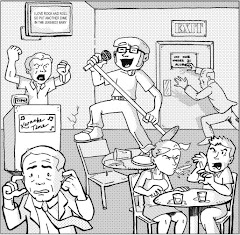
Captain Confederacy #2, December 1991, Epic Comics
writer/colorist: Will Shetterly
penciller: Vince Stone
assistant editor: Richard Ashford
editor: Nel Yomtov
executive editor: Carl Potts
Blogger's note: Entry for February 28, 2008.
If this year’s Presidential election has taught us anything about the grand experiment that is America, it is that the “American dream,” as we’ve come to call it, is incredibly open to vast interpretation. For some, the American dream is the result of a lifetime of hard work -- achieved and earned through dedication and perseverance, just as our forefathers overcame the challenges of escaping their monarchical roots and traveled across the ocean to found a new land and governmental philosophy. Indeed, some perceive our history as a model to follow, living wholeheartedly by the “pursuit” end of that old adage, “the pursuit of happiness.”
On the other hand, some perceive the struggles of our nation’s history as an inbred entitlement to such happiness -- that one’s birthright as an American are the spoils of capitalism and democracy. Happiness was pursued and captured and has become a proverbial Denny’s waitress that offers to refill my coffee on its own, whether I really need it or not! I think I’ll call this dichotomy the “Jay Gatsby versus Billy Madison Principal.”
Of course, this forum isn’t the place for me to pick a side, nor can I say that I ever really will, which is, in itself, a definitive part of the American dream all by itself. No, instead, I offer this narrow-minded analysis to explain a recent revelation about comic books, most specifically, about the Captain America archetype. During A Comic A Day, I’ve encountered many Captain America derivatives, from Captain Paradigm, to the Fighting American, to Strike, to today’s topic, Captain Confederacy. These characters usually boast two distinct parallels to Marvel’s original winghead: firstly, they’re transformed from average citizens to super soldiers, a power that instantly instills an unwavering patriotism and sense of selflessness toward America, so, secondly, all of their uniforms boast the colors of the American flag. Never mind the practicality of brandishing red, white, and blue into battle, but I wonder if Cap would have an opinion of the flag’s commercialization and thusly would feel inadvertently responsible. I mean, a striped shield is one thing, but have you seen those pants with the stars on one leg and the stripes in the other? How about those baseball caps and denim vests that come out around Independence Day? I guess everybody becomes a Captain America archetype at some point in their lives, sans the strength and invulnerability, of course.
(Kat Von D on The Learning Channel’s LA Ink often wears American flag printed pants, but, since anything looks good on her, she’s the exception to their general rule of gaudiness.)
The thing about Captain Confederacy is, while he proudly flaunts his red, white, and blue, his aren’t the colors of the American flag. No, as his name implies, this Captain defends the Confederate States of America, and his series plays out as a virtual “what if” scenario, namely, “What if the Civil War ended differently? What if our nation became irreconcilably divided? What would our country really look like if everybody decided to pursue their interpretation of the American dream?” Now, I barely passed Civics and I can’t say I remember much from my first encounter with Captain Confederacy, so this issue was essentially a blind read for me, boasting a global context I don’t have the passion or time to understand. So, like the Americans crammed into this story’s crowd sequences, I’m beholding these events with my own fair share of wonder and ambivalence. I know Captain Confederacy and his fellow heroes are important, but in the midst of my own interpretation of the American dream, I can’t devote an endless amount of time to them.
You know, just like our current Presidential election. I envy the folks that have time to refresh their perpetually open Drudge Report window every ten minutes. But I digress.
When you strip away this issue’s extensive dialogue, some providing insight into this America’s altered history, some establishing and developing character, Captain Confederacy #2 is essentially about a superhero summit. Twelve heroes from different regions of the world gather as a show of good faith, and while most comics would utilize such a context to offer readers’ a round robin slugfest, these do-gooders do little more than march in a parade and go clubbing. The assassination attempt teased by this issue’s cover image is reduced to a small six panel action sequence, which is an injustice to the story’s pacing and appeal. Indeed, historians might enjoy this series’ escapism, but the potential to inspire interest in history and government for the layman superhero fan is lost in the title’s own mired self-appointed significance. That Vince Stone’s art is burdened with inconsistent inking techniques and blocky amateurish lettering (seriously, like they were using Microsoft autoshapes -- a point of contention on the cusp of the image-conscious Image revolution, I'm sure) is only the last straw in an issue that does very little to engage readers that might have missed Captain Confederacy #1.
Interestingly, according to my review of the next issue (which, again, I read exactly a year ago), Captain Confederacy loses his colors (and perhaps the quantity of his print run), which helps Stone's art a great deal. Goes to show what a little trial and error can accomplish.
So goes the pursuit of the American dream. Ultimately, life, liberty, and the pursuit of happiness are solo ventures, and our country’s inherent freedom practically encourages the multi-faceted and sometimes even conflicting interpretations of its fundamental ideals. I mean, what if my concept of happiness infringed upon another’s? Maybe I want a Starbucks on every corner, whereas my Fellow Man would rather be rid of a coffee-dependant society altogether! Whose America would be the last one standing? If Captain America had to battle all of his derivative patriotic successors, who’s to say he would win just because he was the first?
Supplemental: I try not to research any given issue or series before I review it, but I felt compelled to look up Captain Confederacy and found this ongoing blog about the series. Very insightful, and it adds an interesting layer to the series' creative process and anti-historical context. Check it out!
Showing posts with label Carl Potts. Show all posts
Showing posts with label Carl Potts. Show all posts
Monday, March 03, 2008


Tuesday, January 29, 2008
Rocket Raccoon #1
Rocket Raccoon #1, May 1985, Marvel Comics
creators: Bill Mantlo & Keith Giffen
writer: Bill Mantlo
penciller: Mike Mignola
inker: Al Gordon
colorist: Christie Scheele
letterer: Ken Bruzenak
editor: Carl Potts
EIC: Jim Shooter
Blogger's note: Entry for Sunday, January 27, 2008.
Raccoons have a bad rap. They’re just cursed from birth. That furry black “mask” around their eyes has doomed them to the stereotype of a criminal. I guess all of that rummaging around in trash cans doesn’t help, either . . . but a mask isn’t always an indication of evil. We geeks know that a mask can protect a superhero’s identity and their loved ones therein. Now we also know, thanks to Rocket Raccoon, that a raccoon can rise above prejudice and become an interstellar, laser-wielding champion.
Huh?
Yes, the image of a raccoon as an interstellar, laser-wielding champion was all I needed to purchase this issue at last year’s San Diego Comic Con. I hadn’t even seen the all-star list contributors yet, including a young Mike Mignola, whose characteristic style wasn’t apparent to me on a cover featuring all animal characters. (Uh, pay no attention to that “MM” in the corner . . .!) Indeed, based on editor Carl Potts’ back page introduction -- appropriately titled, “All Right . . . Who’s Responsible for All This?!” -- Rocket Raccoon’s fantastic world inspired some of comics’ best talents, including Bill Sienkiewicz’s caricatures of the creative crew. Rocket Raccoon was the brainchild of Bill Mantlo, who’s also responsible for my favorite Marvel underdogs Cloak and Dagger, and the little guy first appeared in Marvel Fanfare #10 followed by a guest-starring role in Hulk. Those two appearances obviously sparked all of the interest Rocket needed to earn his own four-issue miniseries.
This first issue introduces Rocket’s native sector of space, the Keystone Quadrant, and his home planet Halfworld. When the snake lord Dyvyne’s toysmith is murdered by his competitor’s trademarked robotic clowns, the tongue-smelling tyrant enlists Rocket Raccoon to bring Judson Jakes to justice. Rocket’s girlfriend Lylla is the rightful heir to Jakes’ Mayhem Mekaniks, and while the raccoon is doing Dyvyne’s dirty work, that slippery serpent has planned to wed his woman behind his back, inheriting his competitor’s company. Obviously, Rocket’s paws are full, but on top of this corporate conspiracy, Mantlo infuses an ethereal subplot about the Quadrant’s spiritual existence. Apparently, these alien animals exist to humor their seemingly insane human neighbors, but these toy companies wish to spin a profit from this entertainment. The thought repulses Rocket Raccoon, which inspires themes about servitude, selflessness, and greed.
Apparently, this superheroic raccoon was hiding much more than his identity behind that God given mask. Rocket Raccoon boasts subtexts I wouldn’t have expected from what otherwise looks like a cosmic fairytale. Indeed, for this, the beginning of week-long series of animal-oriented comics, my theory holds true: that character remains the most important element in an introductory issue, especially if that protagonist bucks stereotypes and exceeds expectations.
Supplemental: Click here to see the beginning of my Man-Cave expose, categorizing the stuff in my cocoon of geekdom!
Subscribe to:
Posts (Atom)