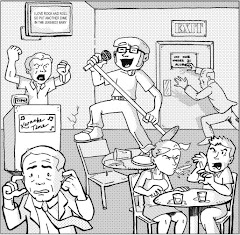
Pop Life #2, March 1999, Fantagraphics Books
by Ho Che Anderson & Wilfred Santiago
Blogger's note: Entry for Thursday, April 10, 2008.
I picked up a few issues of Pop Life a few months ago at the Los Angeles Comic Book and Science Fiction Convention, and while I don't regret the decision I wonder if these issues are appropriate for the A Comic A Day challenge. For several personal reasons, I've made a conscious effort to keep the material I review all-ages appropriate, and though He Che Anderson's writing boasts many universal themes, his stories strike me as sexually charged and definitively adult. There's nothing wrong with that. Pop Life is an obvious and tender labor of love, by an adult for fellow adults, but I simply feel compelled to note its uniqueness in the context of the hundreds of comic books I've reviewed over these past few years. Yes, it certainly pops.
And what is it about? Well, I'm having a difficult time with that one, too. Granted, I read issues #2 and #5, which are vastly distinct in both design and content, but both feature an array of uniquely crafted, introspective stories, which either explore the realms of music, sexuality, social inadequacy, or all three. Consider the lead story in issue #2, which features Danny and his band trying to score a suitable practice space. Unfortunately, their respective homes just can't cut it, considering the protests of their significant others. In the meantime, Danny spends the day hooking up with his wife and his mistress, and chatting with his mom. I'd imagine it the real life of a struggling musician -- the one most of us envy. The following tale, "Miles From Home," is the continuing exploration of a young woman's newfound independence, though in this second chapter, Mo is struggling a bit with loneliness and a sense of impending responsibility. It's a slow bit interesting yarn with a particularly sympathetic scene in a coffee shop, in which one of the kindly townsfolk tries to spark up a conversation with Mo. The sequence reveals that, as much as she wants to find a place in the world, she needs times to herself, as well, and the two hopes aren't necessarily getting along. Dichotomy reigns supreme in Pop Life.
From what I can tell of this issue's design and themes, Anderson with artist Santiago sought to established a "mixed tape" feel to this work, as if the various stories each represented a different track on the same homemade album. Their art styles are vastly different but remarkably cohesive in this series -- Santiago has a confident brushstroke, while Anderson incorporates photography and creates a really textured reading experience. I liked the monotone of "Miles From Home," as it turned a relatively down to earth urban allegory into a vibrant pop art experience. Again, the artists' love for the work exudes from the page.
Which makes issue #5 a bittersweet read, as it's unexpectedly their last. Still, Anderson has experienced quite a bit of success since Pop Life, with his biographical King the recipient of rave reviews. Goes to show where having a dream can really get you -- something someone at any age can easily understand.
Showing posts with label Fantagraphics Books. Show all posts
Showing posts with label Fantagraphics Books. Show all posts
Sunday, April 13, 2008


Friday, April 04, 2008
Har Har Comics #1
Har Har Comics #1, March 1990, Fantagraphics Books
by Mike Kazaleh
Blogger’s note: Entry for Thursday, April 3, 2008.
I decided to follow up on Tuesday’s theme of general hilarity with Har Har Comics #1, yet while Wha . . .Huh? satirized long-established subject matter, Har Har Comics creates its own cartoony characters with a decidedly Looney Tunes motif. Mike Kazaleh’s vignettes starring Hyper Al are the comic strip equivalent of a Bugs Bunny Merry Melody (which, I’m ashamed to admit, I’ve just now realized was Warner Brothers’ way of mimicking Disney’s Silly Symphonies, if only in name), though Al’s adventures are more self-depreciating and almost tragic, depending on your sensitivity to comics’ ability to utilize real life as a source terrible humor.
Consider this issue’s lead story, which depicts the monotony of Hyper Al’s day, beginning with the long line he has to endure in his buildings communal bathroom. “Will today be a day unlike all others? I think not . . .,” he tells himself. What he doesn’t know is that a spaceship has arrived and is looking for the perfect Earthen specimen for their zoo. They find Al and abduct him in his sleep, then, in his exhibit, they decide to mimic his native environment. So, when Al wakes up, he finds himself behind cardboard cutouts of his neighbors . . . in the bathroom line. It’s a great visual gag, but it’s also absolutely terrible to relate to. And many of us can.
The recreation of Al’s native environment reminds of a line uttered by Mitch Hedberg in his stand-up, about capturing a frog in a box with a stick and leaf, because “that’s what he’s used to.” I’m sure you can YouTube it.
This issue’s longest story is called, “Hey! Suppose All Our Pets Were Anthropomorphic!” There’s that word again. Longtime A Comic A Day readers know that I pursued anthropomorphic themes last year to coincide with the theatrical release of TMNT, then again this year for Groundhog Day and Easter. For most of those reviews, I couldn’t put my finger on the word I needed to describe that animal-centric genre, but the revelation that Fantagraphics was practically founded on it, what with series like Critters and Usagi Yojimbo, finally jogged the term. This story, about a man simply walking his dog, explores the concept in a highly animated yet completely realistic context. The dog walks and talks like a man, but he still acts like a dog, panting for his master’s attention and whimpering when he doesn’t get it. This little yarn is an excellent exploration of the human/pet dynamic, one that even a cat lover like me can understand.
What sells this issue in its entirety is the consistency of Mike Kazaleh’s artwork. His style varies a bit depending on his strips’ characters or circumstances, but his brushstroke is solid and confident, rife with motion and feeling. These pages could be storyboards for animated features, but in this case the story is complete, from set-up to unmitigated punchline. If a comic book is going to parallel these humdrum aspects of real life, at least it pads those punches with an appreciated kid glove. Otherwise, the joke . . . is on us.
Sunday, March 23, 2008
Critters #14
Critters #14, July 1987, Fantagraphics Books
by Stan Sakai, Freddy Milton, Dwight R. Decker, Steven A. Gallacci, & Monika Livingstone
Blogger's note: Entry for Friday, March 21, 2008.
Critters is anthropomorphic anthology series, which is the best use of alliteration I've had the pleasure to write in a long time! More notably, Critters chronicles some of the earliest adventures of Stan Sakai's Usagi Yojimbo, the flagship subject of my Easter-oriented reviews of comics starring rabbits. This issue's ten page adventure isn't as spiritually profound as Thursday's experience, but it is equally entertaining and just as suspenseful considering its length. Yojimbo is recruited by an old acquaintance ("friend" wouldn't be an adequate term, as the two share a begrudging-at-best respect for each other) to retrieve a stolen religious statue, a simple enough job as the samurai rhino explains that he intends to provide the distraction so Yojimbo can easily make the grab. Of course, when the dastardly rhino blows our hero's cover, the distraction ends up being Yojimbo himself, but in the end, this hare wins their race of wits when he walks away with half of the statue's reward and sticks his old "buddy" with the bar tab.
Like Thursday's issue, Sakai's simple, expressive art tells the tale almost as effectively as his consice, character-rich dialogue, and these two first impressions have convinced me to pursue more of Yojimbo's adventures in the future. To think, I've had two Usagi Yojimbo action figures (the first edition and space gear variant from the '90s Playmates TMNT line) for nearly eighteen years now, yet I've waited this long to see what the old fellow's really like. Shame on me.
The second story in Critters #14 could relate to the concept of catching up with old acquaintances. In Freddy Milton's Gnuff, a family of dragons has won the rights to build their home on a coveted piece of land, and in this flashback of their earliest days building their cabin, Gnellie, the lady of the house, recounts her attempt to reconnect with fellow travellers the O'Gators. Though Gulliver protests her departure in light of their construction work, Gnellie treks to the O'Gators' plot, only to find their cabin half finished, too. Their rival Harry Hancock (an appropriate name for a rooster!) startles her and tries to have his way with her, but fortunately Gnellie slips through his grasp and makes it home safely. Gulliver's gruff ways eventually get the better of Gnellie and she plays the field to feel better about herself, playing with the hearts of suitors until they made fools of themselves. Her story ends prematurely, undoubtedly to be continued for another issue, which, if it weren't for the fact that she was remembering this tale from an obviously much better point in the future, would make for a rather depressing ending.
I'm torn on Gnuff, though its charm may simply be lost in translation. When I noticed a small "translated by Dwight R. Decker" credit in the corner of this story's first page, I felt compelled to look Gnuff up and learn that Milton is actually a Danish cartoonish, and I presume his strips are simply reprinted for an American audience here in Critters. Still, some of the subtexts are potentially controversial; first of all, Harry Hancock's assault on Gnellie is borderline molestation, which is disturbing enough, but when it's a rooster coming on to a dragon? Further, Gnellie basically explains that she willingly became the town whore to compensate for Gulliver's lack of affection . . . oh, and if I didn't mention it earlier, this tale is a flashback as she tells it to her son. Gnellie's story ends when she remembers to check on the pies she put in oven, to which her son replies, "Okay, that's just as important!" Uhm, what's Danish for, "Hey, after you put the pies on the sill to cool, could you finish the one about when you slept with every guy in town?"
Birthright II was the most peculiar tale of them all, as a team of personified foxes in combat with an anarchistic rebellion while at the same time on the hunt for their lost, possibly captured or dead, prince. Leading the charge is the prince's fiancee, and in this chapter she oversees the construction of a new starship. I couldn't really get into this brief eight pager, as it focused less on the action of these characters' conflict and more on the logistics of their multi-pronged strategy. Steve Gallacci and Monika Livingstone's art was quite impressive, what with its varied brushstroke and watercolor-like graytones, but I can only assume that this installment was a bridge between more explosive plot points. I know foxes are sly, but they have to make their move sometime.
As I was researching the backgrounds of these respective strips, I learned that Critters was Fantagraphics' longest running anthropomorphic (or "furry," as it was called) anthologies, running fifty years for five issues. Goes to show, when it comes to animals like this, there are obviously plenty of tales to be wagged.
Yeah, I know. Sorry 'bout that.
Wednesday, January 23, 2008
Goody Good Comics #1
Goody Good Comics #1, June 2000, Fantagraphics Books
by Gilbert Hernandez, Rick Altergott, Johnny Ryan, Jaime Hernandez
Blogger's note: Entry for Monday, January 21, 2008.
Some kinds of storytelling can only be accomplished in comic books. While many iconic characters or compelling stories have been and will be adapted for film, some ideas simply only make sense in a visual sequential format. Goody Good Comics #1 is such an example.
On the surface, Goody Good Comics #1 is an exercise in surrealism, featuring four unique characters bound only by their apparent pointlessness. Still, as I was reading the tale of Roy, a caveman with an alien for a best friend, and as I was marveling at Gilbert Hernandez’s cartoonish, yet beautifully expressive brushstroke, I couldn’t help but wonder if I was missing the point. In his eighteen-page adventure, Roy befriends a boy king, whose injured knee produces a murderous evil clone that usurps his throne. Since Roy knows the truth about him, the knee-clone pits our dim-witted hero against the blood-sucking Froat, a creature as silly-looking as it is dangerous. When undercover heroines from the Leapin’ Elite Corps seek to resurrect Roy by slicing open his knee, I find myself agreeing with their logic in spite of myself. Fortunately, the real Roy regenerates and rises, joining his tight-lipped alien friend as his dark knee-clone kills the evil boy king, and the enraptured Leapin’ Elitists jump into the sunset.
I told you it was surreal. Still, since the story maintains a semblance of linear thought, I wonder if I’m missing some allegorical significance. I also wonder if that’s what Hernandez wanted me to think, using his tale of fun absurdity as a catalyst for fruitless meditation. He has a blast at the drawing board, the rest of us wonder if he meant something more. Or maybe I’m just thinking too much and should relax and enjoy the ride.
Still, the incorporation of an alien and a young despot makes me think something more is afoot. These archetypes bring all the right kind of baggage to make excellent tongue-in-cheek comics commentary. Somebody please comment and tell me I’m nuts.
At least the other three stories are more straightforward in their silliness. Doofus, who stars in two short strips, first foils his own plans for a perfect afternoon in his backyard by accidentally buying gag “beer piss,” then, a few pages later, tries to sneak his friend Henry Hotchkiss into his house under his mom’s disapproving nose. These little goofs, by Rick Altergott, are illustrated with an ironic layer of detail considering their rather throwaway punchlines, but his and Henry’s outfits boast a certain vaudevillian bravado that makes it all okay in the end. Greaseball by Johnny Ryan is just as visually engrossing, with an emphasis on the “gross,” as three kids try to capture a greasily dripping genie, then ask him for three grease-related wishes -- a million French fries, oily hair, “wheelie banana shoes.” Ryan’s style is very kid-friendly in contrast to Altergott’s brewing adult themes, and I can see Greaseball more at home in Nickelodeon Magazine.
Jaime Hernandez’s back cover Mike Hayes is more transparent in its biting social commentary, depicting a five-panel spread about a ne’er-do-wrong football hero. Mike Hayes: every man wants to be him and every woman wants to be with him. ‘Nuff said.
Again, some kinds of storytelling can only be accomplished in comic books. Yes, my emphasis has been on the absurdity of Goody Good Comics #1, but another underlying trait these stories tell is their succinctness. From five panels to five pages, elaboration isn’t the necessary tool of an accomplished artist . . . especially if he really doesn’t have anything to say!
Subscribe to:
Posts (Atom)