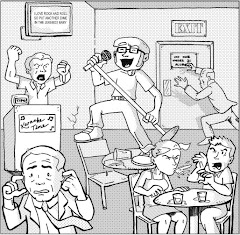
Critters #14, July 1987, Fantagraphics Books
by Stan Sakai, Freddy Milton, Dwight R. Decker, Steven A. Gallacci, & Monika Livingstone
Blogger's note: Entry for Friday, March 21, 2008.
Critters is anthropomorphic anthology series, which is the best use of alliteration I've had the pleasure to write in a long time! More notably, Critters chronicles some of the earliest adventures of Stan Sakai's Usagi Yojimbo, the flagship subject of my Easter-oriented reviews of comics starring rabbits. This issue's ten page adventure isn't as spiritually profound as Thursday's experience, but it is equally entertaining and just as suspenseful considering its length. Yojimbo is recruited by an old acquaintance ("friend" wouldn't be an adequate term, as the two share a begrudging-at-best respect for each other) to retrieve a stolen religious statue, a simple enough job as the samurai rhino explains that he intends to provide the distraction so Yojimbo can easily make the grab. Of course, when the dastardly rhino blows our hero's cover, the distraction ends up being Yojimbo himself, but in the end, this hare wins their race of wits when he walks away with half of the statue's reward and sticks his old "buddy" with the bar tab.
Like Thursday's issue, Sakai's simple, expressive art tells the tale almost as effectively as his consice, character-rich dialogue, and these two first impressions have convinced me to pursue more of Yojimbo's adventures in the future. To think, I've had two Usagi Yojimbo action figures (the first edition and space gear variant from the '90s Playmates TMNT line) for nearly eighteen years now, yet I've waited this long to see what the old fellow's really like. Shame on me.
The second story in Critters #14 could relate to the concept of catching up with old acquaintances. In Freddy Milton's Gnuff, a family of dragons has won the rights to build their home on a coveted piece of land, and in this flashback of their earliest days building their cabin, Gnellie, the lady of the house, recounts her attempt to reconnect with fellow travellers the O'Gators. Though Gulliver protests her departure in light of their construction work, Gnellie treks to the O'Gators' plot, only to find their cabin half finished, too. Their rival Harry Hancock (an appropriate name for a rooster!) startles her and tries to have his way with her, but fortunately Gnellie slips through his grasp and makes it home safely. Gulliver's gruff ways eventually get the better of Gnellie and she plays the field to feel better about herself, playing with the hearts of suitors until they made fools of themselves. Her story ends prematurely, undoubtedly to be continued for another issue, which, if it weren't for the fact that she was remembering this tale from an obviously much better point in the future, would make for a rather depressing ending.
I'm torn on Gnuff, though its charm may simply be lost in translation. When I noticed a small "translated by Dwight R. Decker" credit in the corner of this story's first page, I felt compelled to look Gnuff up and learn that Milton is actually a Danish cartoonish, and I presume his strips are simply reprinted for an American audience here in Critters. Still, some of the subtexts are potentially controversial; first of all, Harry Hancock's assault on Gnellie is borderline molestation, which is disturbing enough, but when it's a rooster coming on to a dragon? Further, Gnellie basically explains that she willingly became the town whore to compensate for Gulliver's lack of affection . . . oh, and if I didn't mention it earlier, this tale is a flashback as she tells it to her son. Gnellie's story ends when she remembers to check on the pies she put in oven, to which her son replies, "Okay, that's just as important!" Uhm, what's Danish for, "Hey, after you put the pies on the sill to cool, could you finish the one about when you slept with every guy in town?"
Birthright II was the most peculiar tale of them all, as a team of personified foxes in combat with an anarchistic rebellion while at the same time on the hunt for their lost, possibly captured or dead, prince. Leading the charge is the prince's fiancee, and in this chapter she oversees the construction of a new starship. I couldn't really get into this brief eight pager, as it focused less on the action of these characters' conflict and more on the logistics of their multi-pronged strategy. Steve Gallacci and Monika Livingstone's art was quite impressive, what with its varied brushstroke and watercolor-like graytones, but I can only assume that this installment was a bridge between more explosive plot points. I know foxes are sly, but they have to make their move sometime.
As I was researching the backgrounds of these respective strips, I learned that Critters was Fantagraphics' longest running anthropomorphic (or "furry," as it was called) anthologies, running fifty years for five issues. Goes to show, when it comes to animals like this, there are obviously plenty of tales to be wagged.
Yeah, I know. Sorry 'bout that.
Showing posts with label Stan Sakai. Show all posts
Showing posts with label Stan Sakai. Show all posts
Sunday, March 23, 2008


Thursday, March 20, 2008
Usagi Yojimbo #76
Usagi Yojimbo #76, June 2004, Dark Horse Comics
by Stan Sakai
Living the devout lifestyle of a geek is not without its spiritual experiences.
Devout readers of my blogs know by now that my recent acquisition of a DirecTV DVR has enabled me to become a faithful fan of Star Trek: Voyager, which airs at least twice daily on the Spike network. I’m several episodes into season four now, and I just hope that they continue to air the series chronologically and comprehensively until its end. The episode I watched yesterday, “The Omega Directive,” ended with former Borg Seven of Nine having her first spiritual epiphany, which I registered as an interesting (and potentially not entirely coincidental) story to see on the Wednesday before Easter.
Enter Usagi Yojimbo #76, my first comic book experience with Stan Sakai’s famous long-eared samurai. Like Panda Khan, my only significant experience with Usagi Yojimbo is his action figure incarnation from the ‘90’s Playmates Teenage Mutant Ninja Turtles line. I actually have both the original figure and his space gear-wearing version, which even as a kid struck me as peculiar. Still, I didn’t learn until much later that Usagi (whose first name is actually Miyamoto) starred in his own comic book as a land-dwelling samurai -- nowhere near space.* Indeed, the first wave of TMNT mania truly made some significant strides in introducing independent comic characters to the mainstream, particularly of the anthropomorphic variety.
(Side note: Special thanks to the Rabbit Valley Comic Shop ad on the back of this issue for using that word, “anthropomorphic.” I’ve reviewed dozens of comics starring personified animals now, and that word has been on the top of my brain for just as long!)
So, I thought, what better time to review an issue of Usagi Yojimbo than the week of Easter, when I can place a special emphasis on anthropomorphic comics specially starring rabbits? I certainly didn’t expect the experience to achieve spiritual significance, especially since this issue was a random buy from a twenty-five cent back issue bin. The cover was simple and iconic enough for me to assume that the story inside was self-inclusive enough for a novice like me to understand. With twenty years of continuity behind Usagi, I think such a concern is legitimate. Fortunately, judging this book by its cover paid off, in more ways than one.
In this issue, Yojimbo encounters a dying doctor whose last wish is for the samurai to deliver a mysterious package to his daughter Ayane. Ayane explains that her father was a doctor assigned to an eclectic port city, where he discovered “a cure . . . for all the people.” Unfortunately, the authorities have dubbed this package illegal contraband and are right on their tail (pardon the pun), until Ayane creates a fatal diversion so Yojimbo can get the package to the next link in her subversive group’s underground chain. He is successful, and when he hands off the package to the kindly fish merchant, he comments, “That -- whatever it is -- has caused enough pain.” The merchant replies, “It is not pain that this brings, Samurai . . . but, rather, salvation.” He unwraps the package, and there it is -- a crucifix. I really didn’t see that one coming.
So you can understand my sense of wonder regarding this issue, as my intent was to read it in pseudo celebration of Easter. Now, if only Sakai could explain the whole painted eggs part . . .
Seriously, I really enjoyed reading this issue. Although Yojimbo doesn’t actually battle anyone, the suspense he and Ayane experience during their flight from the authorities infuses this issue with an exciting sense of adventure and intrigue. Sakai’s use of dialogue is simple and insightful; character development isn’t an aside to the story but a natural result of its context, though after twenty years with Miyamoto, I’m sure he’s pretty familiar with the ol’ hare by now. Interestingly, his line work isn’t perfect and in some cases betrays hints of hurriedness or shortsightedness, yet in its imperfections this issue’s art tells its tale rather comprehensively. I frequently had to remember that these pages are even void of any gray tones, as Sakai uses crosshatching and stippling so effectively, the backgrounds are rich with depth and texture. He has mastered his craft, yet with a story like this, also reveals his potential to surprise and continually entertain.
But what does it all mean? A former Borg, a rabbit samurai . . . are they conspiring to tell me something? Or is this convergence of spiritual themes simply a cosmic coincidence? For now, I’ll embrace this mystery and see if it unfolds in my other pop culture indulgences this week. Of course, I’ll be sure to fill this space with all of the details.
Is it possible? Can man surely not live on comics alone?
* I looked it up. Stan Sakai actually created “Space Usagi,” as well. Here I thought Bucky O’Hare was the only star trekking rabbit out there . . .
by Stan Sakai
Living the devout lifestyle of a geek is not without its spiritual experiences.
Devout readers of my blogs know by now that my recent acquisition of a DirecTV DVR has enabled me to become a faithful fan of Star Trek: Voyager, which airs at least twice daily on the Spike network. I’m several episodes into season four now, and I just hope that they continue to air the series chronologically and comprehensively until its end. The episode I watched yesterday, “The Omega Directive,” ended with former Borg Seven of Nine having her first spiritual epiphany, which I registered as an interesting (and potentially not entirely coincidental) story to see on the Wednesday before Easter.
Enter Usagi Yojimbo #76, my first comic book experience with Stan Sakai’s famous long-eared samurai. Like Panda Khan, my only significant experience with Usagi Yojimbo is his action figure incarnation from the ‘90’s Playmates Teenage Mutant Ninja Turtles line. I actually have both the original figure and his space gear-wearing version, which even as a kid struck me as peculiar. Still, I didn’t learn until much later that Usagi (whose first name is actually Miyamoto) starred in his own comic book as a land-dwelling samurai -- nowhere near space.* Indeed, the first wave of TMNT mania truly made some significant strides in introducing independent comic characters to the mainstream, particularly of the anthropomorphic variety.
(Side note: Special thanks to the Rabbit Valley Comic Shop ad on the back of this issue for using that word, “anthropomorphic.” I’ve reviewed dozens of comics starring personified animals now, and that word has been on the top of my brain for just as long!)
So, I thought, what better time to review an issue of Usagi Yojimbo than the week of Easter, when I can place a special emphasis on anthropomorphic comics specially starring rabbits? I certainly didn’t expect the experience to achieve spiritual significance, especially since this issue was a random buy from a twenty-five cent back issue bin. The cover was simple and iconic enough for me to assume that the story inside was self-inclusive enough for a novice like me to understand. With twenty years of continuity behind Usagi, I think such a concern is legitimate. Fortunately, judging this book by its cover paid off, in more ways than one.
In this issue, Yojimbo encounters a dying doctor whose last wish is for the samurai to deliver a mysterious package to his daughter Ayane. Ayane explains that her father was a doctor assigned to an eclectic port city, where he discovered “a cure . . . for all the people.” Unfortunately, the authorities have dubbed this package illegal contraband and are right on their tail (pardon the pun), until Ayane creates a fatal diversion so Yojimbo can get the package to the next link in her subversive group’s underground chain. He is successful, and when he hands off the package to the kindly fish merchant, he comments, “That -- whatever it is -- has caused enough pain.” The merchant replies, “It is not pain that this brings, Samurai . . . but, rather, salvation.” He unwraps the package, and there it is -- a crucifix. I really didn’t see that one coming.
So you can understand my sense of wonder regarding this issue, as my intent was to read it in pseudo celebration of Easter. Now, if only Sakai could explain the whole painted eggs part . . .
Seriously, I really enjoyed reading this issue. Although Yojimbo doesn’t actually battle anyone, the suspense he and Ayane experience during their flight from the authorities infuses this issue with an exciting sense of adventure and intrigue. Sakai’s use of dialogue is simple and insightful; character development isn’t an aside to the story but a natural result of its context, though after twenty years with Miyamoto, I’m sure he’s pretty familiar with the ol’ hare by now. Interestingly, his line work isn’t perfect and in some cases betrays hints of hurriedness or shortsightedness, yet in its imperfections this issue’s art tells its tale rather comprehensively. I frequently had to remember that these pages are even void of any gray tones, as Sakai uses crosshatching and stippling so effectively, the backgrounds are rich with depth and texture. He has mastered his craft, yet with a story like this, also reveals his potential to surprise and continually entertain.
But what does it all mean? A former Borg, a rabbit samurai . . . are they conspiring to tell me something? Or is this convergence of spiritual themes simply a cosmic coincidence? For now, I’ll embrace this mystery and see if it unfolds in my other pop culture indulgences this week. Of course, I’ll be sure to fill this space with all of the details.
Is it possible? Can man surely not live on comics alone?
* I looked it up. Stan Sakai actually created “Space Usagi,” as well. Here I thought Bucky O’Hare was the only star trekking rabbit out there . . .
Subscribe to:
Posts (Atom)