
Showing posts with label Teenage Mutant Ninja Turtles. Show all posts
Showing posts with label Teenage Mutant Ninja Turtles. Show all posts
Thursday, March 18, 2010
Tales of Leornardo: Blind Sight #3


Wednesday, March 17, 2010
It IS Easy Wearing Green . . .
St. Patrick's Day is no big deal to us fanboys, because some of our favorite heroes wear green all the time. Here's a quick list to commemorate some of comicdom's jolly green giants.
The Savage Dragon. Any longtime reader of A Comic A Day knows that I love Erik Larsen's Savage Dragon, and that both were instrumental to my becoming a loyal comic book reader today. In Larsen's current storyline, "Dragon War," Dragon's deadliest foes have received a transfusion of his blood (stolen, of course), transforming them into gruesome doppelgangers of his usually heroic self. Unfortunately, Dragon too is somewhat transformed, as his brain was recently destroyed and regenerated into his former, alien despot self. So, in many ways, these characters are simply wearing a green facade -- something millions of folks are doing today, assuming that they aren't even Irish . . .

The Teenage Mutant Ninja Turtles. I've had not one but two casual conversations with presumably non-comics readers about the Turtles in the past two weeks, proving that those heroes in a half-shell have transcended the realm of childhood fandom and become veritable icons of pop culture, not unlike Superman or Spider-man. I couldn't be happier for them -- and for me, since the hundreds of dollars my family spent on those toys in the '90s obviously wasn't for naught. It was so I could have conversations about the Turtles with non-comics readers.
The Incredible Hulk. Whenever Bruce Banner gets angry, he puts on a green suit of rage -- again, something I fear millions of folks will do tonight, after drinking a certain gamma-colored beverage, of course.
The Greens Lantern and Arrow. Hal Jordan and Ollie Queen are my favorite best friends in comics, notably because of their hard travels across the country via Denny O'Neil's direction in the '70s, but every now and then a writer will echo those sentiments and bring back the pseudo-political dynamic that made their friendship so current and viable. In DC Universe Decisions, the two actually come to blows, removing the weapons that give them their emerald stripes, yet proving that the clothes do not have to make the man. The winner? Black Canary. Always let the woman have the final word.

Finally, the dollar, the most powerful green of them all, has reared its head in the latest substantial comics purchase, this time of Flash Comics #1. Whether or not it will use its powers for good or evil remains to be seen. Perhaps tonight's St. Patrick's Day exploits will be the truest test of all!
The Savage Dragon. Any longtime reader of A Comic A Day knows that I love Erik Larsen's Savage Dragon, and that both were instrumental to my becoming a loyal comic book reader today. In Larsen's current storyline, "Dragon War," Dragon's deadliest foes have received a transfusion of his blood (stolen, of course), transforming them into gruesome doppelgangers of his usually heroic self. Unfortunately, Dragon too is somewhat transformed, as his brain was recently destroyed and regenerated into his former, alien despot self. So, in many ways, these characters are simply wearing a green facade -- something millions of folks are doing today, assuming that they aren't even Irish . . .

The Teenage Mutant Ninja Turtles. I've had not one but two casual conversations with presumably non-comics readers about the Turtles in the past two weeks, proving that those heroes in a half-shell have transcended the realm of childhood fandom and become veritable icons of pop culture, not unlike Superman or Spider-man. I couldn't be happier for them -- and for me, since the hundreds of dollars my family spent on those toys in the '90s obviously wasn't for naught. It was so I could have conversations about the Turtles with non-comics readers.
The Incredible Hulk. Whenever Bruce Banner gets angry, he puts on a green suit of rage -- again, something I fear millions of folks will do tonight, after drinking a certain gamma-colored beverage, of course.
The Greens Lantern and Arrow. Hal Jordan and Ollie Queen are my favorite best friends in comics, notably because of their hard travels across the country via Denny O'Neil's direction in the '70s, but every now and then a writer will echo those sentiments and bring back the pseudo-political dynamic that made their friendship so current and viable. In DC Universe Decisions, the two actually come to blows, removing the weapons that give them their emerald stripes, yet proving that the clothes do not have to make the man. The winner? Black Canary. Always let the woman have the final word.

Finally, the dollar, the most powerful green of them all, has reared its head in the latest substantial comics purchase, this time of Flash Comics #1. Whether or not it will use its powers for good or evil remains to be seen. Perhaps tonight's St. Patrick's Day exploits will be the truest test of all!
Thursday, December 04, 2008
The Second Day of Comic-mas: Two Turtles’ Woes
By 1990, the Teenage Mutant Ninja Turtles easily usurped the Masters of the Universe as my action figure line of choice. As toy packages often demand, I scrambled to “collect them all!” Christmas was a pivotal time of year to achieve this goal, as long as my parents and grandparents understood where to find a “Mutagen Man.” Of course, fellow fanboys recognize the early ‘90s as the Golden Age of TMNT mania, with the live action film, beloved cartoon series, and all avenues of franchising thrusting our heroes out of their shell and into America’s hearts. To think, it all started as an independent comic book . . .

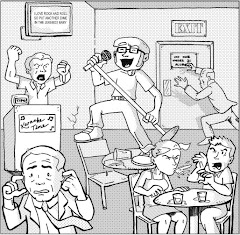
This detail from 1991's Marvel Holiday Special (soon to be reviewed right here!) satirizes the Turtles' popularity at the time.
Flipping through Mirage Studios’ Michelangelo Christmas Special, I’m amazed that Eastman and Laird retained their series’ original look, when I’m sure they could’ve easily sold out and gone mainstream with the most premiere publishing trends of the day. The beginnings of computerized lettering and coloring, higher-end paper stock and cover gimmicks -- these were all at their disposal, but instead this issue, published in ’90 and at a time of years when parents and kids alike are Ninja Turtle fishing, is so meek, it’s almost beneath notice! A minimalist exterior, and all gray-tone interiors . . . You know, for their own safety, the Turtles lived underground, out of sight. Did Eastman and Laird hope to preserve their original creative process by producing comics the same way?
Ironically, in this issue, Michelangelo dons a civilian costume, blends in with the hustling and bustling of the shopping Christmas crowd, and enjoys a day above ground, where he adopts a stray cat and indulges himself in a toy store. Of course, he discovers a ring of toy thieves that has intercepted a truck intended for the local orphanage, so Mickey and his brothers eventually make sure the “Li’l Orphan Alien” dolls make their way to the kids, at the risk of their own exposure. It’s a fun, heart-warming tale with plenty of action, that, in the context of the Turtles’ own popularity as coveted toys, boasts a satirical subtlety, whether or not overtly intentional by its authors.

The back-up yarn starring my favorite Turtle, Raphael, is a bit more baffling, however. Like many other Christmas comics, writer/artist Jim Lawson (second only to Eastman and Laird as the definitive Turtles storyteller) adapts Dickens’ “A Christmas Carol” for one of our heroes, revealing a plethora of proverbial “elseworlds” that result from his outlook on the holidays, and, really, on life. As anticipated, Raph isn’t one for Christmas, he decides to ditch decorating the tree at April’s, and three imposing spirits take him on a walk through time. The first ghost takes Raph (and the readers) to the first Turtles’ tale, when the Foot crashed April’s antique store and nearly killed Leonardo. The second spirit reveals that the guys have resigned to their embittered brother’s disappearances, and the Ghost of Christmas Future prophesizes a bestial Raph living alone in a swamp. Interestingly, in the end, Raphael doesn’t join his brothers merrily, but remains alone in thought -- as if the lesson took but didn’t really persuade. Those shells sure are thick!
What I didn’t like about this tale is how rushed it felt. Lawson told the bare minimum to make “The Christmas Carol” connection, but with thirteen pages, his page layout and the story’s pacing seemed cramped and rushed, respectively. Remember, Raphael is my favorite of the foursome, so maybe I’d just hoped to see more of him. Yet, considering his character is the most dynamic in contrast to the generally joyful holiday season, he offers more of a conflict to explore. I’m sure the eighteen years between this issue and today’s Turtles have explored this dynamic more, if I wasn’t so distracted by toys and movies to actually read the half-shell heroes’ comics!
On the subject of toys, I would like to take this opportunity to talk about some of my Christmas indulgences, especially in light of some recent developments in the action figure collecting community. First of all, the Masters of the Universe franchise is in the midst of its second renaissance in the last ten years; back in 2000, Mattel, with the help of accomplished sculptors the Four Horsemen, modernized He-Man, Skeletor, and Eternia’s supporting cast in the hopes of appealing to old and new fans alike. Unfortunately, despite an engrossing new animated series on Cartoon Network, the toys suffered from the trapping of collectability, with mismatched ratio distributions (i.e. one Mer-Man for every five Skeletors, or something like that) and overwhelming variant editions. Kids were turned off and adult fans were broke and embittered pretty quickly -- especially if you’re still an Evil-Lynn away from completion, like me. Also, while these updated character designs looked great, I thought the figures themselves lacked a certain “playability” in contrast to other, better articulated lines. So, in its sophomore effort, the Masters failed to master their market.
Now, Mattel has decided that the adult collector has the power and has developed an exclusive on-line community featuring better articulated, finely sculpted incarnations of the classic line -- much to my complete delight. I’ve already scored this month’s inaugural He-Man and Beast-Man offerings, with a new figure promised monthly. (A special thanks to my brother for monitoring the Internet the instant the figures became available! I had to work, which goes to show that the responsibilities of adulthood too often trump the persistent delights of youth.) Now, the question is, do I open these figures and play with them, or keep them in their packages to display? I could just as easily open and display them, but if I never touch them, engage them in interactive adventure . . . What’s the point?
I wouldn’t have guessed it, but I’ve recently read some criticism about this direction, that on-line sales threaten to prohibit the line’s success, that reverting to the classic design is a step backward. I’m going on the record here and begging to differ -- Mattel has finally found He-Man’s post ‘80s niche. Simply put, kids aren’t interested in barbarians with ray guns anymore. Consider the more popular franchises of today’s youth -- Pokemon, Yu-Gi-Oh, World of Warcraft. In these worlds, the heroes are passive participants, calling upon other creatures and weaponry to save the day for them. Children can relate to this inability to fight the good fight themselves, and by playing the games affiliated with these new mythologies, become as active in the lore as the very protagonists therein. So, if He-Man is to succeed today, the kids that originally sought him are still his core audience, just grown up into “exclusive collectors.” Now, we have the power!

My pic of the Masters of the Universe Classics He-Man prototype at 2007 San Diego Comic Con.
Yet, He-Man isn’t the only toy-based controversy that has been dancing in my head this holiday season. The latest Justice League Unlimited action figure six-packs are on sale at Target this week, and on Sunday I scoured four local branches for the “Secret Society,” “Apokalips Now,” and “Legends of the League” sets. I found them, but not before I found their boxes -- packed with other figures. Interestingly, the most coveted figures were replaced with previously available ones, with similar features, to boot; for example, the Atomic Skull was replaced with Waverider, who also boasts a translucent flaming head. KGBeast was replaced with the Elongated Man, both of whom have arm accessories. Fortunately, I was keen enough not to buy figures I already own, but the potential origins for this mishap are disturbing. Either collectors are purchasing these sets, pulling the new figures and replacing them with common extras, then returning the sets to Target for their money back, or Mattel is deliberating mis-packaging these boxes to make the new figures more collectible. Either thought is despicable to a simple fan like me, merely interested in having one of every available character. How many sharp kids will be disappointed this Christmas when parents buy the “Secret Society” pack they asked for -- and find a Copperhead where Shadow Thief should be?
Finally, the release of that “Apokalips Now” pack, specifically its inclusion of the character Mantis, has encouraged me to embrace the whims of my inner child and find contemporary counterparts to the action figures I had as a kid. The latest Masters of the Universe line helps, but I also had scattered DC Super Powers and Marvel Secret Wars figures purchased by my folks. Core characters like the Justice League and the Avengers are easy to come by, but baddies like Mantis or Kang are a bit more obscure. Fortunately, Hasbro’s latest Marvel Legends line includes a Kang, so I’m just a modern Magneto short of achieving a renewed version of my childhood collection.
What’s the point, you ask? What’s the point of indulging in comics in the first place? Originally targeting a younger audience, as much as the medium has grown up with its readership, its roots in fantasy and science fiction still appeals to the child in all of us. After all, childhood is in essence the journey to adulthood, the road to becoming something bigger than we already are. Superhero comics replace that need for adults -- having achieved the whole growing up thing -- the need to become something better. Like the Teenage Mutant Ninja Turtles dwelling in the sewers, sometimes the inner child like to dress up like a man and come out to play for awhile. I’ve learned not to toy with his emotions.

This detail from 1991's Marvel Holiday Special (soon to be reviewed right here!) satirizes the Turtles' popularity at the time.
Flipping through Mirage Studios’ Michelangelo Christmas Special, I’m amazed that Eastman and Laird retained their series’ original look, when I’m sure they could’ve easily sold out and gone mainstream with the most premiere publishing trends of the day. The beginnings of computerized lettering and coloring, higher-end paper stock and cover gimmicks -- these were all at their disposal, but instead this issue, published in ’90 and at a time of years when parents and kids alike are Ninja Turtle fishing, is so meek, it’s almost beneath notice! A minimalist exterior, and all gray-tone interiors . . . You know, for their own safety, the Turtles lived underground, out of sight. Did Eastman and Laird hope to preserve their original creative process by producing comics the same way?
Ironically, in this issue, Michelangelo dons a civilian costume, blends in with the hustling and bustling of the shopping Christmas crowd, and enjoys a day above ground, where he adopts a stray cat and indulges himself in a toy store. Of course, he discovers a ring of toy thieves that has intercepted a truck intended for the local orphanage, so Mickey and his brothers eventually make sure the “Li’l Orphan Alien” dolls make their way to the kids, at the risk of their own exposure. It’s a fun, heart-warming tale with plenty of action, that, in the context of the Turtles’ own popularity as coveted toys, boasts a satirical subtlety, whether or not overtly intentional by its authors.

The back-up yarn starring my favorite Turtle, Raphael, is a bit more baffling, however. Like many other Christmas comics, writer/artist Jim Lawson (second only to Eastman and Laird as the definitive Turtles storyteller) adapts Dickens’ “A Christmas Carol” for one of our heroes, revealing a plethora of proverbial “elseworlds” that result from his outlook on the holidays, and, really, on life. As anticipated, Raph isn’t one for Christmas, he decides to ditch decorating the tree at April’s, and three imposing spirits take him on a walk through time. The first ghost takes Raph (and the readers) to the first Turtles’ tale, when the Foot crashed April’s antique store and nearly killed Leonardo. The second spirit reveals that the guys have resigned to their embittered brother’s disappearances, and the Ghost of Christmas Future prophesizes a bestial Raph living alone in a swamp. Interestingly, in the end, Raphael doesn’t join his brothers merrily, but remains alone in thought -- as if the lesson took but didn’t really persuade. Those shells sure are thick!
What I didn’t like about this tale is how rushed it felt. Lawson told the bare minimum to make “The Christmas Carol” connection, but with thirteen pages, his page layout and the story’s pacing seemed cramped and rushed, respectively. Remember, Raphael is my favorite of the foursome, so maybe I’d just hoped to see more of him. Yet, considering his character is the most dynamic in contrast to the generally joyful holiday season, he offers more of a conflict to explore. I’m sure the eighteen years between this issue and today’s Turtles have explored this dynamic more, if I wasn’t so distracted by toys and movies to actually read the half-shell heroes’ comics!
On the subject of toys, I would like to take this opportunity to talk about some of my Christmas indulgences, especially in light of some recent developments in the action figure collecting community. First of all, the Masters of the Universe franchise is in the midst of its second renaissance in the last ten years; back in 2000, Mattel, with the help of accomplished sculptors the Four Horsemen, modernized He-Man, Skeletor, and Eternia’s supporting cast in the hopes of appealing to old and new fans alike. Unfortunately, despite an engrossing new animated series on Cartoon Network, the toys suffered from the trapping of collectability, with mismatched ratio distributions (i.e. one Mer-Man for every five Skeletors, or something like that) and overwhelming variant editions. Kids were turned off and adult fans were broke and embittered pretty quickly -- especially if you’re still an Evil-Lynn away from completion, like me. Also, while these updated character designs looked great, I thought the figures themselves lacked a certain “playability” in contrast to other, better articulated lines. So, in its sophomore effort, the Masters failed to master their market.
Now, Mattel has decided that the adult collector has the power and has developed an exclusive on-line community featuring better articulated, finely sculpted incarnations of the classic line -- much to my complete delight. I’ve already scored this month’s inaugural He-Man and Beast-Man offerings, with a new figure promised monthly. (A special thanks to my brother for monitoring the Internet the instant the figures became available! I had to work, which goes to show that the responsibilities of adulthood too often trump the persistent delights of youth.) Now, the question is, do I open these figures and play with them, or keep them in their packages to display? I could just as easily open and display them, but if I never touch them, engage them in interactive adventure . . . What’s the point?
I wouldn’t have guessed it, but I’ve recently read some criticism about this direction, that on-line sales threaten to prohibit the line’s success, that reverting to the classic design is a step backward. I’m going on the record here and begging to differ -- Mattel has finally found He-Man’s post ‘80s niche. Simply put, kids aren’t interested in barbarians with ray guns anymore. Consider the more popular franchises of today’s youth -- Pokemon, Yu-Gi-Oh, World of Warcraft. In these worlds, the heroes are passive participants, calling upon other creatures and weaponry to save the day for them. Children can relate to this inability to fight the good fight themselves, and by playing the games affiliated with these new mythologies, become as active in the lore as the very protagonists therein. So, if He-Man is to succeed today, the kids that originally sought him are still his core audience, just grown up into “exclusive collectors.” Now, we have the power!

My pic of the Masters of the Universe Classics He-Man prototype at 2007 San Diego Comic Con.
Yet, He-Man isn’t the only toy-based controversy that has been dancing in my head this holiday season. The latest Justice League Unlimited action figure six-packs are on sale at Target this week, and on Sunday I scoured four local branches for the “Secret Society,” “Apokalips Now,” and “Legends of the League” sets. I found them, but not before I found their boxes -- packed with other figures. Interestingly, the most coveted figures were replaced with previously available ones, with similar features, to boot; for example, the Atomic Skull was replaced with Waverider, who also boasts a translucent flaming head. KGBeast was replaced with the Elongated Man, both of whom have arm accessories. Fortunately, I was keen enough not to buy figures I already own, but the potential origins for this mishap are disturbing. Either collectors are purchasing these sets, pulling the new figures and replacing them with common extras, then returning the sets to Target for their money back, or Mattel is deliberating mis-packaging these boxes to make the new figures more collectible. Either thought is despicable to a simple fan like me, merely interested in having one of every available character. How many sharp kids will be disappointed this Christmas when parents buy the “Secret Society” pack they asked for -- and find a Copperhead where Shadow Thief should be?
Finally, the release of that “Apokalips Now” pack, specifically its inclusion of the character Mantis, has encouraged me to embrace the whims of my inner child and find contemporary counterparts to the action figures I had as a kid. The latest Masters of the Universe line helps, but I also had scattered DC Super Powers and Marvel Secret Wars figures purchased by my folks. Core characters like the Justice League and the Avengers are easy to come by, but baddies like Mantis or Kang are a bit more obscure. Fortunately, Hasbro’s latest Marvel Legends line includes a Kang, so I’m just a modern Magneto short of achieving a renewed version of my childhood collection.
What’s the point, you ask? What’s the point of indulging in comics in the first place? Originally targeting a younger audience, as much as the medium has grown up with its readership, its roots in fantasy and science fiction still appeals to the child in all of us. After all, childhood is in essence the journey to adulthood, the road to becoming something bigger than we already are. Superhero comics replace that need for adults -- having achieved the whole growing up thing -- the need to become something better. Like the Teenage Mutant Ninja Turtles dwelling in the sewers, sometimes the inner child like to dress up like a man and come out to play for awhile. I’ve learned not to toy with his emotions.
Tuesday, April 22, 2008
Donatello: Teenage Mutant Ninja Turtle #1
Donatello: Teenage Mutant Ninja Turtle #1, February 1986, Mirage Studios
by Kevin Eastman and Peter Laird
by Kevin Eastman and Peter Laird
Blogger's note: Entry for Friday, April 18, 2008.
Black Panther. Darkseid. The New Gods. Kamandi. These are just a few of the thousands of comic book characters attributed to the creativity of Jack Kirby. Further, for all of the characters that came from Kirby's pen directly, how many more were inspired by his style and originality? Well, I can definitely think of four: the Teenage Mutant Ninja Turtles.
This Donatello one-shot actually explains a lot of things for me. First of all, when I saw the Teenage Mutant Ninja Turtles episode "King" a few years ago, I was both intrigued and confused by its surreal context. In that episode, much like this issue that inspired it, Donatello meets an artist named Kirby, who has bound a magical stone to his pencil and is able to make his drawings come to life for a few seconds. When Don and Kirby stumble into a portal the artist had drawn, they discover a dimension full of Kirby's exotic creations, and they work together to defeat the monsters that have begun attacking the people. Unfortunately, in the end, the portal begins to shrink and only Donatello makes it in time, and though he mourns the loss of his new friend, we're left to assume that Kirby has found a comfortable new home as a god among his creation. Like his note to Don says, "Life at best is bittersweet."
At the time I saw the cartoon, I didn't know there was a twenty-year-old comic book that had inspired it, and my friend and I were just finishing a comic book project of our own, in which an old artist gets lost in a comic book world of his own creation. I thought bitterly that the Turtles had managed to beat us to it. Of course, now I know just how behind the times we were, considering the likes of The Brave and the Bold #124 and other issues like this. Still, while my friend and I sought to explore the logistics of a "real life" comic book universe, Eastman and Laird's foray into extradimensional comic book lands were intended as an homage to the man that inspired their initial collaboration . . . which eventually spawned the world's favorite heroes in a half shell. According to Laird's introduction t his issue, his bond with Kevin Eastman began over a piece of original Kirby art hanging in Laird's office. While I always imagined these two guys playfully sketching in a dark, cramped office, unwittingly building a multi-faceted franchise, I knew much thought about how they got there. It's nice to know that corner piece of the puzzle.
Interestingly, when this issue was published, Jack Kirby was still alive, and when it was adapted into a cartoon some years later, Kirby had passed, so what began as two young artists' love letter to their favorite industry giant inadvertently became two established artists' eulogy for a legend. Either way, the point is clear; a great artist's work can come to life before your very eyes and, more importantly, pull you into his world. It's a place you can both envy and appreciate the man for creating.
Subscribe to:
Posts (Atom)