Finally! "The 12 Days of Comic-mas" is officially the most overdue holiday celebration ever (in writing, anyway), and I'm as eager for it to end as you are! We have a whole new year of graphic goodness to tackle, and with an upcoming President appearing in comic books as frequently as Wolverine guest-starred in every Marvel title from the '90s, we're on the verge of truly experiencing a comic a day in one way or another. Still, first things first: this season's DCU Holiday Special, which, ironically, coincidentally, or both, boasts twelve stories on its table of contents (excluding the beautiful cover by Frank Quitely, and crisp table of contents by letterer Travis Lanham. Since this is the most bountiful anthology I've ever reviewed (not necessarily in page length but in said titled content), I've decided that the most effective way of reviewing this issue is through a succinct "top 12" countdown, like the very twelve days of Christmas that inspired this snail's pace series of entries.
Here we go!
12. "Introduction" -- A splash page featuring the Kents: Ma and Clark greeting a dressed-as-Santa Supergirl at the front door, while in the background Lois and Lana pet Krypto by the tree. I assume writer Sterling Gates simply told artist Karl Kerschl what to draw, and that it didn't sound much different than, "A splash page featuring the Kents: Ma and Clark greeting a dressed-as-Santa Supergirl at the front door, while in the background Lois and Lana pet Krypto by the tree."
11. "The Man in Red" -- Beautifully illustrated by Ivan Reis and Joe Prado, this allegory likens Superman's origins to Santa's, from the powers of flight and "seeing when you are sleeping" via X-ray vision, to the benevolence of selfless do-gooding, to even the arctic hideaway, a parallel I hadn't considered before. Still, this ambitious tale is purely conceptual, and considering its beautiful renderings, I would've appreciated a little more linear substance, i.e. a story.
10. "Somewhere Beyond the Sea" -- Aquaman summons a huge octopus to vanquish some pirates that have tried to hijack a man and his pregnant wife at sea. A good old-fashioned Aquaman story like this would've been a gift in itself, but that the woman's unborn child is somehow royal, and that our hero inadvertently becomes one of the "three kings" paying respect to him, is a holiday twist that pulls off such allegory a little better than the previous tale.
9. "Good King Wenceslas" -- I'll never bad mouth Paul Dini. Ever. But this Batman-oriented fairy tale confused me. Dustin Nguyen's painted artwork is breath-taking, though -- a visual masterpiece that elevates the whole anthology.
8. "A Day Without Sirens" -- Joe Kelly has found another fan in me this year, between I Kill Giants and the potential of Four Eyes. In this short story, Gotham City Police actually experience an entire day without a single 911 call, an initiative advertised by a private party that pull off an emergency-free twenty-four hours. I won't spoil it only to say that the responsible party has a special interest in Gordon's and Batman's happiness. Consequently, I felt some, too.
7. "It's a Wonderful Night" is a cheesy Nightwing/Robin story that seemed a few years behind the times, if not for Tim's grief over the death of his father. Nightwing's Christmas gift for him is lame, something a new Robin would never really need and could frankly see in the Batcave anytime he wanted.
6. "Christmas with the Beetles" -- I've heard of a few comics coming out this year that spotlight or are told from the perspective of villains, and this story kicks off that trend effectively with one thug's family legacy of encountering the Blue Beetle legacy! It's a quaint tale of redemption and intervention, one that addresses the concept that, if heroes experience different incarnation and identities, so must even the lowest of goons. And change could be for the best.
5. "An Angel Told Me" -- In this Huntress story, her alter ego is the real hero. A high school teacher by day, the Huntress decides to guide a bully toward responsibility by taking down his abusive father and supervising his community service, which she swerves to actually serve him. By day, I work with children, too, so I was touched by this story's heart, and the acknowledgement that some heroics can be accomplished without fisticuffs, before nightfall, and after school.
4. "The Night Before Christmas" -- I haven't been following the Teen Titans latest series, let alone their latest roster, so this story, mired in their continuity, starred a bunch of strangers to me. Robin, Wonder Girl, Blue Beetle . . . sure, I know them, but I wonder how influential the Teen Titans relationships really are in comparison to these youngster's respectively solo tales. As apparently easy as it is for the entire DCU to fight a cosmic crisis, try getting something as simple as a romance to transcend a single writer's motivation.
3. "Party Animal" -- This current Justice League tale reads more like a classic Justice League International yarn, thanks in large part to Kevin Maguire's expressive art, but writer Alan Burnett spares no comical expense in detailing the Shaggy Man's happenstance participation in our heroes' annual Christmas party. Simple, fun.
2. "Let There Be Light" struck me as more of a pitch for a solo Dr. Light series than a contribution to a holiday anthology, and I wish it preceded the Justice League story rather than end this otherwise generally enjoyable issue. Not that the story wasn't good, but it wasn't good enough to wrap things up, nor was it comprehensive in spirit or scope. Rodolfo Migliari's photo-realistic art was muddy at times, too, seemingly incomplete at times -- actually pretty dark for a story about light, but that might've been the point I missed.
1. "Ending" -- This issue ends as it began, with a pin-up. From one lookout point in the orbiting Justice League satellite, Superman and Stargirl smile upon Green Lantern and Hawkman, in another wing of the Watchtower. Sans some hanging ribbon and DC's corporate good tidings, the scene is actually pretty creepy . . .
Yet perhaps this page is also indicative of the superhero holiday anthology phenomenon, and how the characters we know and love can only touch upon the spirit of Christmas, watch it from a safe distance, lest one of the two mired mythologies consume the other in a tale of imbalanced fantasy. Superman, Batman, and company are like any family that visit for the holidays; it's great to see them, but after awhile, you just can't wait for them to leave so you can really enjoy the yuletide. Even superheroes can only save the day . . . by flying away!
DCU Holiday Special was published for February 2009 by DC Comics and was written and illustrated by too many talented contributors to list here!
Wednesday, January 14, 2009


The Eleventh Day of Comic-mas: Christmas Pays the Piper!

Christmas is definitely the neediest of holidays. It always needs saving! Threats from thieving grinches or embittered Scrooges plague Christmas almost as much as tidings of comfort and joy! So, when I saw the title to Archibald Saves Christmas, I predicted that the issue would follow the usual formula: villain tries to vanquish the holidays, underdog hero stands against him, villain caves to the overwhelming feelings of good cheer around him. Boy, was I wrong.
Archibald Saves Christmas is actually the first of now several one-shots starring Archibald Aardvark, a down-and-out cartoon star from the earliest days of American animation, when Micky was still a dot-eyed tugboat captain. Archibald was accused of killing his brother/co-star, and as his other co-stars were mysteriously slain, he was driven nuts by the suspicions and apparent conspiracy against him. In this issue, the studio signs Archibald to a new picture with Santa Claus, who rightfully fears for his life but also takes pity on the wayward aardvark. Santa's always been a softy that way.
Archibald is rife with paradox, from its dynamic visuals to the very context of its story. First of all, its plot is at heart a murder mystery and spares no expense in exposing the blood and guts that come with a crime scene. At the same time, its characters are all cutesy cartoons, hailed from the glory days of Disney, Warner Brothers, or Fleischer Studios, complete with a charcoal-style shading indicative of old black-and-white film. Further, despite the title, Archibald is barely lucid enough to save his own career, let alone Christmas. Spoiler alert: Santa dies, and although Archie apparently catches the real killer that has been tormenting his career, Christmas is inexplicably left in the wind. Understandably, the holiday season is just a backdrop for the story and a gimmick to attract readership, no doubt, but I'm still concerned. What person ruled by their inner child wouldn't want to know about the potentially fatal fate of Christmas?
Finally, I feel compelled to keep the culmination of this issue's story a secret, in case folks that haven't read the Archibald series decide to take it on, but I'm genuinely confused by the final panels' "twist." It actually doesn't leave me in any kind of suspense at all, but rather ties things up quite nicely, yet the dialogue implies more to the mystery. Gah, it's hard to explain -- chalk it up to another of the issue's many paradoxes. If someone can shoot me a comment to clarify, I'd appreciate it. You'd save my Christmas, at the very least.
Overall, Archibald Saves Christmas is a fun issue that kicks off an undoubtedly fun series of one-shots, and you haven't seen cartoon characters this "real" since Top Shelf's Three Fingers, which in tone is practically a companion piece. In spite of my inner child's old flights of fancy, I'm glad old cartoon characters like these don't inhabit our world. TMZ has already proven we can barely contain human celebrities! An aardvark with a murder rap stumbling out of the Ivy? That would just beat all, folks.
Archibald Saves Christmas was published in December 2007 by Image Comics and was written by Dwight L. MacPherson, illustrated by Grant Bond, and lettered by Jason Hanley.
Tuesday, January 13, 2009
The Tenth Day of Comic-mas: Terror Learns a Lesson!
Christmas isn't a holiday void of fear. Shoppers desperately scrambling for the perfect gift, families frantically cleaning their homes for the big dinner, children staying up Christmas Eve night with their fingers crossed . . . behaviors all rooted in fear. Fear of failure, fear of criticism, fear of disappointment. Everybody can relate to at least one of those fears, and most can probably add to the list. Consider the characters in this special holiday issue of Terror Inc.
In Terror Inc., a mob informant on death row is afraid his family will experience the holidays without him, so he hires Terror to utilize a few of his posthumous body parts and create a final Christmas memory. Huh? Apparently, Terror is a creature that can attach others' body parts to his and experience their skills and memories -- which comes in handy when the mob tries to capture the informant's family, and Terror uses that failed Olympic track star's legs to race them down, and that circus bearded lady's whiskers to disguise himself as Santa Claus. In the end, the typically greedy, naturally creepy Terror softens up a bit, bringing down the mob and giving the informant's family something to remember him by, in the form of holiday origami figurines about the house. It's the warmest feeling a comic book like this can offer its readers, I suppose, particularly at Christmastime.
I pulled Terror Inc. #8 from a discount bin several months ago, drawn to its twisted holiday imagery, not to mention the clever cover blurb: "You'd better not shout, you'd better not cry, you'd better not pout, get ready to die . . ." I'd never heard of Terror, though, so I was grateful for the classic Marvel-style exposition that somehow incorporates the title character's powers or origins into the natural dialogue of the story. The ability to take and use body parts is Frankenstein-esque in its appeal, but Terror himself is pretty peculiar looking, his face adorned with these odd whiskers that demand as much explanation as his abilities, but they're still a mystery to me. Since he teeters the border between life and death . . . are they for balance?
Fortunately, this issue was well balanced, between the semblance of holiday nostalgia it sought to evoke while also offering the right amount of carnage its faithful readers undoubtedly expected from its monthly installments. Oh, no, not that Carnage, who was just rising to popularity in Amazing Spider-man -- but Terror Inc. apparently does tether itself to the Marvel Universe with a Wolverine team-up next issue. If I ever see that ish, I'll consider picking it up, to see how a gruesome hero like Terror finds his place in the Marvel Universe. Obviously, he isn't around anymore . . . but considering the recent trend to resurrect apparently failed or C-list characters in both the DC and Marvel realms, I wouldn't be surprised if we see him again.
Fear has a way of doing that. Even during the most wonderful time of the year, terror always finds a way to rear its ugly head.
Terror Inc. #8 was published in February 1993 by Marvel Comics and was written by D.G. Chichester, illustrated by Horacio Ottolini, lettered by Steve Dutro and Rick Parker, and colored by Steve Buccellato.
Sunday, January 11, 2009
The Ninth Day of Comic-mas: Fine Ladies for Ransom!
By most standards, Claus #1 is not a really good comic book. The script is long-winded and plagued with melodrama and flat humor, the art is amateurish and lacks the dynamic inking its ambitions dimensions demand, and the digital effects are comparable to something generated in a Microsoft Publisher basics course. To its credit, the issue is published on nice paper and well bound . . .! I'm usually not this critical of comics I dislike, and in fact the negativity ends there, but I don't think the harshness is out of line since this issue is eleven years old and surely its contributors have developed as artists by now. No, just as Claus himself puts most of his efforts in the good list rather than the bad, I do want to focus on this story's strengths, because it certainly does have a few . . .
. . . namely, its contributions to the Santa Claus legend. Most comic books starring the Jolly One attempt to add something to Santa's fantastic story, from Paul Dini's creation of St. Nick's daughter Jingle Belle, to DC's latest holiday special aligning his origin to Superman's -- a rather confusing tale in its allegorical parallels, actually, because I'm not sure what doomed icy alien planet Father Christmas is really from. Thankfully, Claus opts to focus on Santa's current digs in the North Pole, specifically the fact that, if inherently good, fantasy-oriented characters like St. Nick exist, evil ones do, too, and further that those baddies would be out for Santa's powerful resources for their own ends. In this case, a band of militant orcs storm Santa's village and demand he use his mass-production resources to make guns and other weapons. Take that, Saddam!
Also, when the orcs infiltrate Santa's shop, they manhandle Mrs. Claus, who in this incarnation is not the frumpy homebody most holiday tales make her out to be. Artist John Kennedy Bowden draws every woman in this issue like a ten, from the scientist excavating in the North Pole near the Claus residence, to Mrs. Claus herself, to even an ice sculpture Frosty the Snowman tries to hit on. Interestingly, and the funniest part of the issue albeit most likely unintentionally, the missus still calls Santa "Papa," like in those cartoons of old, adding a whole new dimension to the phrase "Sugar Daddy," assuming Santa really likes his cookies. Further, the Draco Comics logo is basically a naked lady holding a gun, which reinforces the company's slogan on this issue's back cover: "The comic book your mother did not want you to read!" I can certainly appreciate an indie publisher's attempt to corner a definitively adult market, but the overtly sexual imagery is too insistent -- perhaps the butt of its own joke.
Okay, so I had one more point of criticism. Let it be recorded that I expressed this issue's potential, that the concept and story in themselves were interesting . . . and who doesn't want to see Frosty and Rudolph kicking a little tail to save Christmas? We were raised on this imagery, and while it was much more innocent when we were kids, I don't blame Draco for trying to mature the material with its audience, even at the risk of its own peril. As I mentioned earlier, I'm interested in how these artists have matured since Claus, too. Who knows? They might yet make my "nice list."
Claus #1 was published in December 1997 by Draco Comics and was written and illustrated by John Kennedy Bowden.
The Eighth Day of Comic-mas: Milking What Makes a Hero
What if you could get super powers for Christmas? No, I don't mean the '80s toy line (though that would still be pretty cool), but rather real-life super powers, distributed by a fringe scientific laboratory specializing in nano-technology? Enter the Power & Glory Holiday Special. In it, Plex/Biomatrix, the organization responsible for giving the world a real superhero in A-pex, "the American Powerhouse," raffles off an opportunity to be a similar superhero for a week, and just our luck, a religious fanatic wins. Only in America!
If that doesn't say "Christmas" enough, Epiphany St. McMiracle (yes, that's her name) leads the First Church of the Internet -- I wonder if its high holy holiday is Cyber Monday -- and after a week's worth of temple-constructing (which beats the old car wash method of raising building funds!), she decides to skip the powering-down process and keep her new abilities . . . like we couldn't see that coming. Just like a spoiled brat on Christmas morn, she refuses to share, and the token fight between her and corporate vigilante Michael Gorski ensues. Fortunately, the scientists that created the super nano-bots weren't dumb enough to overlook the need for a fail safe -- a clever little lyric that disbands McMiracle's molecular structure for good. It's definitely the "ew" moment of the season.
I've never read Power & Glory before, so I can't tell if the tone of its holiday special is the norm for this series (or if I understand the characters' role correctly), but I rather enjoyed the heavy context of this issue's story in contrast to its light-hearted, even satirical tone. From Plex/Biomatrix's marketing of the super-lottery, to the page interviewing celebrities on what they'd do with powers (Nixon's is the best: "If I were super, I'd still be here."), to Gorski's pontifications on the dangers of religion -- this issue tackles a topic world-shattering in proportion and boils it down to social commentary and superhero spectacle, all with an air of holiday cheer. And while there's nothing overtly Christmas about the whole thing, the pomp in contrast to this story's circumstance is enough to maintain a semblance of good cheer even in the midst of potential cyber-religious terrorism.
So, what's the moral of this little holiday parable? Well, super powers are only half of what makes a super hero, of course. I mean, geez, it's already over three weeks after Christmas, and how many of your new toys have you broken, lost, or exchanged for store credit? (I've almost lost my new mp3 player twice!) How responsible would any of us be with flight, or super strength? Keep the power . . . it's not worth the glory!
Power & Glory Holiday Special was published in December 1994 by Malibu Comics and was written and illustrated by Howard Chaykin, lettered by Ken Bruzenak, and colored by Bu' Tones.
Monday, January 05, 2009
The Seventh Day of Comic-mas: Frankensteins A' Dini!
Oh, I know what you're thinking: "Finishing your supposed '12 Days of Comic-mas' is an exercise in futility now! Christmas came and went two weeks ago! Let it go!" Ah, Christmas itself may be nothing more than a 90% clearance sale at Target now, but the 12 days of Christmas ended a mere two days ago, on the holiday known as the Epiphany, or Little Christmas. The 12 days of Christmas actually begin on Christmas Day and countdown to January 6, the day many religions celebrate the three wise men's arrival to that infamous manger, and their gift-giving to the little baby Jesus. So, if anybody really is keeping track, I was a good five posts early, and now just a mere six posts behind . . . which isn't really different than pivoting around December 25 anyway. Oh, just grant me the New Year's guilty pleasure of prolonging the holiday season as long as possible, okay? Who says you can't resurrect the most wonderful time of the year . . . any time of year?
Speaking of resurrection, the latest Christmas comic book I've read was also the latest installment in Paul Dini's annual adventures of Santa Claus's little known daughter Jingle Belle. Santa vs. Frankenstein is a light-hearted one-shot that takes a stab at the recent "holiday crossover" phenomenon, perhaps best known from the Tim Burton film The Nightmare Before Christmas. While Halloween isn't mentioned overtly, Frankenstein is undoubtedly a mascot for the hallowed holiday, capturing its haunting spirit. Further, Jing's best friend is Polly Green, the self-appointed "official witch of Halloween," so what's a few months between pals? No, Dini was right to bring the two seemingly contrasting mythologies together. Think about the way we teach the holidays to children, the way we maintain and illustrate holiday tradition; we've essentially asserted that a realm of fantastic characters work parallel to our year, ringing in the new year, then making people fall in love, then granted folks good luck, etc. Why wouldn't these characters work in concert? Heck, we're lucky they haven't unionized and gone on strike! How would a Santa scab hit all those homes on Christmas night?
In Santa vs. Frankenstein, the real St. Nick is facing a similar dilemma, his output distracted by an anti-Santa special interest group making a successful effort to ban the jolly old elf from Christmas! If only his daughter were at her sock monkey assembly line, and not whimsically skiing, where she stumbles onto the frozen form of the Frankenstein monster! She brings the goliath home, where Santa makes the wayward weirdo feel welcome by putting him in charge of assembling goth toys. When Franky discovers the anti-Santa plot, he relates the torch-wielding conspiracy and attempts to foil it, inadvertently giving St. Nick a chance to publicly fight "a monster" and save the day. It's a win-win, as both Santa Claus and Frankenstein reinforce a world friendly to these figureheads of fantasy.
Paul Dini's writing is both jovial and poignant when necessary, and his love for old animation is obvious through artist Stephanie Gladden's traditional stylings. Paul Dini has influenced some of my favorite franchises, from Masters of the Universe to of course Batman: The Animated Series, and his ability to contribute to both the Christmas and Frankenstein mythologies is not only no surprise, but a pleasant holiday treat, to boot. Interestingly, based on his back-page essay, this issue launches his "Dinicartoons" imprint, a subset of Top Cow Productions featuring titles by Dini and his fellow favorite writers and artists. I'm actually surprised that he took this long to accept such an offer, that his ability to spearhead franchises didn't inspire him to create his own until now. Still, you know the old saying . . . and when it comes to a monster like Frankenstein finding a home or a little ol' blogger like me wrapping up a Christmas series, it certainly applies . . .
Better late than never.
Jingle Belle: Santa vs. Frankenstein was pubished in December 2008 by Image Comics and was written by Paul Dini, illustrated by Stephanie Gladden, colored by Felix Serrano, and lettered by Troy Peteri.
Sunday, January 04, 2009
The Sixth Day of Comic-mas: Sick Secret Santas!
Made-for-television Christmas specials are a holiday season staple, from stop-motion animation classics like Rudolph the Red-Nosed Reindeer to more traditionally animated shorts like A Charlie Brown Christmas. Considering how quickly these specials and their featured characters have become household names in the grand scheme of holiday mythology, it makes sense that other similarly popular characters would try to make their impression during Christmastime -- characters like the Powerpuff Girls with their 'Twas the Fight Before Christmas, or Batman in the recent The Brave and the Bold episode "Invasion of the Secret Santas!" Originally aired on December 12, the episode has been saved in my girlfriend's TiVo since, and I recently watched it again with her . . . which became a gift in itself, as the show introduced her to aspects of the DC Universe she'd never otherwise experience.
So, yes, I'm going to review "Invasion of the Secret Santas!" for my patented Twelve Days of Comic-mas. I know it's not a comic book, but it's a definitively comic-based property, and I don't mind braving the deviation. Heh.
First of all, I think I've seen every The Brave and the Bold episode so far (thanks to the aforementioned TiVo), and I've enjoyed the series' campy look -- a welcome alternative to the Dark Knight's other most recent animated incarnation, The Batman. While that show set the new standard for rockin' opening credits sequence, even riffing the Adam West "biff"/"pow" effects via electric guitar, it suffered from comparisons to its beloved predecessor, Batman: The Animated Series, whose continuity ran concurrent to The Batman through Justice League Unlimited anyway, thus perpetually overshadowing it. In my opinion, The Batman's greatest nemesis was its inconsistency between kid-friendly, action-oriented stories and its shallow attempts at continuity-oriented character development, two aims not necessarily exclusive but difficult to balance in any given twenty-two minute Saturday morning cartoon. In the end, The Batman was really just a commercial for new character designs and related franchising, relegated to waiting for Robin until Teen Titans was canceled then hastily introducing a Justice League to follow in its older brother's footsteps, to no avail.
But this really has nothing to do with The Brave and the Bold, if only to contrast that this newer series has shed the skin of any preceding molds and has found the balance between appealing to kids by embracing the Batman camp of the Silver Age, and beckoning to fans with DC's B- and C-list heroes. (Interesting, the recent "Batman: R.I.P." arc mined old presumably forsaken Silver Age material, too, though not necessarily in a kid-friendly way.) This is the magic of watching Etrigan the Demon brawling with knights and dragons. Further, the series' format essentially grants viewers two adventures, a brief brawl prior to the opening credits, then a more developed plot afterward. In "Invasions of the Secret Santas," viewers see Batman and Blue Beetle best the Sportsmaster, then the Dark Knight and Red Tornado take down the toy-mastering Funhouse (apparently actually spelled "Fun Haus," but I'm going phonetically, here). Talk about playing to a child's short attention span!
Further, enter: my girlfriend's exposure to the DC Universe, in all its inconsistently campy glory. "The Sportsmaster is a weird idea for a character," she mused as we watched the baddie trap competitive bowlers in big, clear pin-shaped cages. After Bats and the new Blue Beetle take down the jerky jock, the real tale unfolds, featuring the original Red Tornado as he explores the holiday spirit, and Batman regretfully reminiscing his spoiled childhood during Christmastime, as the villainous Funhouse infiltrates homes across the city with little sentient, jewelry-stealing action figures. (What's the difference between his scheme and the twelve bucks I'm paying for Mattel's DC Universe Classics at Wal-Mart? Highway robbery, either way!) Red Tornado's rigidity and characteristically robotic voice offers some comic relief (my girlfriend mentioned her amusement about him the next day, so the gags stuck!), yet a shadow looms over this episode, as viewers see the infamous Crime Alley flashback, obscured for youngsters' sake by the darkness of the alley, yet ironically more ominous and tragic in its ambiguity. Hence, my claim toward DC's inconsistency, which in this case isn't a bad thing at all. A show parents can watch with their kids, and that adult, fanboyfriends* can inflict on their girlfriends? That's pretty bold, considering the dichotomy of today's television.
So, in twenty-two minutes, my girlfriend unwittingly found herself exposed to such new glossary terms as "Ulthoon" and "S.T.A.R. Labs," right alongside familiar imagery like Christmas trees and Santa Claus. The holiday spirit storms your home front every year through the television, really whether you like it or not. The comic book goodness I've loved for years has finally taken the same front, in this case hidden in pretty Christmas wrapping paper for the unsuspecting child in all of us. The Santas have truly invaded.
* Fanboyfriend (noun): a favored male companion obsessed with comic books, toys, video games, et al.
The term has been loosely used on-line, but not yet clearly defined. My New Year's gift to pop culture speak.
Friday, December 26, 2008
The Fifth Day of Comic-mas: Five Gory Things
Yes, "the twelve days of comic-mas" isn't moving along nearly as fast as the actually holiday season is, but I've been distracted by another holiday countdown: my twelve nights of consecutive karaoke. I'm determined to finish these reviews, though, and I've given myself until New Year's Day to do so. Heck, if you follow some religious traditions, Christmas doesn't technically end until January 6, dubbed Little Christmas, which honors the arrival of the Wise Men. I hope it doesn't come to that, but if so thank the Catholics for their thorough celebrations. Moving on . . .
 For children and geeks alike, toys are a critical part of the Christmas holiday. When I was a child, I anxiously awaited the army of action figures that waited for me under the tree, and some twenty-five years later, my wish list hasn't changed a bit: Green Lantern, Aquaman, He-Man, Beast-Man. The figures have changed quite a bit, though -- from the old, practically-bound-by-rubber bands Masters of the Universe guys to the new, finely sculpted and articulated Matty Collector line, or from the old "squeeze my legs" Super Powers to the new DC Universe Classics. Also, the rite of acquisition has changed; my mother doesn't comb department store aisles for these figure anymore, but opts to give the cash and the deed to that hunt, which is just as well, considering the Target or Wal-Mart exclusivity of these toys. Now, rather than run downstairs to the Christmas tree, I'm running to the toy aisle at Target, but that eager feeling is just the same.
 So, ACG's Christmas Horror special resonates more so than usual, as its cover depicts a creepy Santa unloading severed heads from his sack, and its contents feature four stories of creepy toys. Children often dream of intercepting Santa, and this cover image twists it to represent an issue of harrowing potential. Thankfully, the stories don't disappoint, though I am confused as to whether the material is new or reprinted, since its production quality is relatively low, rife with muddied lettering and/or shading. Either way, if the effect is intended to mimic pre-Comics Code horror, or if these tales were dug up from genuinely classic anthologies, bravo. I'm sure a brief Internet search would reveal the truth, but the mystery is just as enjoyable -- which is what keeps most kids from spying on Santa in the first place.
I should also note that many of these tales reminded me of the classic Twilight Zone episode "Living Doll" starring Teddy Savalas. It's definitely one of the series' best; look it up if you haven't seen it.
To sum up these terrifying tales of holiday horror: The first features a kid that thwarts an airplane hijacking by bringing his action figures to life. In what seems like The Indian and the Cupboard on acid, the terrorists are picked off by the likes of an incarnated pirate, caveman, knight, and the like. In the end, the child is revealed as death itself -- a cop out of a twist, but it isn't the end of this story the reader is meant to enjoy, but the means.
In "Terrible Teddy," a bank robber accidentally runs over and kills a boy on his pursuit from the police, but before the fuzz can catch him, the child's tattered teddy bear does the burglar in, first by way of the crook's own paranoia, then with fangs, claws, and good old fashioned revenge-fueled malling. Where was "My Buddy" when those kids picked on me in elementary school, eh?
"The Thing Some Kids Dream Up!" is the most ambitious and elusive of the issue's stories, since the cause of its fright isn't rightly explained, if only through the motivations of the supernatural. Instead, this is the simply a story of a child's nightmares made manifest, then of his own bravery in defeating them when his father steps into the crossfire. Its illustrations were also different than the others, the line work more crisp and less characteristic of a traditional classic.
Finally, the last of the four stories also stars a teddy bear, one direly devoted to its childish master. In this case, the teddy becomes the presumably imaginary friend to the neglected child of wealthy parents, and when the butlers implements the girl's abduction and attempted ransom, the bear strikes! In her sudden absence, the parents also realize their faults and vow to become better parents, and the bear . . . well, it finds another child to "save." The open-ended nature of this tale is the best way to end the issue overall.
Interestingly, only that last yarn has an element of Christmas in it; the others simply boasts influential, haunted toys. Again, though, it's the cover that ties it all together, transporting the mind back to that first moment under the Christmas tree. Heck, think about the way you approached those gifts, eager to rip open the wrapping . . . filling the room with the sounds of that tearing, then casting one gift aside with a hungry drive to get to the next . . . those precious childhood Christmas mornings are just as savage and violent as the stuff of a horror story! That the beast still dwells inside some of us, and prowls unsuspected department store aisles . . . beware those that stand between me and the DC Universe Classics Batman Beyond . . .!
Christmas Horror was published by Avalon Communications in 1999 and features the talents of Mike Zeck, Joe Molloy, Joe Gill, Pat Boyette, Nicola Cutti, Jack Abel, and others.
Monday, December 22, 2008
The Fourth Day of Comic-mas: The Fantastic Four Calling
Now that we know how the Punisher's Christmas went (in a word, badly), how does the rest of the Marvel Universe celebrate this merriest of holidays? Well, if the 2005 Marvel Holiday Special is any indication, they celebrate it together; after all, before any civil wars or Skrull invasions, the Marvel Universe began with a family, the Fantastic Four. Appropriately, the Storms star in two of the three tales in this issue, sandwiching a New Avengers story that boasts more heart than necessary. But every issue begins with its cover, and I just have to say . . .

Stuart Immonen offers a crisp, festive image of Spider-man and the Fantastic Four decorating a Christmas tree, the Thing hoisting it up, and Reed stretching to its top with a luminous star . . . but Johnny is garnishing the shrub with . . . flame? Uhm, most folks do their darnedest to avoid setting their trees on fire! His sister is adorning the branches with . . . invisible ornaments? Er, sure -- the next time I bring a tree home, I'm going to leave it be and tell everyone to enjoy my decor courtesy the Baxter building. Of course, Spidey is stringing up with patented web-balls (oh, grow up people), which is fine considering the source, but generally a web-covered tree isn't one you want, unless the nursery offers a pre-purchase bug extermination. So, long story short, while the illustration definitely captures the Christmas spirit, it practices very little practicality. Of course, superheroes are used to crises, so what's a scorched tree compared to, say, a city-wide Santa-napping epidemic?
Such is the plight of Marvel's first family, as the Mole Man's Moloids kidnap mall Santas around the city in an attempt to find their missing master, who uttered St. Nick's name before his sudden disappearance. While Reed, Sue, and Johnny are content tracking down the Moloids' lair for a good old fashioned Christmas clobbering, Ben embraces the spirit of the season and pursues a more civil solution. His detective work uncovers the Mole Man's grandmother, who reveals that the villain's grandfather dressed as Santa during the holidays -- a grandfather with distinctly arched, Namor-like eyebrows. The Thing recruits the sea king to help him appease the Moloids, assuring peace on earth for all above and below the earth . . . but what of Mole Man himself? The catalyst of this tale rests on a splash page gag that fell flat with me, since Christmas comics are usually throw-away one-shots anyway.
The following story, a New Avengers story, embodies the other side of that coin, as a wayward Stark Industries scientist uses an old Ultron husk to create a real-life Santa -- a Santron -- with dangerous results. Before the fight before Christmas, the Avengers banter with ongoing gags about kissing Spider-Woman under the mistletoe and refusing B-listers like Gravity their invitation to the party, then Santron comes down the chimney. Spidey and Ant-Man concoct an awesome scheme to trick the Kringle-bot into submission, and its memory banks reveal its creator -- enter the overwhelming, unnecessary holiday-infused origin, in which that Stark scientist scorns Santa's falsehood and invests her own tangible alternative. What the story took a page to explore, a single caption of emotional inner monologue would've accomplished just as effectively. Ah, well, if the holidays are about anything else, it's overindulgence.
Which explains the third story, which uses a more traditional storytelling technique, namely the rhyming scheme of a carol or nursery rhyme, to tell the same tale we'd just read two times already -- the villainous act justified by the holiday spirit, thus excused by the superheroes that made everything okay. In this case, the Fantastic Four thwart their old, presumably reformed foe the Hurricane in the midst of his stealing toys for his poor kids; again, the Thing asserts compassion, but the tale makes little effort to offer that any of the heroes actually compensated the store for the few items that caught the eye of the Hurricane. Now, that's one way to beat the Black Friday crowd: just break in to your local department store on Christmas Eve!
Of course, these criticisms are intended with as much good humor as these yarns themselves; watching our favorite superheroes celebrate the holidays humanizes these icons. Whereas we geeks fantasize what it's like to be like them, in this case we get to watch them act like us, stressed about shopping and Christmas parties, frustrated by the plights of those less fortunate, generally wishing the best tidings for all around us. If only everyone had family that could make themselves invisible from time to time . . .!
Marvel Holiday Special #7 was published for February 2006 by Marvel Comics and is by Mike Carey, Mike Perkins, Laura Martin, Dave Lanphear, Jeff Parker, Reilly Brown, Pat Davidson, Christina Strain, Shaenon Garrity, Roger Langridge, Al Gordon, and Sotocolor's J. Brown.
Monday, December 08, 2008
The Third Day of Comic-mas: Three Franks Hence
The release of The Punisher Xmas Special two weeks ago and Punisher: War Zone in theaters that Friday definitely put the red back in the red and green decor of the Christmas season, and I'm just talking about all the blood spatter. Punisher: War Zone didn't even make the top five movies of the weekend, and as an opening movie, that's sadly disheartening. Now, it's become the third least grossing Marvel film, behind Howard the Duck and Elektra. I saw War Zone at its first midnight showing, which I try to do for every mainstream cinematic comic book adaptation, so my initial impression was clouded by fatigue. Awake and aware now, I confess that I really liked the flick . . . and apparently I'm in the minority.
Back up. Punisher: War Zone suffers from the recently dubbed "requel" syndrome -- it expands an established franchise without acknowledgement of, and makes a subtle effort to redo, previously established material. Batman Begins did this, The Incredible Hulk did this, and this film does, too, all with good reason. Regarding Batman and the Hulk, both characters had experienced so many different on-screen incarnations that screenwriters and directors, like Tim Burton and Ang Lee, felt little reservation for putting their own spin on their adaptations. While the result is a movie that best captures the director's style, it also becomes a dated representation of the character, like all the rest. However, the Punisher benefits from a little discontinuity between films, because he is essentially an one-dimensional character. He shoots bad guys. The end. Why have three Punisher films to date if the story is basically the same, if not to allow different directors their take at the anti-hero?
Now, I've never seen the Dolph Lundgren Punisher, but I've heard things. Personally, I had my fill of Dolph in Masters of the Universe, and my inner child, as disappointed as even he was in that movie, can't accept He-Man playing Frank Castle. So, the Thomas Jane vehicle of a few years ago was my first on-screen Punisher, and, while I wasn't disappointed, I did find a few fanboy-nagging flaws with the film. I was grateful for the mining of Garth Ennis' Welcome Back, Frank, but I couldn't swallow the tropical Florida setting. Also, Jane's Punisher suffered from B-list actor syndrome -- when a better established actor is cast as the villain. (Nicholson's Joker is the classic example; on the 1989 Batman movie posters, his name trumps Keaton's, and Keaton is the hero, the title character!) While we see familiar faces like the Russian and Spacker Dave, they take a backseat to the Punisher's foe, whose familiar face is, well, John Travolta, which disconnected me from the film every time he appeared on screen. Finally, the Punisher uses a bow and arrow. I know his arsenal is extensive, but when that shot was one of the movie's first promo stills, I was ill at ease. Call me shallow.
Enter Punisher: War Zone, which I think became a requel when Jane pulled out of the project, and all the better at least for my little qualms with its predecessor. In this incarnations, we're spared the origin story and instead see the Castles' killings via flashback -- thankfully, in Central Park where it belongs. Yes, welcome back, Frank, indeed . . . to New York, to supporting characters like Microchip and Detective Soap, to a familiar nemesis like Jigsaw. Sure, the violence was campy, but I don't know why fans of films like From Dust 'Til Dawn wouldn't dig it. Sure, Dominic West's performance was over the top (the best comparison I read on a message board likened West's Jigsaw to Tommy Lee Jones' Two-Face), but the things he says are comparable with any funnybook foe on a vengeful tirade. I'm truly perplexed why War Zone didn't have a similar opening weekend to the likes of Daredevil or Ghost Rider? While all Marvel movies are not equal in quality and storytelling ability, aren't all Marvel fans at least willing to give them an equal chance?
Of course, the most beloved incarnation of Frank Castle remains in his native comics, yet even that original Punisher has experienced experimentation for popularity's sake. Remember when Punny died and came back as a spirit of vengeance? Consider Hollywood's challenge, sifting through decades' worth of material to create ninety minutes that both consolidate the character's essence for longtime fans yet capture a new audience with a fresh appeal, too. I can imagine a similar challenge for the one writing Punisher's annual Christmas special, since the holiday one-shot appeals to holiday-spirited fanboys like me, vaguely familiar with Castle's roots, along with those regular readers. At this point, I suppose the Punisher Max Xmas Special has been categorically more successful than the film that followed. By way of body count, Frank is the gift that keeps on giving.
I actually anticipated the Punisher Max Xmas Special some weeks ago when I saw preview pages up at Comic Book Resources. Roland Boschi's art is gritty and energetic, and when I read the story's synopsis, I had high hopes for its potential for allegory. My wishes were fulfilled, as Punisher strives to deliver a baby in the crosshairs of a gang war, in a Herod-like attempt to eradicate the son of a premiere crime family. Of course the Punisher takes the expectant parents to a manger (in a race track, but still), where, despite (or because of) the birth of their innocent baby, they get their just desserts, too. It's a fast-paced tale rife with violence and holiday symbolism -- in other words, it's the most wonderful time of the year.
Not so much for Marvel cinema. MSN has an article about the future of comic book adaptations, and whether or not the future is bright. Please. The Punisher has killed a lot of things, but comic book film adaptations aren't one of them -- in any incarnation.
Punisher MAX Christmas Special was published by Marvel Comics for February 2009 and was written by Jason Aaron, illustrated by Roland Boschi, colored by Daniel Brown, and lettered by VC's Cory Petit.
Thursday, December 04, 2008
The Second Day of Comic-mas: Two Turtles’ Woes
By 1990, the Teenage Mutant Ninja Turtles easily usurped the Masters of the Universe as my action figure line of choice. As toy packages often demand, I scrambled to “collect them all!” Christmas was a pivotal time of year to achieve this goal, as long as my parents and grandparents understood where to find a “Mutagen Man.” Of course, fellow fanboys recognize the early ‘90s as the Golden Age of TMNT mania, with the live action film, beloved cartoon series, and all avenues of franchising thrusting our heroes out of their shell and into America’s hearts. To think, it all started as an independent comic book . . .

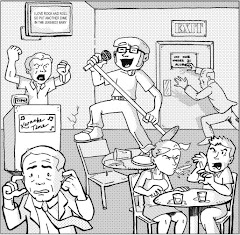
This detail from 1991's Marvel Holiday Special (soon to be reviewed right here!) satirizes the Turtles' popularity at the time.
Flipping through Mirage Studios’ Michelangelo Christmas Special, I’m amazed that Eastman and Laird retained their series’ original look, when I’m sure they could’ve easily sold out and gone mainstream with the most premiere publishing trends of the day. The beginnings of computerized lettering and coloring, higher-end paper stock and cover gimmicks -- these were all at their disposal, but instead this issue, published in ’90 and at a time of years when parents and kids alike are Ninja Turtle fishing, is so meek, it’s almost beneath notice! A minimalist exterior, and all gray-tone interiors . . . You know, for their own safety, the Turtles lived underground, out of sight. Did Eastman and Laird hope to preserve their original creative process by producing comics the same way?
Ironically, in this issue, Michelangelo dons a civilian costume, blends in with the hustling and bustling of the shopping Christmas crowd, and enjoys a day above ground, where he adopts a stray cat and indulges himself in a toy store. Of course, he discovers a ring of toy thieves that has intercepted a truck intended for the local orphanage, so Mickey and his brothers eventually make sure the “Li’l Orphan Alien” dolls make their way to the kids, at the risk of their own exposure. It’s a fun, heart-warming tale with plenty of action, that, in the context of the Turtles’ own popularity as coveted toys, boasts a satirical subtlety, whether or not overtly intentional by its authors.

The back-up yarn starring my favorite Turtle, Raphael, is a bit more baffling, however. Like many other Christmas comics, writer/artist Jim Lawson (second only to Eastman and Laird as the definitive Turtles storyteller) adapts Dickens’ “A Christmas Carol” for one of our heroes, revealing a plethora of proverbial “elseworlds” that result from his outlook on the holidays, and, really, on life. As anticipated, Raph isn’t one for Christmas, he decides to ditch decorating the tree at April’s, and three imposing spirits take him on a walk through time. The first ghost takes Raph (and the readers) to the first Turtles’ tale, when the Foot crashed April’s antique store and nearly killed Leonardo. The second spirit reveals that the guys have resigned to their embittered brother’s disappearances, and the Ghost of Christmas Future prophesizes a bestial Raph living alone in a swamp. Interestingly, in the end, Raphael doesn’t join his brothers merrily, but remains alone in thought -- as if the lesson took but didn’t really persuade. Those shells sure are thick!
What I didn’t like about this tale is how rushed it felt. Lawson told the bare minimum to make “The Christmas Carol” connection, but with thirteen pages, his page layout and the story’s pacing seemed cramped and rushed, respectively. Remember, Raphael is my favorite of the foursome, so maybe I’d just hoped to see more of him. Yet, considering his character is the most dynamic in contrast to the generally joyful holiday season, he offers more of a conflict to explore. I’m sure the eighteen years between this issue and today’s Turtles have explored this dynamic more, if I wasn’t so distracted by toys and movies to actually read the half-shell heroes’ comics!
On the subject of toys, I would like to take this opportunity to talk about some of my Christmas indulgences, especially in light of some recent developments in the action figure collecting community. First of all, the Masters of the Universe franchise is in the midst of its second renaissance in the last ten years; back in 2000, Mattel, with the help of accomplished sculptors the Four Horsemen, modernized He-Man, Skeletor, and Eternia’s supporting cast in the hopes of appealing to old and new fans alike. Unfortunately, despite an engrossing new animated series on Cartoon Network, the toys suffered from the trapping of collectability, with mismatched ratio distributions (i.e. one Mer-Man for every five Skeletors, or something like that) and overwhelming variant editions. Kids were turned off and adult fans were broke and embittered pretty quickly -- especially if you’re still an Evil-Lynn away from completion, like me. Also, while these updated character designs looked great, I thought the figures themselves lacked a certain “playability” in contrast to other, better articulated lines. So, in its sophomore effort, the Masters failed to master their market.
Now, Mattel has decided that the adult collector has the power and has developed an exclusive on-line community featuring better articulated, finely sculpted incarnations of the classic line -- much to my complete delight. I’ve already scored this month’s inaugural He-Man and Beast-Man offerings, with a new figure promised monthly. (A special thanks to my brother for monitoring the Internet the instant the figures became available! I had to work, which goes to show that the responsibilities of adulthood too often trump the persistent delights of youth.) Now, the question is, do I open these figures and play with them, or keep them in their packages to display? I could just as easily open and display them, but if I never touch them, engage them in interactive adventure . . . What’s the point?
I wouldn’t have guessed it, but I’ve recently read some criticism about this direction, that on-line sales threaten to prohibit the line’s success, that reverting to the classic design is a step backward. I’m going on the record here and begging to differ -- Mattel has finally found He-Man’s post ‘80s niche. Simply put, kids aren’t interested in barbarians with ray guns anymore. Consider the more popular franchises of today’s youth -- Pokemon, Yu-Gi-Oh, World of Warcraft. In these worlds, the heroes are passive participants, calling upon other creatures and weaponry to save the day for them. Children can relate to this inability to fight the good fight themselves, and by playing the games affiliated with these new mythologies, become as active in the lore as the very protagonists therein. So, if He-Man is to succeed today, the kids that originally sought him are still his core audience, just grown up into “exclusive collectors.” Now, we have the power!

My pic of the Masters of the Universe Classics He-Man prototype at 2007 San Diego Comic Con.
Yet, He-Man isn’t the only toy-based controversy that has been dancing in my head this holiday season. The latest Justice League Unlimited action figure six-packs are on sale at Target this week, and on Sunday I scoured four local branches for the “Secret Society,” “Apokalips Now,” and “Legends of the League” sets. I found them, but not before I found their boxes -- packed with other figures. Interestingly, the most coveted figures were replaced with previously available ones, with similar features, to boot; for example, the Atomic Skull was replaced with Waverider, who also boasts a translucent flaming head. KGBeast was replaced with the Elongated Man, both of whom have arm accessories. Fortunately, I was keen enough not to buy figures I already own, but the potential origins for this mishap are disturbing. Either collectors are purchasing these sets, pulling the new figures and replacing them with common extras, then returning the sets to Target for their money back, or Mattel is deliberating mis-packaging these boxes to make the new figures more collectible. Either thought is despicable to a simple fan like me, merely interested in having one of every available character. How many sharp kids will be disappointed this Christmas when parents buy the “Secret Society” pack they asked for -- and find a Copperhead where Shadow Thief should be?
Finally, the release of that “Apokalips Now” pack, specifically its inclusion of the character Mantis, has encouraged me to embrace the whims of my inner child and find contemporary counterparts to the action figures I had as a kid. The latest Masters of the Universe line helps, but I also had scattered DC Super Powers and Marvel Secret Wars figures purchased by my folks. Core characters like the Justice League and the Avengers are easy to come by, but baddies like Mantis or Kang are a bit more obscure. Fortunately, Hasbro’s latest Marvel Legends line includes a Kang, so I’m just a modern Magneto short of achieving a renewed version of my childhood collection.
What’s the point, you ask? What’s the point of indulging in comics in the first place? Originally targeting a younger audience, as much as the medium has grown up with its readership, its roots in fantasy and science fiction still appeals to the child in all of us. After all, childhood is in essence the journey to adulthood, the road to becoming something bigger than we already are. Superhero comics replace that need for adults -- having achieved the whole growing up thing -- the need to become something better. Like the Teenage Mutant Ninja Turtles dwelling in the sewers, sometimes the inner child like to dress up like a man and come out to play for awhile. I’ve learned not to toy with his emotions.
Monday, December 01, 2008
The First Day of Comic-mas: A Dragon in a Pair o' Bandages
Most contemporary Christmas stories pivot around one or more of three well-established dynamics: (1.) exploring Santa Claus mythology, (2.) converting an anti-Christmas rascal, and (3.) saving Christmas itself from impending doom. Consider Fred Claus, the latest Vince Vaughn opus released on DVD. Regarding Santa lore, Fred Claus answers the heretofore unasked question, "What if Santa Claus had a brother?" Variations of this inquiry common in contemporary storytelling include, "What if Santa Claus had a child," "What if Santa Claus needed a successor," and "What if Santa Claus was institutionalized for claiming he was, well, Santa Claus?" Further, Kevin Spacey plays an efficiency expert determined to end Christmas -- like the Grinch that tried to steal it, or the Scrooge that tried to ignore it. I don't envy Christmas its rogues gallery. Fortunately, in Fred Claus' case, an ailing Santa still fulfills Spacey's childhood wish (which is, ironically, a Superman cape) and fills him with the Christmas spirit . . . and not a moment too soon, as Spacey's plans to halt the holiday are nearly fulfilled, if not for a last minute miracle.
Sound familiar? That's what I mean. Every secular Christmas story retains at least one of those characteristics. Heck, if it didn't, audiences would be reduced to watching happy people celebrate a peaceful holiday. We can't have that, can we?
Christmas comic books are no exception to these rules. In fact, the comic book, a medium dependent on visual iconography and conflict-driven storytelling, is the perfect forum for a contemporary Christmas story. (I've mentioned this before.) The comparisons are palpable -- Christmas has its make-believe heroes, complete with magical origins and supernatural abilities, determined to deliver good will to the world. That Santa delivers toys and doesn't battle mad scientists is just a footnote. Rudolph's red nose is just a turn on the color wheel from being a magic green ring.
So, for the next twelve reviews, I'm going to take a look at some of these comics and see how they hold up to tradition and expectation. In true A Comic A Day fashion, I've never read these comic books before; like a child on Christmas morning, I really don't know what to expect.
Which is why I've decided to begin, like everything else in my comic book collecting career, with Erik Larsen, with his beloved Savage Dragon. Contrary to what my blog might lead you to believe, I haven't read every issue of Savage Dragon; in fact, I have a few significant holes in my Dragon collection. Sometimes, at three bucks a pop, one just has to discriminate when staring at the new release shelf week after week. Also, despite my love for his work, I've acknowledged, like many fans, that Larsen's work has been inconsistent in recent years, thanks in large part to his role as publisher for Image Comics. Fortunately, this holiday issue of Savage Dragon predates that erratic work and reflects the best of post issue #100 Dragon -- featuring Dragon and his family battling Chicago's freakish underground. Specifically, in this issue, Dragon's former fellow cop Rita is missing; coincidentally, Santa has disappeared, too, and some of his elves have offered their services on the hunt for Rita if the finned-one can save Christmas. While practice-flying the sleigh, the villainous, jet-sled riding Seeker arrives, and as Dragon defeats him, his friends find Rita and finish off her captors. It's a happy ending, albeit a bit typical for Dragon, what with both of his hands blown off.
Don't worry. They'll grow back.
That's the thing about Savage Dragon -- the outrageous is totally normal, and with Larsen's recent foray into cutting edge Presidential politics, in every way, from Rita's long-standing struggle with side effects from a Martian shrinking ray, to Barack Obama congratulating Dragon on his return to the police force. Interestingly, Larsen doesn't actually show Santa in this issue (browse through some Dragon back issues for the only Santa appearance that suits the series), and in fact Saint Nick's abduction is reduced to a fleeting, tongue-in-cheek caption on the last page, but this dismissive tone is satirical to the very point I posed in the beginning. When Santa's helper first appeared, Dragon expressed his disbelief. Then, with Christmas in peril, the reader gets a sneak peak at the North Pole, a glimpse at how some of "the magic" works. Then, finally, Christmas is saved.
Sound familiar?
I confess, I haven't seen A Miracle on 34th Street in its entirety. I haven't read A Christmas Carol. But I remember that time the gray Hulk battled Rhino as a mall Santa Claus. I remember when a Scarecrow-gas victim dressed as Santa and went on a killing spree in Gotham City just for the fun of it. I remember the first episode of The Simpsons, and every Christmas episode since. While literature and film have established the traditions of holiday storytelling, one need not indulge them considering the strength of the Christmas spirit. From Ebenezer Scrooge to the Savage Dragon . . . the essence of selflessness is the gift that keeps on giving.
Savage Dragon #106 was published in December 2002 and is by Erik Larsen, with lettering by Chris Eliopoulos and coloring by Reuben Rude.
Friday, November 28, 2008
Of Neglected Traditions: Comics Starring Native American Heroes & Thanksgiving
I feel sorry for Thanksgiving. Wedged between the tummy-ache aftermath of Halloween and the hustle-bustle of Christmas, Thanksgiving has been reduced to a holiday footnote -- its decorations barely worthy of an entire aisle at department stores, its celebration diminished by headlines about Black Friday. It's definitely the most structured of the holidays, for those that follow its established traditions: parade, football game, meal, nap. That's Thanksgiving, in a nutshell, sans the obligatory turkey, pilgrim, and Indian arts and crafts, which have become the unfortunate target of political correctness.
Well, A Comic A Day isn't going to let this wayward holiday go down without a fight! After all, beneath its harvest hues and garnished gluttony, Thanksgiving is really about the battle between what one has and what one wants. So what if the pilgrims made nice for dinner? We're still into the business of acquisition -- if, hundreds of years later, the lines outside of Best Buy haven't taught us anything else. That's the Mayflower of the 21st century!
So, in the days leading up to Thanksgiving, I read three comic books starring Indian, a.k.a. Native American, protagonists. When one lists the different genres of comics, the "Indian protagonist" category is often lost to the western, or in some extreme cases sci-fi/fantasy, so I was genuinely curious to see if these issues, from three different publishers to boot, offered some legitimacy to this native niche. (More pointedly, when did "pilgrims vs. Indians" become "cowboys vs. Indians?") Here are the issues I read, with brief descriptions:
Showcase #87 (DC Comics, December 1969): I liked this issue right away, because its featured character, Firehair, is a red-headed Indian. Also, Joe Kubert's definitive style made this supernatural adventure all the more vivid, as Firehair is injured in a tussle with a Grand Canyon cougar and stumbles into a voodoo shaman's camp, where the mystic puts our wayward hero through some rather incredible paces, including a showdown with the very beast that "holds the world!" In the end, Firehair awakens and discovers that his terrible trial was just a fever dream, that the shaman and his people have been working tirelessly to nurse him back to health. Right . . .?
Shaman's Tears #1 (Image Comics, May 1993): I've read and reviewed Shaman's Tears #2, so I was eager to its prequel, to see how this series began. In this inaugural issue, Josh, the prodigal son of his tribe, returns home just in time to hear his mother's dying wish, that he fulfill his role as their people's "chosen one." As Josh endures a ritual that attunes his soul with the Earth, an organization dubbed Circle Sea Enterprises begins its legal battle to retain the rights to produce human/animal hybrids, presumably for military application. Thus, in both a scientific and spiritual sense, a connection and reliance upon the animal kingdom pervades this issue and promises a confrontation of food chain-climbing proportions!
Turok, Dinosaur Hunter #0 (Valiant Comics, November 1995): Following the "zero issue" trend of the early '90s, this installment with a concise synopsis of Turok's origins, including all of the significant Valiant crossovers up 'til then, too. Apparently, Turok, a strong teacher crossbred between two tribes, wandered into a mystical land of dinosaurs one day, where his protege married a jungle woman and many other Valiant heroes periodically ended up as different evil forces sought to capture the dimension's power. Turok eventually destroyed the land to prevent its power from falling into the wrong hands, and all of its inhabitants except him ended up in their respective eras. Now, in present day, Turok continues the traditions of his people, seasoned by the lessons he's learned from battle.
So, what do these issues have in common? I discovered two significant, prevalent themes amongst these three decidedly different issues:
1. Each issue boasts a tradition vs. progression diatribe, specifically between two characters that epitomize either side of the conflict. Firehair versus the Shaman. Josh versus his mother. Turok versus his apprentice. Interestingly, Turok is the only hero among these title characters that prefers "the old ways," but that his moniker is "dinosaur hunter" implies an inevitable sense of impending extinction, undoubtedly unintended by his creators. Still, this dichotomy makes for an interesting subplot, brewing beneath the surface of each series' main conflict and promising a simmering development of character dynamic. The real question is, can tradition and progression ever meet in the middle? Surely, one issue from these characters' multitude of adventures isn't enough to answer that, for them or us.
2. Similarly, each issue contains a definitive element of the supernatural, often contrasted by science, as if Native American culture is a source or beacon for all earthen spiritual phenomena. Firehair's trials, while eventually revealed as a fever dreams, are nevertheless presented with the expectation that readers will accept voodoo as a part of Indian culture. Shaman's Tears presents this contrast most decisively, adapting one's quest for an anthropomorphic spirit guide into freak hybrid genetics. While Turok's dinosaur land has unexplained origins (and reminded me of the recent IDW one-shot Lost and Found), the arrival of technology-based militant forces exposed its mystical context and was strangely reminiscent of the Nazi magic mythology of World War II. Are we really supposed to believe that Native Americans are this naturally transcendent? Further, is that the only basis for creating Indian-centric graphic fiction, as if they have nothing else to offer the comic book landscape?
Perhaps the two consistencies are tied together by their battle for identity. While the easy go-to for Indian-centric stories is their inherent spirituality, the juvenile voices of opposing progression might reflect the authors' need to find more -- to delve into the depths of their characters' more human side.
Now there's something to chew on this Thanksgiving. Really, before anyone claims political incorrectness or offense in the face of stereotypical Indian imagery, they should make an effort to understand the culture they've decided to "protect." Fire, tears, and dinosaurs . . . if these images are in any way analogous to Native American culture, these comic books might actually be a start. I'm always thankful when comics do more than simply entertain!
Tuesday, November 25, 2008
Take a Hard Look at Yourself: Hardware #8
"Dead men."
"Rising from their graves."
"Trying to drag me down."
Are these the first three captions of Hardware #8, or President Elect Barack Obama's first thoughts every morning since Wednesday, November 5? After all, every President has had to face the ghosts of the presidency's past, and in these months of transition between George W. Bush's and Barack Obama's terms in office, who knows how many skeletons the good Senator from Illinois has found in the closets of the White House?
Well, the Internet is full of blogs ready and willing to unearth those specters. Actually, it's full of blogs that review comic books, too . . . Anyway, yes, those three captions kick off a haunted issue of Hardware, the inevitable Milestone book I've decided to review in the context of preparing for Obama's anticipated presidency. If Tom Strong taught us about the vulnerability of our reality, and the Seekers showed us subtlety of spirituality, what insight can Hardware offer about black men in positions of power? Simply put, it's like I said . . .
They're haunted.
I've never read Hardware before; in fact, my experience in the Milestone Universe is limited to some select issues of Static Shock and Icon. Near as I can tell, Hardware is a black Iron Man, plain and simple. Brilliant inventor . . . armored alter-ego . . . it's all there on the first page's obligatory origin blurb. This issue, a transition between storylines, I assume, as it seems both tethered to the character's established baggage yet approachable for new readers like me, explores the demons that come with such genius, an aspect of the "self-made armored hero" paradigm firmly established in the mainstream by last summer's blockbuster Iron Man flick. "Woe is me for not using my inventive intellect for good instead of apathy-that-has-led-to-evil sooner! I'll spend the rest of my career in repentance!" The most tender moments in Iron Man, and this entire issue of Hardware -- in a single sentence. No wonder Hollywood never calls.
Seriously, though, writer Dwayne McDuffie uses these twenty-two pages to do what he does best: tell a compelling character-driven story, laced with plenty of societal commentary and action. In Hardware #8, the title character faces the ghosts of his past, from the victims of his superheroic adventures, to the family he forsook to become an inventor, to his mentor-turned-nemesis, to his lost love, to . . . himself. Every episodic encounter boasts a similar theme -- Wake up! -- which, while initially interpreted as a call to integrity, becomes the literal solution when Hardware awakes and realizes the misadventure was a nightmare. McDuffie definitely seizes this opportunity to pull aside the veil on Hardware's inspirations, citing the traditional African trickster tale as the proverbial outline for his armored hero's literary basis. While some might consider this a writer's faux pas, I perceive the move as shedding light on what is to pave the way for what's to come. In the end, Hardware muses, "I can't make up for what I've done. But I can live up to my ideals from now on. I can do better." In other words, some skeletons are best dragged out of the closet so they can finally be buried.
The Obama connection is obvious. First of all, any man, white, black, or green (that's if he's choking at an ambassador's dinner table or something), must face the legacy of his leadership before tackling the role as his own. From the department store manager that inherits a part-time team he didn't hire to the CEO of a corporation facing the realities of America's capitalism and economy, any and every position of authority is burdened some degree of context and challenge that demands sacrifice to be overcome. In the case of the presidency, the concept of collateral damage ranges from firing federal employees to the loss of human life on the battlefield, both of which are ironically equally criticized. How many nightmares will Obama suffer his first year in office? Will they look anything like McDuffie's analysis in Hardware #8?
The comic book medium isn't without similar ghosts. I mentioned McDuffie's "Teenage Negro Ninja Thrashers" pitch a few posts ago -- which is a hilariously biting treatise for Marvel Comics' penchant for jive-talking, skateboarding, young black superheroes. His Milestone line (slated to return to DC continuity soon enough) is essentially the fulfillment of that brief in-office satire, establishing a canon of black heroes with a wide range of nobility and strife -- everything that makes for a fun superhero story. He took his own advice and decided to do better. That's all anybody can do, face to face with the past. The key is one's capacity for honest introspection . . . and I don't think that's something one can learn. The ability to examine oneself . . . should come with one's hardware.
Hardware #8 was published by DC Comics and Milestone Media in October 1993 and was written by Dwayne McDuffie, illustrated by J.J. Birch and Jason Minor, colored by Noelle Giddings, and edited by Steve Dutro.
Sunday, November 16, 2008
Seek, and Ye Shall Find: The Seekers #1
Continuing my feeble exercise to explore black comic book heroes in an attempt to understand the idolism around Senator Barack Obama's approaching presidency, I dug up my unread copy of The Seekers #1, acquired for a quarter at Frank & Sons. Judging this issue by its cover (not recommended), The Seekers is a series deliberately targeting black youth, not unlike a title from DC's Milestone Comics, right down to the obligatory skateboard. (If you haven't read Dwayne McDuffie's poignant pitch for Teenage Negro Ninja Thrashers, you can find it at this installment of Comic Book Resources' "Comics Should Be Good.") It even features art from Shawn Martinbrough, a Milestone alumnus whose work I first encountered and appreciated in Detective Comics a few years ago. Alas, I'm saving a legitimate Milestone issue for a near-future review, and, besides, The Seekers has a different target audience in mind.
The Seekers is a . . . gulp . . . religious comic book!
A Comic A Day has only touched the surface of religion in comics, from the comically devout modernization to the harsh, preachy condemnation. Thankfully, The Seekers establishes a third, more likable category: the fun, Bible-driven misadventure. Actually, the cartoon series Superbook and The Flying House really established the fun, Bible-driven misadventure, but The Seekers adapts the concept for a new, definitively more urban generation. In this issue, Jesse discovers an iPod that transports its user to different periods of time. Stashed in Jesse's church by its desperate inventor, the iPod is sought by community icon Steven Dark, a suspicious, sometimes ominously red-eyed man in cahoots with an errand raven. When Jesse's new friend, the issue's token white kid named Brooklyn, needs to research the Revolutionary War, they select a song by Paul Revere and the Raiders to experience the era personally, but when Jesse returns to his bedroom, Brooklyn doesn't. To be continued indeed.
The Seekers is published by Urban Ministries, Inc., a company that describes itself as an African-American Christian publisher, and is just one of four titles in their Guardian Line imprint. Although this issue is laced with overtly religious advertisements, its content is the furthest from preachy a supposedly Christian comic can get, and honestly I rather enjoyed the story, told boldly through Martinbrough's broad, expressive brushstroke. The tale's overarching mythology retains a bit of obligatory spirituality, considering that keepers of the iPod are called seekers and that the kids' first journey takes them to 10 B.C. Galilee, but sugar-coating the message by actually utilizing the comic book medium to its fullest potential makes the pill go down that much easier.
So, what's the Obama connection? Well, you don’t need me to tell you that religion was a critical component of this year’s Presidential election. Speculation about Senator Obama's religious affiliation ran from ardent analysis to conspiratorial craziness, culminating in a statement by Colin Powell that seemed to hush up anyone duly concerned. To paraphrase, Powell said, Senator Obama is not a Muslim, but if he were, so what? Indeed, as if the racial undertones weren’t enough . . .! On a surface level, Powell's inquiry is applicable in any instance of discrimination; for example, recent headlines report that a batch of retired generals are condemned the military’s old "don't ask, don't tell" policy. Basically, they're asking, if some soldiers are gay, so what? In the context of this review, here’s a Christian comic book. So what? A Muslim might make a great President, a gay guy or gal might make a great solider, and a Christian comic might make for a great read.
Of course, while a comic book comes and goes in twenty-two pages and is relatively immaterial in the grand scheme, a President has four long years to mess everything up. Gulp.
On a more spiritual level, The Seekers tells an entertaining story with a religious context, proving that religion can be present without being overbearing. That Jesse finds the iPod in a church, and that his first trip back in time reflects a Biblical account of world history, is almost more writer's prerogative than publisher's mission statement, at least in this single issue. And, yes, I do want to read #2, if I ever find it, which goes to show just how effective good storytelling is in comparison to preachy editorializing. Besides, considering that the iPod time-travels based on definitively secular bands or song titles, these spiritual matters seem grounded enough in the real world to remain entertaining despite the potential for a sappy moral. Further, that the browsing button on mp3 players is commonly called the "seek" button is a pun that hasn’t escaped me here, especially with the rewind and fast forward symbols affixed in The Seekers logo. We're all seeking something sometime, even if it’s just a song by Genesis. That's as spiritual as Phil Collins gets!
In regards to the Presidency, very few Presidents have actually asserted their religion (specifically, their particular faction of Christianity, at least thus far!), with the exception of the occasional comforting Bible verse in the midst of tragedy, which seems acceptable enough in our politically correct society. Then again, if you're looking for something to offend you -- seek, and ye shall most definitely find.
Wednesday, November 12, 2008
The Dragon Bump
Awesome developments in Savage Dragon/Barack Obama relations:
http://weblogs.redeyechicago.com/geektome/2008/11/the-savage-drag.html
http://weblogs.redeyechicago.com/geektome/2008/11/the-savage-drag.html
Monday, November 10, 2008
What Could Have Been: Tom Strong #20
What a difference a week makes.
Last Monday, skeptical Americans, on the brink of an undoubtedly historical Presidential election, wondered about the fate of their country. A week later, Americans either celebrating a victory or lamenting a loss can still be proud that their nation has made a giant step forward in abolishing its reputation for racism, perhaps setting a standard for the rest of the world. That's how I see it, anyway.
The question is, did Barack Obama win because of the Dragon bump? Pundits will argue that one for the next four years, I'm sure . . .
To acknowledge America's celebration of change, I decided to read a few of the comic books in my stable of unread issues that star black protagonists -- a theme I've traditionally utilized in February for Black History Month, but black history has been made this month, so the obligatory wait would be a disservice. My hope in these next few reviews is to find some parallels between the black heroes of comics and our President Elect, who has become a real life hero to many, many people (and who has now starred in a few comics of his own!). Leave it to Alan Moore to kick off the concept with practically prophetic results.
When the Comic Bookie closed last month, I was delighted to find several issues of Tom Strong in the fifty cent bins. Tom Strong remains one of those series I regret not buying monthly, yet also remains a guilty pleasure when I flip through discounted back issue boxes, as it isn't foremost on my mind but always climbs the must-buy list when I find a cheap issue. With all the publicity surrounding the release of The Watchmen movie, Moore's other works are likely to take a backseat in these coming months, until of course each of them are optioned for film production, too. I dare say that Tom Strong is one of the writer's most ambitious works, though, with thirty-six issues spanning eight years (the longest Moore has been associated with any one character or story, with the exception of Swamp Thing, unless someone can cite another example). Reflecting, sometimes satirizing, the science fiction pulp of the '50s, Tom Strong also combines strands from almost every other significant comic book genre, as well (western, romance, horror . . . it's all in there, sometimes in a single issue!), utilizing flashback sequences and/or chapter breaks liberally yet with reverence. Again, why I still haven't read every issue is beyond me.
Tom's origin is perhaps the most interesting contribution to the entire series, however, as Moore successfully tells a complex, engaging origin story with striking originality. When scientist Sinclair Strong and his wife Susan are shipwrecked on a deserted island, Strong makes the best of it by building a laboratory where he and his wife raise their son in a high-gravity chamber, educating him and nourishing him with an indigenous root, goloka, in a culminating effort to perfect his mind and body. When a volcanic eruption destroys the lab and kills Tom's parents, Tom finds comfort in the local, hidden tribe, and he takes a bride who eventually joins him on a journey back to Millennium City, where he becomes a science hero. Of course, fans know there are many more critical intricacies to this story, but these are the nuts and bolts necessary to understand issue #20.
See, in issue #20, Tom encounters a visitor from an alternate timeline, one where his origins are vastly different. Apparently, when one of Susan's pre-Sinclair suitors gives her an element capable of dividing time, she does just that, creating a history that prematurely kills Strong and strands her on the island with Tomas Stone, their ship's Jamaican (?) captain. When Tom Stone is born, he attains the same longevity and strength from the island's beloved goloka and learns vicariously through Sinclair's stranded books, essentially becoming the same man from the original timestream, but with darker skin. In Millennium City, this alienation actually builds a bridge of camaraderie with the one that would become his mad scientist arch nemesis, and together they become a force for good. However, Susan soon discovers the timeline's split, and . . . ha, to be continued. Surely a tale with such chronological consequence couldn't be told in a single issue, eh!
So, what does all of this have to do with Barack Obama? Well, Moore pens a prolific line that reminded me of the Illinois Senator's recent accomplishments. When Tom's mother sees how beloved her son is in Millennium City, she muses, "And everyone's so friendly to colored people now. You must have educated them, son." The implication stands, that the positive impact of a single individual with a high enough profile could redirect the perspective toward an entire group of people. Racism certainly isn't over, in either our reality or Strong's alternate history I'm sure, but racists can at least tangibly grasp that they're in the minority, that they're in the wake of something much more progressive than their rooted and anchored beliefs. Thankfully, we didn't need a skewered timeline to teach us that.
Yet, this catalyst in Tom Strong #20 is what appealed to me most of all. A week ago, Americans were like-minded in their contemplation of another reality, one in which their candidate of choice didn't win -- an Earth-2, if you will. How exciting is it that those that aren't into comics or science fiction can understand the Doc Brown concept of an alternate timeline? In this other world, how many of your friends really moved to Canada when McCain-2 won the election? How did his spending freeze affect the economy-2? Most interestingly, how soon did Palin-2 take the White House, if at all? I'm hoping to discover some traits in black comic book heroes that reflect our reality now, the one with Barack Obama poised as America's President, but Alan Moore turns racism on its ear a bit and shows us that sometimes the color of one's skin does matter, just enough.
Tom Strong #20 was published by America's Best Comics in June 2003 and was written by Alan Moore, illustrated by Jerry Ordway and Karl Story, colored by Dave Stewart, lettered by Todd Klein, and edited by Kristy Quinn and Scott Dunbier.
Monday, November 03, 2008
The Ghostbusters, Then & Now: Ghostbusters: The Other Side #1
On Friday, I saw a human-sized chicken practicing its trumpet outside of the local high school. A cave woman stood behind me in line at Starbucks. My girlfriend saw a Jedi walk into a Hollywood Denny's. This is Halloween, when the line between fantasy and reality gets blurred just enough to permit such frivolity without fear of consequence . . . and I love it. Batman -- heck, a legion of Batmen, as if from the various folds of Hypertime -- is as common a sight as Spongebob Squarepants, in a crossover that demands no cry for copyright infringement or corporate credit. It's the inner child unleashed, and it's the closest we get to a dimensional rift between this world and the ones we've created in cartoons, comic books, and movies over the years. So, IDW's new Ghostbusters comic book, undoubtedly released in October to coincide with Halloween, is appropriately titled "The Other Side." Leave it to those poltergeist pulverizers to so aptly direct and reflect trends in pop culture yet again.
Coincidentally, the Ghostbusters had become a big part of my Halloween celebration this year before I even knew of Ghostbusters: The Other Side. A local movie theater hosted a special screening of Ghostbusters earlier in the month, and I dragged my girlfriend and old Slimer toy along to partake in that beloved slice of my childhood. Fortunately, apparently I wasn't the only kid that watched and rewatched his Ghostbusters VHS, running my VCR remote's tracking buttons rampant after some one hundred viewings or so, and when Ray hushes Egon and Peter in the opening library scene with, "Listen! You smell something?" I was delighted to join dozens of others in knowing laughter. At the time, I bet Ghostbusters struck unsuspecting audiences as just another flick starring those guys from Saturday Night Live. Who would've suspected that those wry 105 minutes would've inspired an franchise that has included a few cartoon series, a long line of toys, and several comic book series?
Inspired by seeing "the guys" on the big screen (well, the screening was actually projected onto the back of a building, but you know what I mean), I dug up some old Ghostbusters comics I'd purchased a few months ago at the Los Angeles Comic Book and Sci-Fi Convention. Published by Now Comics, these issues reflect the continuity and likenesses of The Real Ghostbusters animated series, which boasts a strong argument for vetoing the films and adopting the "official" image of the franchise. After all, that cartoon series and subsequent toy line recruited kids in a way the original movie never could have, contributing to the success of Ghostbusters 2. (I remember thinking as a kid, Winston shaved his mustache for the sequel to look more like his cartoon counterpart.) Multi-colored jumpsuits and a blond Egon are mere aesthetics when compared to the way these cartoon and comic book series cemented the characters' respective personalities and made Slimer a household name. I rest my case, for now.
So, when I saw the cover to Now Comics' The Real Ghostbusters #13, I was excited to read the issue because it featured Bigfoot, a supernatural creature that has been striding through comics quite a bit lately (different interpretations of Sasquatch currently star in The Perhapnauts and Proof, and those are the comics off the top of my head). Neither a ghost or a fully evolved human being, I wondered how the Ghostbusters would capture such a creature; unfortunately, the story was more heart than attack, as the guys venture to reunite two lovesick lemures (a cousin to the Bigfoot, I guess) before a weather-controlling ghost uses the female's connection to the climate against mankind. The plot was compelling enough, and the art was great, but the issue wasn't comprehensive to the Ghostbusters mythos to warrant a Halloween review for me. Like the lemure, the issue I wanted to read had big shoes to fill.
Enter Now Comics' The Real Ghostbusters #25. I'm something of a numerology nerd regarding my comics, so I thought #13 would be a good Halloween-oriented issue. Of course, it was more a stroke of bad luck in contrast to my intentions, so I tried #25, as this year commemorates the original film's twenty-five year anniversary. I had to mull it over, but I was much more satisfied with the result. In this issue, the Ghostbusters are recruited by the government to rescue some soldiers trapped in another, spectre-ridden dimension, and in the process they discover a hidden history that exposes atomic tests as the cause of such interdimensional rifts. The Gozer "dogs" from Ghostbusters make a cameo appearance, albeit as robots intended to test the guys' skills, and in the end Egon thwarts the dimensional denizens by touting the Ghostbusters' rep rather than let 'er rip with the proton packs, which is almost as satisfying. Still all-ages friendly, this story's anti-government implications retain a definitely adult aspect that made this issue enjoyable to a longtime fan like me, particularly considering the Ghostbusters' trend for spitting in the face of nonprofit environmental agencies or using national monuments as battering rams.
So, I was totally ready to write up that review when I happened to see another review at Comic Book Resources, this one of a comic called Ghostbusters: The Other Side. I had no idea that IDW had commandeered the franchise from 88 MPH, who had published a Ghostbusters miniseries a few years ago that I had an incredibly hard time finding. Still, excited for a new adventure, I rushed to my comic book store yesterday and picked it up. Admittedly, I was a little tainted by the CBR review; I try not to read reviews about comics I want to own, but I found myself in agreement with a few of Doug Zawisza's assessments. First of all, while I'm a fan of Tom Nguyen's work, this issue seems a little rushed, and specifically his likenesses of Peter and Ray are inconsistent at best, literally fluctuating between vague caricatures of Bill Murray and Dan Ackroyd respectively and the designs from the animated series. Also, perhaps more nitpicky from a fanboy's perspective, I'd hoped for something more than a linear plot. I wanted more dangling threads. The only familiar faces we see are the four Ghostbusters themselves -- no Janine, Louis, or Dana. Considering this issue's cliffhanger, I'm sure we'll see them next ish, but I feel like Louis locked out of his apartment. There's potential for a big party here, and I want somebody to "let me iiiiin!"
In The Other Side, the guys are up against a mob of old time gangster ghosts that have the ability to possess people, an apparently unforeseen aspect to ghost-busting based on Egon and Ray's perplexed response. When one of the ghoulish gangsters displaces Peter's soul, the guys spend a majority of the issue researching the phenomenon, until the end when . . . well, I won't spoil it, because the potential to explore complex themes of the spirit world is rich here, if writer Keith Champagne is so bold, which would result in a truly great GB story. He is careful to place this issue in the world of the films, sometime after the sequel, as the lead antagonist expresses concern that the guys have been able to best the likes of Gozer and Vigo (they're mentioned twice, to boot), but the vernacular is all-ages friendly, as is the story's general structure. Fingers crossed that future issues present some complexity, resulting in a crossing of this tale's multifaceted streams.
As a quick aside, one thing that both the Now and this IDW issues have in common is the very feeble attempt at humor on Venkman's part. Of course, Bill Murray's performance in both films is priceless, and Lorenzo Music's deadpan voice acting in the animated series is a childhood guilty pleasure, so writer Champagne and James Van Hise obviously understand what I mean by "big shoes to fill." Fortunately, Champagne dodges the bullet by incapacitating Peter for a majority of the issue, while Van Hise . . . well, his comic was for kids. Lame one-liners get a pass if they can make a kid laugh. 'Nuff said, I guess.
In the shadow of Halloween, a general celebration of the undead, I'm grateful that the Ghostbusters franchise is still alive and well, and that it so infiltrated my hallowed holiday celebration. Sure, it's great to reminisce with the old Now Comics, but this IDW series (not to mention the new video game, but there are other blogs for that) is a very worthy addition to the canon. Indeed, no one human being could stack books like this.
Subscribe to:
Posts (Atom)