I worry for Wednesday Comics' safety. No, I'm not concerned about its success; I think this title is innovating enough to maintain a core readership's attention for its intended twelve consecutive weeks. I mean, I worry for my copy's safety. If you haven't heard of Wednesday Comics, you probably don't read comics, so you may be interested to know that the title is a weekly newspaper-sized anthology starring some of DC Comics' most popular characters, like Superman, Batman, Wonder Woman, and the Flash. It's printed on newsprint, too, which implies an inherent sense of importance and mobility, like the newspaper a businessman might tuck under his arm getting on or off the subway. As such, I'm tempted to bring this thing with me where ever I go, to share its art and format with others -- but we fanboy folk are trained to treasure our comics, to "bag and board" them against the elements, as if the value of the paper they're printed on is more than the story or art within. Now you see my mid-week dilemma.
Of course, when the second issue hits stands tomorrow, I'll probably feel less attached to this first one. I certainly don't intend to lug all twelve issues around with me when this series is said and done. Yet, DC's plan to offer mainstream comics in a more mainstream way has reignited my love for their characters, especially when the monthly titles we geeks are accustomed to browsing are mired in crossovers and continuity. Oh, yes, I'm as excited about Grant Morrison's new Batman and Robin as much as the next guy, but I can't very well share this spirited new title with just anyone -- not without explaining that the Dark Knight is now former Robin Dick Grayson, and that the Boys Wonder is Bruce Wayne's son Damien. Wednesday Comics looks like the Sunday funnies everyone read as a kid, and its content is just as approachable. Oh, Batman is present and accounted for, but as the troubled hero he should be . . . not a continuity victim forced to play pass-the-cowl.
So far, at least. With only one issue available, and with every story only one newspaper-sized page long, these tales promise to move at a snail's pace compared to the usual twenty-two page chapters most familiar to longtime fans. Also, considering the instant accessibility of the Internet, I wonder if the average reader can hold on for twelve long weeks; the most common criticism I've read of this first issue is how either nothing really happens, or it seems something is just about to happen. Uhm, that's kind of the point -- to establish characters and concepts, either through the introduction of a dilemma or a sudden explosion of inexplicable action, all with motivations to come. Me, while I'm usually a story-first kind of guy, I'm willing to fork out the controversial $3.99 every week for the chance to see how these all-star artists are using the bigger format to pace their respective adventures. Some, like the Wonder Woman piece, crammed in as many panels as possible; the Hawkman and Sgt. Rock pieces sought more spacious ambiance than that. I liked both, presuming the story will find a favorable pace once it gets over the hump of week one.
There's the rub. This first issue is experimental, in style and substance, and as such will be hit or miss for many fans, new and old. If Wednesday Comics finds distribution outside the standard comics shop, I wonder if it would become as important a pop culture piece as that well-tucked newspaper. Any comic with the right gimmick can make the news. The distinction between marketing gimmick and legitimate artistic exercise will be in its ability to be the news, to be as important and exciting to read as any other daily headline.
Wednesday Comics #1 was written and illustrated by way too many contributors to list here and was released on July 8, 2009 by DC Comics.
Tuesday, July 14, 2009


Thursday, May 14, 2009
Free Comic Book Day 2009, part 4: Love and Capes!
Love and Capes #10, Maerkle Press
by Thom Zahler
SIGNIFICANCE: Forget the publishers and retailers that made Free Comic Book Day possible, and let's acknowledge the makeshift holiday's unsung heroes: the girlfriends geeks dragged around to multiple comic book stores on a perfectly beautiful Saturday afternoon. While many of them rolled their eyes at the likes of regular superhero/fantasy fare like Blackest Night or The Stuff of Legend, Thom Zahler's Love and Capes might've caught their attention, and rightfully so. Love and Capes caters to both the diehard superhero fan and the woman in his life looking for a way into that rather exclusive world -- and most importantly, it's entertaining.
STORY: I've been a fan of Love and Capes for a long time, and creator Thom Zahler was kind enough to send me complimentary copies of the first few issues a few years ago, so I'm familiar with its lead characters the Crusader, his fiancee Abby, their friends Charlotte and Darkblade, and Crusader's super-ex Amazonia. In this issue, Abby longs to understand the struggles Crusader experiences as a superhero, so she solicits a friendly sorcerer to bestow her similar powers for a limited time, and while what ensues is a string of episodic inside jokes about the responsibilities of super-heroism, Zahler's story takes a mature, tragic twist to keep his characters' feet on the ground -- literally. Generally, Zahler paces his story in four panel bursts, with a punchline or significant develop every fourth panel, which serializes the overall adventure and maintains a playful, episodic tone. Finally, his respect of both superhero and relationship-oriented pop culture fuels a respectful tale that should entertain a definitively co-ed audience. It ain't called Love and Capes for nothin'!
ART: Love and Capes is an one-man show, so while I feel Zahler's strength is in his storytelling and dialogue, his illustrations are equally capable. Betraying shades of Bill Finger and Bruce Timm, his art is cartoony without being cartoonish, since so much of the story concentrates on legitimate adult concerns. His lettering and coloring skills are fluid and critical to the art and page design, creating an overall crisp, commercial package that is as appealing and universal to look at as it is to read. Speaking of which . . .
PACKAGE: Like Erik Larsen with Savage Dragon, Thom Zahler was willing to offer a new issue in the sequence of his series as a Free Comic Book Day offering, which is bold considering the seemingly independent status of Maerkle Press and the ease with which these episodic strips could be placed into a reprinted sampler anthology. Zahler's inside front cover is a perfect primer, with his bio, a story synopsis, and character descriptions -- but the best marketing ploy is in the back, when Thom invites readers to Crusader and Abby's wedding by personalized caricature via a $25 cost. Honestly, I'm considering the offer, because who wouldn't want to appear in a comic book, especially one so critical to the series' development? His pitch is the best: "You might not have been invited to Lois and Clark's wedding. You probably couldn't attend Peter and MJ's wedding (and, if you did, you don't remember it)." Hilarious!
DO I WANT MORE? Isn't it obvious? While Love and Capes isn't an action-oriented superhero title, it doesn't pull any punches in its wry sense of humor or thorough exploration of super-powers in the real world context of male/female relationships. The question isn't really if I want more -- it's, would the lady in your wife want any? If so, this is the book for her.
by Thom Zahler
SIGNIFICANCE: Forget the publishers and retailers that made Free Comic Book Day possible, and let's acknowledge the makeshift holiday's unsung heroes: the girlfriends geeks dragged around to multiple comic book stores on a perfectly beautiful Saturday afternoon. While many of them rolled their eyes at the likes of regular superhero/fantasy fare like Blackest Night or The Stuff of Legend, Thom Zahler's Love and Capes might've caught their attention, and rightfully so. Love and Capes caters to both the diehard superhero fan and the woman in his life looking for a way into that rather exclusive world -- and most importantly, it's entertaining.
STORY: I've been a fan of Love and Capes for a long time, and creator Thom Zahler was kind enough to send me complimentary copies of the first few issues a few years ago, so I'm familiar with its lead characters the Crusader, his fiancee Abby, their friends Charlotte and Darkblade, and Crusader's super-ex Amazonia. In this issue, Abby longs to understand the struggles Crusader experiences as a superhero, so she solicits a friendly sorcerer to bestow her similar powers for a limited time, and while what ensues is a string of episodic inside jokes about the responsibilities of super-heroism, Zahler's story takes a mature, tragic twist to keep his characters' feet on the ground -- literally. Generally, Zahler paces his story in four panel bursts, with a punchline or significant develop every fourth panel, which serializes the overall adventure and maintains a playful, episodic tone. Finally, his respect of both superhero and relationship-oriented pop culture fuels a respectful tale that should entertain a definitively co-ed audience. It ain't called Love and Capes for nothin'!
ART: Love and Capes is an one-man show, so while I feel Zahler's strength is in his storytelling and dialogue, his illustrations are equally capable. Betraying shades of Bill Finger and Bruce Timm, his art is cartoony without being cartoonish, since so much of the story concentrates on legitimate adult concerns. His lettering and coloring skills are fluid and critical to the art and page design, creating an overall crisp, commercial package that is as appealing and universal to look at as it is to read. Speaking of which . . .
PACKAGE: Like Erik Larsen with Savage Dragon, Thom Zahler was willing to offer a new issue in the sequence of his series as a Free Comic Book Day offering, which is bold considering the seemingly independent status of Maerkle Press and the ease with which these episodic strips could be placed into a reprinted sampler anthology. Zahler's inside front cover is a perfect primer, with his bio, a story synopsis, and character descriptions -- but the best marketing ploy is in the back, when Thom invites readers to Crusader and Abby's wedding by personalized caricature via a $25 cost. Honestly, I'm considering the offer, because who wouldn't want to appear in a comic book, especially one so critical to the series' development? His pitch is the best: "You might not have been invited to Lois and Clark's wedding. You probably couldn't attend Peter and MJ's wedding (and, if you did, you don't remember it)." Hilarious!
DO I WANT MORE? Isn't it obvious? While Love and Capes isn't an action-oriented superhero title, it doesn't pull any punches in its wry sense of humor or thorough exploration of super-powers in the real world context of male/female relationships. The question isn't really if I want more -- it's, would the lady in your wife want any? If so, this is the book for her.
Sunday, May 10, 2009
Free Comic Book Day 2009, part 3: Resurrection
Resurrection #0, Oni Press
Marc Guggenheim & Jim Massey (w), Justin Greenwood & Robbi Rodriguez (a), Dan Jackson & Dave McCaig (c), Douglas E. Sherwood (l)
SIGNIFICANCE: According to Editor-in-Chief James Lucas Jones' inside back cover essay, Resurrection #0 bridges the gap between series' first seven-issue volume and a new incarnation premiering next month. So, this issue is a resurrection in a very literal sense of the term, bringing back a title old readers might recognize yet establishing a fresh start for new readers like me. A wise use of Free Comic Book Day on Oni's part -- and including the reprinted Tek Jansen back-up story, capitalizing on the mainstream popularity of Stephen Colbert, isn't a bad idea, either.
STORY: In Resurrection #0, Dwight Miller is a self-professed alien abductee that survives a global, ten year long extraterrestrial invasion to document the entire experience from his unique perspective and seek out his estranged wife in a barren New York. In the Big Apple, Dwight meets Wendy, a self-taught computer tech that has maintained monthly communications with the only other person on-line, Carlo in Italy. Unfortunately, Carlo has been befriended by the mysterious Paul Cole, who somehow played a part in Dwight's perspective of events, and when Cole captures Dwight in New York, the mystery man discovers that Dwight's journal is missing. His truth being out there is undoubtedly the catalyst that launches the new Resurrection series, and surprisingly it elicits intrigue about an extraterrestrial invasion without actually showing any aliens.
Fortunately, the Tek Jansen back-up story makes up for that in spades, as the Alpha Squad 7 agent is sent undercover to convert a tyrannical alien faction to the ways of equal party treatment, with hilariously violent results.
ART: Artist Justin Greenwood at his best elicits shades of Eduardo Rizzo, and at his worst a rushed Rick Leonardi -- neither of which is a bad thing, but the comparisons never congealed into a truly memorable, unique visual experience. Robbi Rodriguez, however, captures the cocky caricature of Stephen Colbert in an exaggerated interstellar environment with ease, transcending the story's satirical roots to tell a real sci-fi adventure with its own merit.
PACKAGE: As I eluded, the Resurrection/Tek Jansen combination is an excellent way to attract old and new readers alike, with ample ads for other successful Oni projects like Maintenance and Scott Pilgrim vs. the World and that behind-the-curtains editorial by Jones. Considering that these comics were free, Jones' appreciation for the editorial and marketing talent that make the production of comics possible beyond the writing and artistic process of the printed page is an interesting insight for anyone interested in the medium as an industry. His essay could be akin to Dwight's lost chronicle, documenting the way things really happen -- and it's up to us to look beyond the story we're given, to give the concept of comics a second look.
DO I WANT MORE? If Resurrection revives the apocalyptic intrigue it promises to deliver, I'm in! An alien invasion is fun escapism compared to the swine flu scare of real life.
Marc Guggenheim & Jim Massey (w), Justin Greenwood & Robbi Rodriguez (a), Dan Jackson & Dave McCaig (c), Douglas E. Sherwood (l)
SIGNIFICANCE: According to Editor-in-Chief James Lucas Jones' inside back cover essay, Resurrection #0 bridges the gap between series' first seven-issue volume and a new incarnation premiering next month. So, this issue is a resurrection in a very literal sense of the term, bringing back a title old readers might recognize yet establishing a fresh start for new readers like me. A wise use of Free Comic Book Day on Oni's part -- and including the reprinted Tek Jansen back-up story, capitalizing on the mainstream popularity of Stephen Colbert, isn't a bad idea, either.
STORY: In Resurrection #0, Dwight Miller is a self-professed alien abductee that survives a global, ten year long extraterrestrial invasion to document the entire experience from his unique perspective and seek out his estranged wife in a barren New York. In the Big Apple, Dwight meets Wendy, a self-taught computer tech that has maintained monthly communications with the only other person on-line, Carlo in Italy. Unfortunately, Carlo has been befriended by the mysterious Paul Cole, who somehow played a part in Dwight's perspective of events, and when Cole captures Dwight in New York, the mystery man discovers that Dwight's journal is missing. His truth being out there is undoubtedly the catalyst that launches the new Resurrection series, and surprisingly it elicits intrigue about an extraterrestrial invasion without actually showing any aliens.
Fortunately, the Tek Jansen back-up story makes up for that in spades, as the Alpha Squad 7 agent is sent undercover to convert a tyrannical alien faction to the ways of equal party treatment, with hilariously violent results.
ART: Artist Justin Greenwood at his best elicits shades of Eduardo Rizzo, and at his worst a rushed Rick Leonardi -- neither of which is a bad thing, but the comparisons never congealed into a truly memorable, unique visual experience. Robbi Rodriguez, however, captures the cocky caricature of Stephen Colbert in an exaggerated interstellar environment with ease, transcending the story's satirical roots to tell a real sci-fi adventure with its own merit.
PACKAGE: As I eluded, the Resurrection/Tek Jansen combination is an excellent way to attract old and new readers alike, with ample ads for other successful Oni projects like Maintenance and Scott Pilgrim vs. the World and that behind-the-curtains editorial by Jones. Considering that these comics were free, Jones' appreciation for the editorial and marketing talent that make the production of comics possible beyond the writing and artistic process of the printed page is an interesting insight for anyone interested in the medium as an industry. His essay could be akin to Dwight's lost chronicle, documenting the way things really happen -- and it's up to us to look beyond the story we're given, to give the concept of comics a second look.
DO I WANT MORE? If Resurrection revives the apocalyptic intrigue it promises to deliver, I'm in! An alien invasion is fun escapism compared to the swine flu scare of real life.
Sunday, May 03, 2009
Free Comic Book Day 2009, part 2: Fist of Justice!
With this entry, the second review of Free Comic Book Day 2009, A Comic A Day celebrates its 550th post! Considering that several of my posts contain more than one review, I can only imagine how many comics I've discussed during the course of this personal challenge gone awry, but thanks to my annual allotment of free comics, the fanaticism continues! That said . . .
Fist of Justice #1, Digital Webbing Press
Mike Imboden (w); Andre Coelho & Pow Rodrix (a); Edemilson Alexandre, Mick Clausen, Matt Webb, & Ryan Scott (c), Ed Dukeshire (l)
SIGNIFICANCE: Digital Webbing was wise to choose Fist of Justice as its Free Comic Book Day contribution, considering the inevitable success of X-Men Origins: Wolverine and the mainstream attention superheroes will receive as a result. Further, Digital Webbing is actually one part publishing house, one part on-line creative network, so newbies to comics could benefit from the knowledge that such a traditionally print-oriented medium has become a prevalent, multifaceted presence on the Internet, too. Personally, while I've read some Digital Webbing titles in the past, I'd never explored their website before today, and I'm impressed at the depth of their talent and resources.
STORY: Fist of Justice uses many of the superhero storytelling standards fanboys take for granted and coordinates them into an adventure that focuses on action and character development. Following his greatest failure at the hands of the evil Dr. Dibuk, Marc Mason, a.k.a. the Fist of Justice was captured for thirty years, until a magical comrade saved him and restored his youth. With another hero touting the Fist of Justice title, Marc was a man out of time, until another old friend, the retired hero Black Light, convinced him to confront his loose cannon successor and take his mantle back. A few fisticuffs later, Marc Mason gets the upper hand and becomes the Fist of Justice again! With the origin of Captain America and reclamation stories like Batman: KnightsEnd in mind, Fist of Justice retains a Golden Age charm while keeping a contemporary theme of absolute power corrupting absolutely at the forefront. Plenty of action keeps the potential for emo introspection at bay and makes for an adventurous, character-oriented inaugural issue.
ART: I'm actually surprised by how much I enjoyed this issue's interior art. Pow Rodrix gets inside front cover credit for his three-page origin sequence, but Andre Coelho illustrates the majority of this issue and maintains a balanced sense of mood and sequential choreography. His art is particularly aided by the colorists, who kept things dark and cool-toned until our hero's triumph in the end. Further, a real visual treat awaits readers at the end of this issue . . .
PACKAGE: . . . in the sneak preview art pages for future issues of Fist of Justice. Penciled by Pow Rodrix (Does he expect us to think that's his real name?), these pages pack quite a punch and offer a fun behind-the-scenes look at the development of a comic book. Another supplemental page depicting the Fist of Justice prototype action figure by Shocker Toys and some Digital Webbing gags rounds out an excellent introduction to the company, their artistic vision of the comics genre, and their marketing strategy as a business.
DO I WANT MORE? Yes! I know now that Fist of Justice is a few issues deep, but I plan on picking up #2 at my local shop the next time I visit, to see what kind of momentum the story and the company have attained since this first effort. Of course, both the character and the company have been around quite a while, but Free Comic Book Day offers a great chance for new readers to feel like they're joining something from the beginning. In this case, since the title character is a fish out of water in the 21st century, the feeling is thankfully mutual.
Fist of Justice #1, Digital Webbing Press
Mike Imboden (w); Andre Coelho & Pow Rodrix (a); Edemilson Alexandre, Mick Clausen, Matt Webb, & Ryan Scott (c), Ed Dukeshire (l)
SIGNIFICANCE: Digital Webbing was wise to choose Fist of Justice as its Free Comic Book Day contribution, considering the inevitable success of X-Men Origins: Wolverine and the mainstream attention superheroes will receive as a result. Further, Digital Webbing is actually one part publishing house, one part on-line creative network, so newbies to comics could benefit from the knowledge that such a traditionally print-oriented medium has become a prevalent, multifaceted presence on the Internet, too. Personally, while I've read some Digital Webbing titles in the past, I'd never explored their website before today, and I'm impressed at the depth of their talent and resources.
STORY: Fist of Justice uses many of the superhero storytelling standards fanboys take for granted and coordinates them into an adventure that focuses on action and character development. Following his greatest failure at the hands of the evil Dr. Dibuk, Marc Mason, a.k.a. the Fist of Justice was captured for thirty years, until a magical comrade saved him and restored his youth. With another hero touting the Fist of Justice title, Marc was a man out of time, until another old friend, the retired hero Black Light, convinced him to confront his loose cannon successor and take his mantle back. A few fisticuffs later, Marc Mason gets the upper hand and becomes the Fist of Justice again! With the origin of Captain America and reclamation stories like Batman: KnightsEnd in mind, Fist of Justice retains a Golden Age charm while keeping a contemporary theme of absolute power corrupting absolutely at the forefront. Plenty of action keeps the potential for emo introspection at bay and makes for an adventurous, character-oriented inaugural issue.
ART: I'm actually surprised by how much I enjoyed this issue's interior art. Pow Rodrix gets inside front cover credit for his three-page origin sequence, but Andre Coelho illustrates the majority of this issue and maintains a balanced sense of mood and sequential choreography. His art is particularly aided by the colorists, who kept things dark and cool-toned until our hero's triumph in the end. Further, a real visual treat awaits readers at the end of this issue . . .
PACKAGE: . . . in the sneak preview art pages for future issues of Fist of Justice. Penciled by Pow Rodrix (Does he expect us to think that's his real name?), these pages pack quite a punch and offer a fun behind-the-scenes look at the development of a comic book. Another supplemental page depicting the Fist of Justice prototype action figure by Shocker Toys and some Digital Webbing gags rounds out an excellent introduction to the company, their artistic vision of the comics genre, and their marketing strategy as a business.
DO I WANT MORE? Yes! I know now that Fist of Justice is a few issues deep, but I plan on picking up #2 at my local shop the next time I visit, to see what kind of momentum the story and the company have attained since this first effort. Of course, both the character and the company have been around quite a while, but Free Comic Book Day offers a great chance for new readers to feel like they're joining something from the beginning. In this case, since the title character is a fish out of water in the 21st century, the feeling is thankfully mutual.
Saturday, May 02, 2009
Free Comic Book Day 2009, part 1: The Origin of an X-Man!
Denny's can have its Grand Slams. The comic book industry has been giving away its wares for years -- on the first Saturday in May, excitedly dubbed Free Comic Book Day! Although I'm still five comics short of the whopping forty issues available* at participating comic shops today -- after visiting five different stores in Orange County, natch -- I aim to some of these issues over the next few weeks, starting with Wolverine: Origin of an X-Man right now! Free entertainment, indeed!
To keep these forty reviews short and sweet, I'll be reviewing these comics through five categories: (1.) Significance, or why the publisher chose to offer that particular issue for free, (2.) Story, (3.) Art, (4.) the Package, including supplemental material and overall presentation, and (5.) Does It Make Me Want More? After all, Free Comic Book Day is an evangelical marketing campaign that attempts to recruit new readers -- even longtime readers like me that surely haven't experienced every publisher in the industry, or every title they offer. Sure, I jump at the chance to get something for nothing, but is it good enough to make me pay for more? Let's find out . . .
Wolverine: Origin of an X-Man #1, Marvel Comics
Fred Van Lente (w), Gurihiru (a), Dave Sharpe (l)
SIGNIFICANCE: For the past few years, Free Comic Book Day has followed the release of a major Marvel motion picture, i.e. Spider-Man 3, Iron Man, and this year X-Men Origins: Wolverine. Coincidence? Well, offering a comic called Wolverine: Origin of an X-Man is a no brainer . . . like any retailer putting out the Christmas decorations as soon as summertime ends.
STORY: Resisting any allusion to the film franchise's version of Wolverine's origin, in this "Great for All Ages" issue, the government's Department H (for hero?) deploys Wolverine into a town seemingly overrun by nanobots. Determined to prove his worth to the top brass and coping with his amnesia, Logan tears his way though a robotic tractor and an evil seahorse to discover the cause of the town's consumption -- and what appears to be a mindless exhibition of Wolverine's powers turns into a pop psychological allegory for his struggle with identity. The final panel has a similar effect to the film's climatic fight scene, delightfully setting the stage for the character's role as we know it today.
ART: Marvel released Ed McGuinness's cover for this issue several months ago, much to many fans' excitement, but the interior art is provided by Gurihiru, who strikes me as McGuinness-lite with a manga flair. Since Wolverine doesn't fight any organic foes in this story, sparing an all-ages audience the blood bath that would from the mighty mutant's berzerker rage, Gurihiru seems correspondingly restrained, but his Wolverine is the runt we know and love, and page and panel layouts are creative and easy to follow. Considering our hero's battle with identity, this issue's art casts aside any darkness to remind us of Wolvie's adventurous side, too -- and Gurihiru challenges veteran readers to remember the same of comics, as well.
PACKAGE: This issue doesn't offer anything by way of supplemental material, except for an ad about another Wolverine-centric comic currently available, but most interestingly is its size. Most comics measure in at 6 5/8" by 10 3/8" (by my measurements), and this issue comes in at 6 1/4" by 9 1/2". Marvel's Avengers offering is the same diminutive size, which makes me wonder if this format is more economical overall. If so, I wouldn't be opposed to a little shrinkage industry-wide, if it meant saving us readers from increased prices. This 32-pager also boasts only four third party full-page ad pages, including the unobtrusive inside front and back covers, so it's practically unadulterated mutant mayhem in the pure Marvel manner -- proving Wolverine may not be the only one that's the best at what he does.
DO I WANT MORE? While I would've enjoyed a more engrossing battle sequence, Wolverine is an irresistible character, and when he's allowed to slash his way through robots and use a little detective skills to boot, it makes for a fun, albeit forgettable story. Indeed, if not for that final panel, this story would have little to no significance in the character's development at all. Unfortunately, anyone interested in jumping from this freebie into one of Wolverine's monthly comic book appearance might find himself overwhelmed by continuity. The "all-ages" nature of Wolverine: Origin of an X-Man may make it timeless, but it's also already a little dated.
More Free Comic Book Day goodness to come . . .! To be continued . . .!
*The FCBD issues I just couldn't find are APE Cartoonapalooza #2, Arcana Studio Presents, Attack of the Alterna-Zombies!, Dabel Brothers Showcase, The Stuff of Legend, and the anniversay edition of Teenage Mutant Ninja Turtles #1. Any help?
To keep these forty reviews short and sweet, I'll be reviewing these comics through five categories: (1.) Significance, or why the publisher chose to offer that particular issue for free, (2.) Story, (3.) Art, (4.) the Package, including supplemental material and overall presentation, and (5.) Does It Make Me Want More? After all, Free Comic Book Day is an evangelical marketing campaign that attempts to recruit new readers -- even longtime readers like me that surely haven't experienced every publisher in the industry, or every title they offer. Sure, I jump at the chance to get something for nothing, but is it good enough to make me pay for more? Let's find out . . .
Wolverine: Origin of an X-Man #1, Marvel Comics
Fred Van Lente (w), Gurihiru (a), Dave Sharpe (l)
SIGNIFICANCE: For the past few years, Free Comic Book Day has followed the release of a major Marvel motion picture, i.e. Spider-Man 3, Iron Man, and this year X-Men Origins: Wolverine. Coincidence? Well, offering a comic called Wolverine: Origin of an X-Man is a no brainer . . . like any retailer putting out the Christmas decorations as soon as summertime ends.
STORY: Resisting any allusion to the film franchise's version of Wolverine's origin, in this "Great for All Ages" issue, the government's Department H (for hero?) deploys Wolverine into a town seemingly overrun by nanobots. Determined to prove his worth to the top brass and coping with his amnesia, Logan tears his way though a robotic tractor and an evil seahorse to discover the cause of the town's consumption -- and what appears to be a mindless exhibition of Wolverine's powers turns into a pop psychological allegory for his struggle with identity. The final panel has a similar effect to the film's climatic fight scene, delightfully setting the stage for the character's role as we know it today.
ART: Marvel released Ed McGuinness's cover for this issue several months ago, much to many fans' excitement, but the interior art is provided by Gurihiru, who strikes me as McGuinness-lite with a manga flair. Since Wolverine doesn't fight any organic foes in this story, sparing an all-ages audience the blood bath that would from the mighty mutant's berzerker rage, Gurihiru seems correspondingly restrained, but his Wolverine is the runt we know and love, and page and panel layouts are creative and easy to follow. Considering our hero's battle with identity, this issue's art casts aside any darkness to remind us of Wolvie's adventurous side, too -- and Gurihiru challenges veteran readers to remember the same of comics, as well.
PACKAGE: This issue doesn't offer anything by way of supplemental material, except for an ad about another Wolverine-centric comic currently available, but most interestingly is its size. Most comics measure in at 6 5/8" by 10 3/8" (by my measurements), and this issue comes in at 6 1/4" by 9 1/2". Marvel's Avengers offering is the same diminutive size, which makes me wonder if this format is more economical overall. If so, I wouldn't be opposed to a little shrinkage industry-wide, if it meant saving us readers from increased prices. This 32-pager also boasts only four third party full-page ad pages, including the unobtrusive inside front and back covers, so it's practically unadulterated mutant mayhem in the pure Marvel manner -- proving Wolverine may not be the only one that's the best at what he does.
DO I WANT MORE? While I would've enjoyed a more engrossing battle sequence, Wolverine is an irresistible character, and when he's allowed to slash his way through robots and use a little detective skills to boot, it makes for a fun, albeit forgettable story. Indeed, if not for that final panel, this story would have little to no significance in the character's development at all. Unfortunately, anyone interested in jumping from this freebie into one of Wolverine's monthly comic book appearance might find himself overwhelmed by continuity. The "all-ages" nature of Wolverine: Origin of an X-Man may make it timeless, but it's also already a little dated.
More Free Comic Book Day goodness to come . . .! To be continued . . .!
*The FCBD issues I just couldn't find are APE Cartoonapalooza #2, Arcana Studio Presents, Attack of the Alterna-Zombies!, Dabel Brothers Showcase, The Stuff of Legend, and the anniversay edition of Teenage Mutant Ninja Turtles #1. Any help?
Tuesday, March 17, 2009
Dancing Under the Yellow Sun
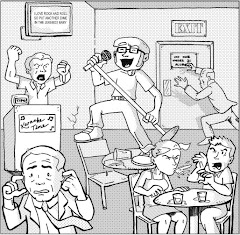
Last night on Dancing With the Stars, The Guy That Was Naked In The Sex in the City Movie (I'm sorry, does he have a name?) danced the salsa to 3 Doors Down's "Kryptonite" (not a salsa standard, I reckon) and ended the routine by taking off his glasses and ripping his shirt open to reveal a Superman-esque logo. With so many celebrities getting injured as a result of their participation in this competition, was this song a declaration of his endurance -- or a bid to star in the next Man of Steel film? If it's neither, it was pointless.
Monday, March 09, 2009
Who's Watching Us Watch Who's Watching the Watchmen?
A week later, the Internet buzz about The Watchmen, and I've read many fans' reviews and impressions of the movie. They're all exactly the same. While many fans seemed to like to film, they can't help but criticise the original material that was omitted. Honestly, after years' worth of various inspirations and incarnations in pre-production, Zach Synder has created a film that goes out of its way to please steadfast fans and appeal to a blissfully ignorant mainstream audience. One part Forest Gump, one part X-Men, The Watchmen is a story that explores how history would differ if superheroes really existed, and now if they faced age and prejudice. While fanboys mettle over the minutiae of the film's forsaken details, I'm more interested in the piece's timeless ramifications. Over twenty years later, the dark corners of politics and pop culture that inspired Alan Moore still exist, and how would 2009 look in the world of The Watchmen?
First of all, the primary catalyst in Alan Moore's plot is the superhero as the has-been, with each of his Watchmen fulfilling the obvious various roles left when their iconic status dissolved. The Night Owl is the most realistic result, as he lives a meek life that silently regrets but functionally copes with its devolution, like a retired police officer. The Comedian is his polar opposite, living as an extravagant citizen yet obviously haunted by his past, particularly as the weight of his actions and their consequences occur to him in his old age. Dr. Manhattan is the personification of human achievement and therefore represents the inevitable product of mankind's own quest for power and celebrity, consequently both revered and misunderstood. Silk Spectre is his proverbial Tammy Faye Bakker, the first lady trapped by her leading man's reputation, not to mention her mother's legacy, which results in rebellion. If being a superhero wasn't against the grain, she'd garner some other controversy, again like Tammy Fay, or overcompensate with her own quest for authority, like Hillary Clinton. Rorschach is the wild card, like the child actor that refuses to quit and in fact proves himself by embracing the other extreme. Obviously, Jackie Earle Haley related to the role.
From the damaged child star to the retired cop, these archetypes in contemporary society and pop culture are just as vivid and significant today as they were in 1985, and Ozymandias is the best example and most pivotal to the Watchmen's story. At the beginning of the story (I really can't say "comic" or "film," because this plot now transcends either medium), Ozzie is depicted as a brilliant eccentric, hanging out in front of Studio 54 and negotiating his action figure line. Yet, we know behind the scenes he's really a mad scientist with twisted, benevolent intentions. Did Alan Moore know in 1985 that he was foreseeing George Clooney's career? Think about it -- George is a paparazzi darling, yet just recently he spoke with the Vice President in Washington about international affairs. We live in the kind of world where a celebrity feels influential in worldwide crises. If superheroes were real, they would always be on TMZ, and with that kind of attention, could their egos settle for foiling mere street level crime? The humility of Superman is so idealistic, it's unrealistic. Sean Penn stars in a movie about gay rights, and he's become a gay rights activist. How many times would a real Batman thwart the Joker before deciding to go all Erin Brockovich on companies that profit from poisonous chemicals?
The context of The Watchmen story is secondary to its characters and their history. Whether it's a giant squid or a nuclear bomb that destroys the city, the timeless appeal of Alan Moore's script is its heroes' respective resilience, made easier to understand through his frequent allusions and parallels to Hollywood and pop culture. From his opening credits onward, Snyder effectively changes world history by just dropping the stunning visuals of the superhero into the middle of America's Golden Age, and he pulls no punches with how ridiculous some of them looked. That image of the Minutemen is akin to watching The Wizard of Oz today; we know it can be done better, but the charm of how cinema began respects its humble beginnings. Yet now we know that Judy Garland wasn't a perfect person behind that mid-western smile, too. Like a comic book becoming a movie, whenever something takes on another face, we tend to prefer what we're used to seeing. Sometimes, we'd rather not watch.
First of all, the primary catalyst in Alan Moore's plot is the superhero as the has-been, with each of his Watchmen fulfilling the obvious various roles left when their iconic status dissolved. The Night Owl is the most realistic result, as he lives a meek life that silently regrets but functionally copes with its devolution, like a retired police officer. The Comedian is his polar opposite, living as an extravagant citizen yet obviously haunted by his past, particularly as the weight of his actions and their consequences occur to him in his old age. Dr. Manhattan is the personification of human achievement and therefore represents the inevitable product of mankind's own quest for power and celebrity, consequently both revered and misunderstood. Silk Spectre is his proverbial Tammy Faye Bakker, the first lady trapped by her leading man's reputation, not to mention her mother's legacy, which results in rebellion. If being a superhero wasn't against the grain, she'd garner some other controversy, again like Tammy Fay, or overcompensate with her own quest for authority, like Hillary Clinton. Rorschach is the wild card, like the child actor that refuses to quit and in fact proves himself by embracing the other extreme. Obviously, Jackie Earle Haley related to the role.
From the damaged child star to the retired cop, these archetypes in contemporary society and pop culture are just as vivid and significant today as they were in 1985, and Ozymandias is the best example and most pivotal to the Watchmen's story. At the beginning of the story (I really can't say "comic" or "film," because this plot now transcends either medium), Ozzie is depicted as a brilliant eccentric, hanging out in front of Studio 54 and negotiating his action figure line. Yet, we know behind the scenes he's really a mad scientist with twisted, benevolent intentions. Did Alan Moore know in 1985 that he was foreseeing George Clooney's career? Think about it -- George is a paparazzi darling, yet just recently he spoke with the Vice President in Washington about international affairs. We live in the kind of world where a celebrity feels influential in worldwide crises. If superheroes were real, they would always be on TMZ, and with that kind of attention, could their egos settle for foiling mere street level crime? The humility of Superman is so idealistic, it's unrealistic. Sean Penn stars in a movie about gay rights, and he's become a gay rights activist. How many times would a real Batman thwart the Joker before deciding to go all Erin Brockovich on companies that profit from poisonous chemicals?
The context of The Watchmen story is secondary to its characters and their history. Whether it's a giant squid or a nuclear bomb that destroys the city, the timeless appeal of Alan Moore's script is its heroes' respective resilience, made easier to understand through his frequent allusions and parallels to Hollywood and pop culture. From his opening credits onward, Snyder effectively changes world history by just dropping the stunning visuals of the superhero into the middle of America's Golden Age, and he pulls no punches with how ridiculous some of them looked. That image of the Minutemen is akin to watching The Wizard of Oz today; we know it can be done better, but the charm of how cinema began respects its humble beginnings. Yet now we know that Judy Garland wasn't a perfect person behind that mid-western smile, too. Like a comic book becoming a movie, whenever something takes on another face, we tend to prefer what we're used to seeing. Sometimes, we'd rather not watch.
Saturday, February 28, 2009
Reading Reminds Us What's Fundamental in "The Scrapyard Detectives" #4

Monday, March 2, is Read Across America Day, a nationwide educational celebration of Dr. Seuss's birthday. As an advocate for youth by day and a comic book geek by night, I've often tried to reconcile these two passions by introducing kids to comics, since they know many of the medium's iconic characters from television and film anyway. Unfortunately, the likes of Batman and Spider-man are usually too mired in continuity for younger readers. Can you imagine trying to explain Spidey's "Character Assassination" or Batman's "R.I.P." to a seven-year-old? I know that DC and Marvel produce one-shots or child-friendly series free of these stories' bonds, but I regret that today's youth can't pick up any issue featuring their favorite superhero and find instant entertainment, like I did as a kid.
Enter: Jinn, Raymond, and Robert -- the Scrapyard Detectives. I've reviewed The Scrapyard Detectives twice before and was quoted on the back of the series' first trade paperback, so it isn't hard to guess that I really like this book. Creator/artist Bill Galvan has kept in touch over the years and was kind enough to send me complimentary copies of this latest issue for the students in my after school program. This kindness is indicative of the spirit of his series -- getting entertaining comics into the hands of kids, no strings attached. While Jinn, Raymond, and Robert certainly have an ongoing story with their own respective character dynamics, the series' rotating writers assure that each issue is its own reward, including previous tales' themes and relationships while avoiding the loose ends that dissuade new readers. In short, I can think of no better way to encourage reading than by handing a child The Scrapyard Detectives #4.
Further, an appreciation for reading is only half of what this series strives to instill in children. This fourth issue, written by none other than J.M. DeMatteis, takes place on the two-year anniversary of the accident that left Jinn in a wheelchair, and while she copes with the young driver's hope for forgiveness, her teammates deal with the adoration of their biggest fan, Raymond's little cousin Katie. These two plots collide when the Detectives individually shun the people that want their attention the most, inadvertently bringing them together in a climatic moment of revelation and resolution. I won't spoil this issue's ending, because a mere synopsis would stifle the last page's emotional impact and I'd really like everybody reading this review to attain the issue themselves, but needless to say DeMatteis gives readers of all ages a reason to examine their attitudes toward friends and foes alike.
Enter: Jinn, Raymond, and Robert -- the Scrapyard Detectives. I've reviewed The Scrapyard Detectives twice before and was quoted on the back of the series' first trade paperback, so it isn't hard to guess that I really like this book. Creator/artist Bill Galvan has kept in touch over the years and was kind enough to send me complimentary copies of this latest issue for the students in my after school program. This kindness is indicative of the spirit of his series -- getting entertaining comics into the hands of kids, no strings attached. While Jinn, Raymond, and Robert certainly have an ongoing story with their own respective character dynamics, the series' rotating writers assure that each issue is its own reward, including previous tales' themes and relationships while avoiding the loose ends that dissuade new readers. In short, I can think of no better way to encourage reading than by handing a child The Scrapyard Detectives #4.
Further, an appreciation for reading is only half of what this series strives to instill in children. This fourth issue, written by none other than J.M. DeMatteis, takes place on the two-year anniversary of the accident that left Jinn in a wheelchair, and while she copes with the young driver's hope for forgiveness, her teammates deal with the adoration of their biggest fan, Raymond's little cousin Katie. These two plots collide when the Detectives individually shun the people that want their attention the most, inadvertently bringing them together in a climatic moment of revelation and resolution. I won't spoil this issue's ending, because a mere synopsis would stifle the last page's emotional impact and I'd really like everybody reading this review to attain the issue themselves, but needless to say DeMatteis gives readers of all ages a reason to examine their attitudes toward friends and foes alike.

What I like most about The Scrapyard Detectives is its realistic depiction of youth. Its three protagonists aren't perfect. Just like any kid, their tender friendships are just as vulnerable to rash anger and bullying, to emotional outbursts and name calling. Still, these characters remain fictional role models because of their ability to deal with these feelings in time. Also, as this is a youth-oriented detective series, writer DeMatteis tips the proverbial hat to the Hardy Boys and Nancy Drew, acknowledging the roots of the genre while maintaining a sense of humor about itself. Of course, Bill's illustrations are the consistent spirit of this book, and I'm grateful that his kids look like kids. Too many comic book artists are snared by their inclinations to exaggerate musculature and unwittingly draw children like little adults; Galvan's style keeps things simple and expressive. His attention to detail is admirable, too; this might sound silly, but I like that his depictions of suburbia include power lines. When I look at the Scrapyard Detectives' neighborhood in the background of the main story, I see the cul-de-sac from my childhood. In every way, Jinn, Robert, and Raymond could be the kids next door.
Finally, The Scrapyard Detectives is an unapologetic example of a comic book first. Unlike many other nonprofit or special interest groups that use the comic book format to convey a message, thus producing a sub par product, Diversity Ink seems determined to offer a quality package, from cover to cover. Consider that this issue has three variant covers, one by the legendary Joe Staton, the other by the talented Shawn McManus, not to mention the fun pin-up by J.J. Harrison. Consider the inherent pride that comes with this issue's branding by the Comic Code Authority. Consider its appeal for letters and artwork, and its rewarding said efforts with an exclusive "Secret Case Files" issue. (Bill, does this count as a letter? I want that comic!) The excerpt from the Detectives' forthcoming novel proves that any character with a firm foundation in comics can transcend the medium -- that the power of words and pictures put together make other storytelling efforts want to rise to the occasion, too.
Sometimes I wonder what I'd read on a regular basis if I wasn't such an avid fan of comic books. Would I have developed more appreciation for novels, or nonfiction? Would I read historical texts, or plays? I wonder, would I even really read at all? For me, the comic book has been a gateway medium, instilling an appreciation for the sequential nature of theater, for the vivid imagery of poetry, for the economy of words necessary in short fiction. Today's kids aren't much different. While television, film, and video games offer a basic understanding of plot, the thrill of a comic book can still excite the imagination and inspire new heights of interaction with literature. If society is lucky enough, the right kids get their hands on comics like The Scrapyard Detectives #4 -- the kinds of comics that teach the integrity of good storytelling right alongside the value of having integrity as a person, too.
For more information about The Scrapyard Detectives, please visit The Diversity Foundation's website.
The Scrapyard Detectives #4 was published by the Diversity Foundation, written by J.M. DeMatteis, illustrated by Bill Galvan and Rob Hawkins, and lettered by Dave Lanphear.
Thursday, February 26, 2009
Jivin' with Black History Month: Justice League of America #173

When I saw the cover to Justice League of America #173, I knew the issue would be the perfect send off to Black History Month. Consider this image’s implications, before even cracking the comic open: Black Lightning refuses to join the team based on the impression of the no-name “jive bunch of turkeys” behind Superman. Would Black Lightning really refuse the Justice League based on the awkward physical appearance of other heroes? Is Black Lightning really judging the proverbial book by its cover -- leading me to do so, as well? Further, one has to wonder, did black people really talk like that back in 1979? Themes of discrimination and stereotyping abound, and we haven’t even read the story yet.
Fortunately, though the issue’s plot goes in a slightly different direction than its cover implies, Justice League of America #173 is a tale about testing one’s character, which is just as integral to Black History Month. When Green Arrow recommends Black Lightning for JLA membership, the Flash misunderstands his motives, saying, “I never thought you would suggest we take in a token black . . .” The accusation sparks a heated debate that results in the decision to test Lightning’s mettle -- through fisticuffs. The League disguises their identities (as the weirdoes on the cover) and attacks the unsuspecting hero quite mercilessly, and though Black Lightning defeats Green Lantern and Zatanna’s villainous alter egos, the Flash’s speed overwhelms him. Enraged, Lightning almost chokes out Green Arrow, and when the League reveals their motives, he declines their offer. “You just better get yourself another boy!” he retorts. Though his statement is dismissed, its undertone brings the racial theme full circle.
I’m grateful writer Gerry Conway didn’t pull any punches with his dialogue in this issue. Although Flash’s rash judgment is chalked up to grief over his wife’s recent death, Green Arrow’s reputation as “Mister Liberal” (Barry’s words!) does dictate many of his decisions and the heroes were right to examine the context of the recruitment. That even the world’s greatest superheroes have to deal with social impressions and implications is a refreshing take on their roles as public figures, in 1979 and now thirty years later.* Could you imagine a super-team of exclusively white heroes in the crosshairs of today’s media? Would their recruitment of a hero like Black Lightning be hailed as historical, or outdated obligation? I wonder how the rest of the world hails our inauguration of a black President, considering other countries' acceptance of minorities in leadership.

Of course, the elephant in the room is Black Lightning's name, as his superhero alias purely denotes his skin color and nothing more. Surely a character created nowadays wouldn't face a potentially demeaning moniker like this, yet Lightning's character has transcended that distinction and become timeless in both his name and role as a representative of his race in the DC Universe.
To that end, interestingly, a brief subplot about the impending Metropolis Vigilante Act raises questions about Conway’s mentality behind mentioning it. When a detective warns Black Lightning that his antics might attract political and legal attention, the hero replies, “Any law that’s gonna affect this boy’ll also hafta affect Superman . . . and no way is that gonna happen in this town.” The statement seems true enough in the DC Universe, where Superman could do no wrong, but was Conway establishing an allegory for the contradictory judgments of society, as well? Was he trying to combat social injustice and assert that the law of the land is applicable to anyone, despite racial stereotypes that certain youth are more prone to criminal activity?
Although Black Lightning’s dialogue is definitely dated (if even accurate to the vernacular of the time, rife with words like “jive” and slang contractions like “hafta”), his integrity as a hero is unquestionable. Although his electric powers are offensive in nature, he primarily uses them defensively and takes down his opponents hard and quickly, an interesting contrast to the League’s preference to just jump right in and throw punches -- even against a fellow good guy, even as just a test! The world’s greatest superheroes come off as the world’s most arrogant, too, in their assumption that Lightning would embrace their offer. I’d say this hero passed the test, staying true to his passions rather than succumbing to the temptations of celebrity.
I wish they still made comics like this. First of all, while it wasn’t critical to my review, I’d be remiss not to at least mention that artists Dick Dillin and Frank McLaughlin deliver amazing, engaging work here. Further, although your typical super-villain schemes in the background, setting up the next issue, this issue surely stands on its own, offering real characterization, fun action, and a few poignant questions about real life. Judging Justice League of America #173 based solely on its cover doesn’t do it justice.
* This issue was released in December 1979, the month and year of my birth. It would be interesting to track down all of the comics published that month, to understand what was happening in my beloved medium as I was entering the world. Hmm . . .
Justice League of America #173 was published by DC Comics and was written by Gerry Conway, illustrated by Dick Dillon and Frank McLaughlin, lettered by Ben Oda, and colored by Jerry Serpe.
Never Toy With An Octomom!

The media's willingness to call Nadya Suleman "Octomom" is a comforting notion for fanboys like me eager to see superheroes in real life someday. I mean, if real news people can say "Octomom" with a straight face, names like "the Shocker" or "Bronze Tiger" would roll right off the tongue. Considering this connection to comics, I thought I'd draw one about the infamous Octomom, in her inherent role as a super villain. I called the strip "Vs. Current Events" with the hopes that in the future other celebrities or fame-seekers will adopt aliases with similar appeal. Fingers crossed!
Wednesday, February 18, 2009
Making a Monkey of Obama!: The Power of the Political Cartoon
As a comic book fan, I often underestimate the importance of the political cartoon. Often placed in the most sophisticated sections of the paper, like "Business" or "Opinion," the political cartoon takes the comic dynamic of word and image interplay and presents to the most general audience ever, and presumably those smart enough to keep up with current events and relevant social dialogue. So, I shouldn't be surprised that a political cartoon has sparked such a fervent debate today.
Consider this piece that appeared in The New York Times.

Yes. I've already showed the piece to a few different people, and they all react the same way. "Oh, it's calling Obama a monkey." I usually don't cry racism in a crowded theater, but, man, this political cartoon is racist! Now, political cartoonists only get one panel a day, and in this twenty-four news cycle world, I know they often try to kill a few birds with one gag. Still, likening the monkey shot in Connecticut for mauling a woman with the President's attempt to stimulate the economy . . . I can't even think of a just comparison that isn't racist!
The Times editor is defending the strip and claiming that outraged parties like Reverend Al Sharpton are merely seeking publicity, which he is, but if the point isn't racism, what is it? That Obama's stimulus package is so stupid, monkeys helped him work on it? Even if the President weren't black, a trait that carries the historical racist comparison to monkeys, this punchline would be weak at best. The cartoonist should've realized that his connection between these stories would pale to the negative impression his strip might have, even unintended. This isn't a grand leap; it's simple algebra. If Monkey = Stimulus Package, and Stimulus Package = President Obama, then Monkey = President Obama. This is common sense.
In a world where Don Imus is fired for say the word "nappy-headed," pop culture's opinion makers and proclaimers need to choose their words wisely. When those words are tied to an image, as in the beloved nature of the comic, the responsibility is doubled. Yeah, yeah -- they just have to live with that monkey on their backs.
Consider this piece that appeared in The New York Times.

Yes. I've already showed the piece to a few different people, and they all react the same way. "Oh, it's calling Obama a monkey." I usually don't cry racism in a crowded theater, but, man, this political cartoon is racist! Now, political cartoonists only get one panel a day, and in this twenty-four news cycle world, I know they often try to kill a few birds with one gag. Still, likening the monkey shot in Connecticut for mauling a woman with the President's attempt to stimulate the economy . . . I can't even think of a just comparison that isn't racist!
The Times editor is defending the strip and claiming that outraged parties like Reverend Al Sharpton are merely seeking publicity, which he is, but if the point isn't racism, what is it? That Obama's stimulus package is so stupid, monkeys helped him work on it? Even if the President weren't black, a trait that carries the historical racist comparison to monkeys, this punchline would be weak at best. The cartoonist should've realized that his connection between these stories would pale to the negative impression his strip might have, even unintended. This isn't a grand leap; it's simple algebra. If Monkey = Stimulus Package, and Stimulus Package = President Obama, then Monkey = President Obama. This is common sense.
In a world where Don Imus is fired for say the word "nappy-headed," pop culture's opinion makers and proclaimers need to choose their words wisely. When those words are tied to an image, as in the beloved nature of the comic, the responsibility is doubled. Yeah, yeah -- they just have to live with that monkey on their backs.
Sunday, February 15, 2009
Global Heart Warming: Millennium Fever #1
 As I was flipping through a myriad of back issue bins at today's monthly Los Angeles Comic Book and Sci-Fi Convention, pulling up the occassional issue and mulling over its potential to join my collection, my girlfriend sarcastically asked me, "Hey, did you just judge that comic book by its cover?"
I replied, "Of course. That's what I've been doing for all of them!"
Consider Millennium Fever #1. When I picked up this issue in a similar twenty-five cent bin blitz almost a year ago, I reserved it for a Valentine's Day read, since its cover seemingly depicts two youngsters falling in love. Further, since these youngsters are African-American, what better way to acknowledge Black History Month in the midst of Cupid's annual target practice? If only President Lincoln made a cameo holding a groundhog, based solely on its cover, Millennium Fever #1 could be the perfect February comic book!
Of course, every time I make a wide-sweeping generalization about a comic book like this, I underestimate its impact. Millennium Fever is actually a complex coming-of-age story, certainly tackling issues of love and racial identity, but also dabbling in macabre, potentially apocalyptic science fiction, that binds its hero's quest for identity into the fabric of the entire universe itself! Okay, maybe it isn't that complex, since I did only read the first issue, but writer Nick Abadzis laces teenager Jerome's persistant inner monologue with a haunting tone that transcends his typical adolescent circumstances. It starts simple enough, as Jerome laments his virginity at his grandmother's funeral, an odd contrast for sure, but then grows more intricate when his reminiscing about his diverse family tree become a treatise about the beauty of music and communication.
The love story boasted by this issue's cover kicks into gear after Jerome's failed, drunken attempt to hook up with his high school crush, when he desperately responds to a personal ad and meets the girl of his wet dreams. I won't spoil this issue's ending, especially since it's so weird without the next issue's presumed explanation that I probably couldn't do the sequence justice anyway, but needless to say, between that, his blossoming ability with language, and a doom-and-gloom subplot about global warming and oncoming catastrophe, Jerome is in way over his head.
Artist Duncan Fegredo and letterer Ellie DeVille expertly choreographed their efforts to ensure that Abadzis' captions didn't choke the visual flow of the story, and the package comes together nicely. Fegredo keeps his characters expressive and animated while retaining the necessary realism to keep this introductory installment "slice of life" until the strangeness rears its head on the last page, and I assume the crammed paneling was intentional, preserving the moment's mystery for next issue's elaboration. The more spacious paneling was preserved for character-oriented moments like Jerome listening to music in his bedroom, which must've been Abadzis' hope anyway. Get to know your heroes before they save the world from itself, that's what I always say!
While writer Andrew Kreisberg would have us believe that his latest issue of Green Arrow/Black Canary is the best Valentine's Day gift for your sweetheart, I challenge you to thumb through your local stash of discounted back issues for Millennium Fever #1. Its lesson? The quest for true love might not be the end of the world, but it certainly helps postpone it. Also, if you're lucky enough to have someone in your life that will endure your hunt for this or any other obscure back issue, like me -- count your blessings. If it were the end of the world, I'd feel fine!
Millennium Fever #1 was published by DC Comics' Vertigo for October 1995 and was written by Nick Abadzis, illustrated by Duncan Fegredo, colored by Nathan Eyring, and lettered by Ellie DeVille.
Friday, February 06, 2009
Putting the "Bat" Back in "Bat Crap Crazy!"
Christian Bale's tirade on the set of Terminator: Salvation has swept the mainstream news this week, and I love that most outlets are equating his rage with his role as Batman. Here are my favorite highlights of this week's Bale-istic tantrum:
- TMZ releases audio of Bale's rant against the Director of Photography on the set of Terminator: Salvation.
- "Christian Bale" calls and curses out David Letterman. (I couldn't find an on-line clip of that, but The Tony Mendez Show hilariously jumps on the Bale-wagon . . .)
- Jimmy Fallon satirizes the rant on the blog promoting his upcoming late night talk show.
- A Batman flips out for tourists and passers-by in front of the Grauman's Chinese Theater in Hollywood.
When I played that last clip for a co-worker, he astutely pointed out that, as much as comedians and wanna-be Internet superstars are riffing Bale, none of them have been as funny as the real thing. Agreed!
Addendum: Apparently, Bale has publicly apologized for his behavior. Over twenty-two pages' worth of comments on the MSN story about his regret practically exclusively chastise the actor's initial tirade, and then even the apology itself, so I took the opposing stance with the following post:
I'd love to put a recorder or video camera in any of your cars, you hypocrites! Or maybe the last time you and your significant other really went at it? Everybody flips out sometimes, and sometimes it lasts LONGER than four minutes! Who cares if he's sorry for the sake of publicity or damage control -- Don't you make your kids say "I'm sorry" even when they don't mean it? His attitude is EXACTLY why we like him -- everybody loves the tough guy. That's why he's been in Batman, and now Terminator, two of the biggest film franchises ever. We want to see him kick butt . . . and we're hypocrites when we can't take him doing it for a few minutes in real life, especially if he and the DP really cleared the air and moved on THAT DAY, MONTHS ago.
Re: Bale as a role model. Your kids will only hear this rant if YOU let them access TMZ or the nightly news. Heck, ever think that maybe a few seconds of the rant might be a good chance for parents to talk about anger management? Remember when parents used chances like this to teach lessons about life, rather than rave about the perpetual victimization of their kids?
And I bet your daughter HAS dated "that nut." You just don't know it yet.
Yes, many of the comments addressed Bale as a role model, and that last jab was intended for the dude that said he'd never let his daughter date a nut like that. Talk about rubbing another man's rhubarb . . .!
- TMZ releases audio of Bale's rant against the Director of Photography on the set of Terminator: Salvation.
- "Christian Bale" calls and curses out David Letterman. (I couldn't find an on-line clip of that, but The Tony Mendez Show hilariously jumps on the Bale-wagon . . .)
- Jimmy Fallon satirizes the rant on the blog promoting his upcoming late night talk show.
- A Batman flips out for tourists and passers-by in front of the Grauman's Chinese Theater in Hollywood.
When I played that last clip for a co-worker, he astutely pointed out that, as much as comedians and wanna-be Internet superstars are riffing Bale, none of them have been as funny as the real thing. Agreed!
Addendum: Apparently, Bale has publicly apologized for his behavior. Over twenty-two pages' worth of comments on the MSN story about his regret practically exclusively chastise the actor's initial tirade, and then even the apology itself, so I took the opposing stance with the following post:
I'd love to put a recorder or video camera in any of your cars, you hypocrites! Or maybe the last time you and your significant other really went at it? Everybody flips out sometimes, and sometimes it lasts LONGER than four minutes! Who cares if he's sorry for the sake of publicity or damage control -- Don't you make your kids say "I'm sorry" even when they don't mean it? His attitude is EXACTLY why we like him -- everybody loves the tough guy. That's why he's been in Batman, and now Terminator, two of the biggest film franchises ever. We want to see him kick butt . . . and we're hypocrites when we can't take him doing it for a few minutes in real life, especially if he and the DP really cleared the air and moved on THAT DAY, MONTHS ago.
Re: Bale as a role model. Your kids will only hear this rant if YOU let them access TMZ or the nightly news. Heck, ever think that maybe a few seconds of the rant might be a good chance for parents to talk about anger management? Remember when parents used chances like this to teach lessons about life, rather than rave about the perpetual victimization of their kids?
And I bet your daughter HAS dated "that nut." You just don't know it yet.
Yes, many of the comments addressed Bale as a role model, and that last jab was intended for the dude that said he'd never let his daughter date a nut like that. Talk about rubbing another man's rhubarb . . .!
This Meets That, and Another Thing: Anticipating Johnny Monster #1
Browsing through Image Comics' upcoming releases, I read this description of Johnny Monster #1:
Johnny Monster is the world's foremost super-star monster hunter, but what the world doesn't know is that he was raised by the same monsters he's "hunting"! Now, in order to save his adoptive family... he must fight them! From the acclaimed writer of DEAR DRACULA and Necessary Evil, Johnny Monster mixes Tom Strong with Godzilla movies by way of Tarzan and the Phantom to create a compelling and different monster mash!
I'd read some press about this series before and was reminded of my excitement for it, until that critical last line soured my impression by representing everything I hate about today's conceptual summary driven society. Consider: Johnny Monster is described as a "compelling" and "different" series through comparison with four other well known stories! Honestly, the plot's description had me at "he was raised by the same monsters he's 'hunting,'" and the illusions of both Tarzan and Godzilla were evoked naturally (especially via the cover image), so I didn't need the help. I know I'm a more intuitive reader than some, but now it's to my detriment, because I'm afraid the book's uniqueness actually ends there.
Johnny Monster and the folks at Image that wrote this description aren't too blame; this "X meets Y to make Z" way of describing art has become a culture-wide phenomenon, from describing the TV show Fringe as The X-Files meets CSI to the music of Nickelback as Creed meets Three Doors Down. (Which is an ironic comparison in itself, because Creed is really just Pearl Jam meets a bullet in my friggin' head, but I digress.) The implication is potentially twofold: either contemporary originality is only the combination of ideas that have preceded us, or modern audiences aren't smart enough to understand something new without some comparison to the past. I shudder to think which is true, or, worse, that this phenomenon is one meeting the other. Tell me that didn't blow your mind.
I sympathize with Johnny Monster, and, beat all, I'm buying that first issue. We're being raised by the monsters we've created, and I don't know how we can kill them in good conscience.
Johnny Monster #1 is coming out February 18, 2009 from Image Comics, is written by Joshua Williamson, and is illustrated J.C. Grande.
Johnny Monster is the world's foremost super-star monster hunter, but what the world doesn't know is that he was raised by the same monsters he's "hunting"! Now, in order to save his adoptive family... he must fight them! From the acclaimed writer of DEAR DRACULA and Necessary Evil, Johnny Monster mixes Tom Strong with Godzilla movies by way of Tarzan and the Phantom to create a compelling and different monster mash!
I'd read some press about this series before and was reminded of my excitement for it, until that critical last line soured my impression by representing everything I hate about today's conceptual summary driven society. Consider: Johnny Monster is described as a "compelling" and "different" series through comparison with four other well known stories! Honestly, the plot's description had me at "he was raised by the same monsters he's 'hunting,'" and the illusions of both Tarzan and Godzilla were evoked naturally (especially via the cover image), so I didn't need the help. I know I'm a more intuitive reader than some, but now it's to my detriment, because I'm afraid the book's uniqueness actually ends there.
Johnny Monster and the folks at Image that wrote this description aren't too blame; this "X meets Y to make Z" way of describing art has become a culture-wide phenomenon, from describing the TV show Fringe as The X-Files meets CSI to the music of Nickelback as Creed meets Three Doors Down. (Which is an ironic comparison in itself, because Creed is really just Pearl Jam meets a bullet in my friggin' head, but I digress.) The implication is potentially twofold: either contemporary originality is only the combination of ideas that have preceded us, or modern audiences aren't smart enough to understand something new without some comparison to the past. I shudder to think which is true, or, worse, that this phenomenon is one meeting the other. Tell me that didn't blow your mind.
I sympathize with Johnny Monster, and, beat all, I'm buying that first issue. We're being raised by the monsters we've created, and I don't know how we can kill them in good conscience.
Johnny Monster #1 is coming out February 18, 2009 from Image Comics, is written by Joshua Williamson, and is illustrated J.C. Grande.
Thursday, January 29, 2009
Blue Beetle Blues
 In his recent "The Buy Pile" at Comic Book Resources, Hannibal Tabu comments that the latest issue of Blue Beetle is the penultimate one. While I haven't read the series, its cancellation saddens me for three distinct reasons:
1. As Hannibal explains, the current Blue Beetle, Jaime Reyes, is one of the few "ethnic" heroes offered by one of the major comic book companies, not to mention a Hispanic hero. In a medium where the Latino community is often exploited as "gangstas" for action-oriented fodder, Jaime's potential will be sorely missed.
2. Jaime is the first Blue Beetle to receive so much mainstream exposure! His frequent appearances in Cartoon Network's Batman: The Brave and the Bold (kudos for admitted geek and favorite blogger Wil Wheaton for his performance as Ted Kord last week), and the subsequent action figures, have made the Beetle a household name, relatively speaking! Remember, I work with kids (85% of whom are Hispanic, to boot), and they know who the Blue Beetle is! Of course, this doesn't inspire them to buy his comic at $2.99 a pop . . . not when they can get six bags of Hot Cheetos for just as much.
3. Every time a second-stringer's solo title get cancelled, I remember and lament some of my own favorite B-listers, like Marvel's Cloak and Dagger, or Batman's wayward teen-aged nemesis Anarky (whose recent appearance in Robin seemed to deviate from the character I remember, though I like the new threads . . .). Beetle's thirty-six issues make up a remarkable run for a character of his stature, it seems, especially since his third-generation alter ego is a name unfamiliar to longtime readers. When will DC and Marvel finally exclusively concentrate on their core properties, the ones with mainstream potential and decades' long history? Just kill off everyone else in some crazy cosmic crisis, already -- it's not like you haven't been doing that slowly in the past fifteen years, anyway.
Based on Hannibal's brief review, I've been missing out on a great series. Though I think Jaime will continue his adventures with the Teen Titans, the silver lining is the cancellation of Blue Beetle will inevitably condemn it to the quarter bins, where I can now collect the whole series for less than ten bucks! Take that, Seniors Barnes & Noble, with your graphic novel section!
Monday, January 19, 2009
Keep It Up: An Anti-List for 2009, part 3
This week gave us Martin Luther King, Jr. Day, the newly appointed Divorce Day, and of course President Obama's inauguration, and as such is pretty much the last week one can pontificate about what's come before in the wake of an exciting new future, so I have a twofold desire to remember the highlights of comics in pop culture last year and to make some comics-specific resolutions for 2009. Although we're only nineteen days deep, these two years already stand in stark contrast to each other. How so, you ask?
First of all, 2008 was a year directed by the influence of comic books (pun intended). Consider that, in a single year, moviegoers had the chance to experience real-world incarnations of Iron Man, the Hulk, Batman, the Punisher, Hellboy, the heroes of Wanted, and the Spirit, not to mention the return of beloved franchises like Speed Racer, Indiana Jones, Star Wars, and the X-Files. Sure, these films represent the gamut of box office success, but each of them equally shared the responsibility of exposing a mainstream audience to characters that are pillars to fanboy culture. Further, from the tragedy of Health Ledger's death to the tabloid interest of David Duchovny's sex addiction, most of these films offered some tidbit that contributed to the grand scheme of entertainment news in 2008, the actual respective movie not withstanding. In short, 2008 took the topics of message boards and late night gaming tournaments and dragged them into the daylight, around the office water cooler. I'm not sure if we geeks should thank '08, or vice versa!
On the flipside, 2009 has become the year comics bend to the news, rather than the other way around. Message boards are abuzz with the current Obama trend in titles like Amazing Spider-man and Savage Dragon, and the cover price debate rages in the face of a challenging economy. Movies like The Watchmen and the resurrection of franchises like Star Trek are certainly stirring the pot, but sans another unfortunate celebrity death, I don't think pop culture will maintain its love affair with comics until the next Iron Man becomes reality. Right now, comics are pop culture's booty call, "blowing it up" only when nothing else is going . . . and some action is better than none.
On the homefront, I appreciated 2008's premiere of MattyCollector.com, Mattel's adult-oriented on-line toy store, primarily featuring DC Superheroes in both realistic and animated forms, and a new He-Man action figure line currently exploiting the characters' classic look via today's advanced action figure sculpting and articulation styles. While the idea of Internet exclusivity sparked debate among earnest fanboys accustomed to scouring Target and Wal-Mart aisles for the latest action figures, the site has been obviously well received, since many of its products are sold out despite arguably high shipping rates. I'm as financially strapped as the next guy, but the chance to own an exclusive, high quality He-Man figure is perhaps the strongest opiate to face my inner child ever . . . and if I'm buying He-Man, he needs a bad guy to fight, right? Masters of the Universe is plural, right?
 Therein lies my motivation as a collector for 2009: now, more than ever, collect to my inner child. I began this resolution early, thanks in large part to the latest wave of Marvel Legends action figures. See, when I was a kid, I owned the first wave of Marvel's Secret Wars figures, and since I didn't avidly read comics at the time, those eight toys were my Marvel Universe. Thanks to the now mainstream availability of Kang (and my girlfriend's diligence on eBay to score a Magneto), I decided to recreate those eight characters in modern toy form and effectively end all other Marvel action figure purchases. Mattel's adult-oriented DC and He-Man franchises will remain my only plastic guilty pleasures, so much so that I'll in turn eBay some fringe items in my collection to obtain them all -- or as close as I can get, considering convention exclusives and my own budget. So, while obtaining some of these elusive figures will condemn me to an ongoing crisis, at least trimming the fat of my fanaticism doesn't pit me against a proverbial infinity gauntlet of spending. Yes, I said it!
Regarding comics, the steadfast cornerstone of my collecting compulsions, I aim to continue purchasing series that appeal to my need for relevant stories and dynamic character development. I define "relevant" as all-encompassing; that is, if I can hand a comic book story (whether or not contained in a single issue, or a mini-series, or within an ongoing -- the story withstands any format) to a friend and recommend it as an excellent piece of approachable literature, it's relevant. Joe Kelly's I Kill Giants quickly comes to mind, as those seven issues tell a compelling story about a teenaged girl whose inner turmoil manifests into a fantastic allegorical struggle. If you know the series, you know that the context is socially significant, presented through a filter of dark humor and schoolyard antics many people can understand. Conversely, Grant Morrison's "Batman: R.I.P." stars one of the world's most recognizable icons, but I could never recommend it to a friend. It's too mired in classic Batman continuity to make sense to anyone not familiar with the comics' lore, and it's too dependent on Final Crisis and other events in the DC Universe to retain a self-enclosed identity. If I were to recommend a comic starring a hero driven to avenge the death of his or her parents, one in which the hero is a regular person tests the limit of his or her own abilities even in the face of impossible odds, I'd point to the Luna Brothers' The Sword. It's still a relatively young series with true cinematic potential -- and if it does find it's way to the silver screen, my friends can feel like they were on the ground floor of a brand new franchise!
Of course, I'm still prone to purchasing my guiltiest of pleasures: comics starring superheroes fighting social injustices like illiteracy or gang violence. Expect to see more of those comics here soon . . .
Finally, 2008 brought many changes to personal life, as well -- a few that required me to downsize my living quarters, a trend I understand has afflicted many an economically-challenged fanboy of late. Still, despite the limited space, I've effectively managed to recreate the bedroom I had as a child through an adult standard of organization and functionality. Collecting comics and toys is interesting in its adaptability to life: a boy's bedroom is supposed to have this stuff, and in high school and college the clutter becomes a quirky celebration of pop culture, not without its vulnerability to trends or social rejection -- but for me, that just meant focusing more on practical items like a Spider-man toothbrush over a more lofty purchase like a Bowen bust of Starfox or something. Now, in my late twenties, I've come full circle; I've been saying lately that my Christmas list at 29 differs little from my list from just nine. Kang, He-Man, Hawkman . . . Kids today don't know how good they have it! What does an adult do with a comic book long box tower eleven high? He keeps it up. What does he do with an action figure collection cluttering his shelves?
Keep it up.
First of all, 2008 was a year directed by the influence of comic books (pun intended). Consider that, in a single year, moviegoers had the chance to experience real-world incarnations of Iron Man, the Hulk, Batman, the Punisher, Hellboy, the heroes of Wanted, and the Spirit, not to mention the return of beloved franchises like Speed Racer, Indiana Jones, Star Wars, and the X-Files. Sure, these films represent the gamut of box office success, but each of them equally shared the responsibility of exposing a mainstream audience to characters that are pillars to fanboy culture. Further, from the tragedy of Health Ledger's death to the tabloid interest of David Duchovny's sex addiction, most of these films offered some tidbit that contributed to the grand scheme of entertainment news in 2008, the actual respective movie not withstanding. In short, 2008 took the topics of message boards and late night gaming tournaments and dragged them into the daylight, around the office water cooler. I'm not sure if we geeks should thank '08, or vice versa!
On the flipside, 2009 has become the year comics bend to the news, rather than the other way around. Message boards are abuzz with the current Obama trend in titles like Amazing Spider-man and Savage Dragon, and the cover price debate rages in the face of a challenging economy. Movies like The Watchmen and the resurrection of franchises like Star Trek are certainly stirring the pot, but sans another unfortunate celebrity death, I don't think pop culture will maintain its love affair with comics until the next Iron Man becomes reality. Right now, comics are pop culture's booty call, "blowing it up" only when nothing else is going . . . and some action is better than none.
On the homefront, I appreciated 2008's premiere of MattyCollector.com, Mattel's adult-oriented on-line toy store, primarily featuring DC Superheroes in both realistic and animated forms, and a new He-Man action figure line currently exploiting the characters' classic look via today's advanced action figure sculpting and articulation styles. While the idea of Internet exclusivity sparked debate among earnest fanboys accustomed to scouring Target and Wal-Mart aisles for the latest action figures, the site has been obviously well received, since many of its products are sold out despite arguably high shipping rates. I'm as financially strapped as the next guy, but the chance to own an exclusive, high quality He-Man figure is perhaps the strongest opiate to face my inner child ever . . . and if I'm buying He-Man, he needs a bad guy to fight, right? Masters of the Universe is plural, right?
 Therein lies my motivation as a collector for 2009: now, more than ever, collect to my inner child. I began this resolution early, thanks in large part to the latest wave of Marvel Legends action figures. See, when I was a kid, I owned the first wave of Marvel's Secret Wars figures, and since I didn't avidly read comics at the time, those eight toys were my Marvel Universe. Thanks to the now mainstream availability of Kang (and my girlfriend's diligence on eBay to score a Magneto), I decided to recreate those eight characters in modern toy form and effectively end all other Marvel action figure purchases. Mattel's adult-oriented DC and He-Man franchises will remain my only plastic guilty pleasures, so much so that I'll in turn eBay some fringe items in my collection to obtain them all -- or as close as I can get, considering convention exclusives and my own budget. So, while obtaining some of these elusive figures will condemn me to an ongoing crisis, at least trimming the fat of my fanaticism doesn't pit me against a proverbial infinity gauntlet of spending. Yes, I said it!
Regarding comics, the steadfast cornerstone of my collecting compulsions, I aim to continue purchasing series that appeal to my need for relevant stories and dynamic character development. I define "relevant" as all-encompassing; that is, if I can hand a comic book story (whether or not contained in a single issue, or a mini-series, or within an ongoing -- the story withstands any format) to a friend and recommend it as an excellent piece of approachable literature, it's relevant. Joe Kelly's I Kill Giants quickly comes to mind, as those seven issues tell a compelling story about a teenaged girl whose inner turmoil manifests into a fantastic allegorical struggle. If you know the series, you know that the context is socially significant, presented through a filter of dark humor and schoolyard antics many people can understand. Conversely, Grant Morrison's "Batman: R.I.P." stars one of the world's most recognizable icons, but I could never recommend it to a friend. It's too mired in classic Batman continuity to make sense to anyone not familiar with the comics' lore, and it's too dependent on Final Crisis and other events in the DC Universe to retain a self-enclosed identity. If I were to recommend a comic starring a hero driven to avenge the death of his or her parents, one in which the hero is a regular person tests the limit of his or her own abilities even in the face of impossible odds, I'd point to the Luna Brothers' The Sword. It's still a relatively young series with true cinematic potential -- and if it does find it's way to the silver screen, my friends can feel like they were on the ground floor of a brand new franchise!
Of course, I'm still prone to purchasing my guiltiest of pleasures: comics starring superheroes fighting social injustices like illiteracy or gang violence. Expect to see more of those comics here soon . . .
Finally, 2008 brought many changes to personal life, as well -- a few that required me to downsize my living quarters, a trend I understand has afflicted many an economically-challenged fanboy of late. Still, despite the limited space, I've effectively managed to recreate the bedroom I had as a child through an adult standard of organization and functionality. Collecting comics and toys is interesting in its adaptability to life: a boy's bedroom is supposed to have this stuff, and in high school and college the clutter becomes a quirky celebration of pop culture, not without its vulnerability to trends or social rejection -- but for me, that just meant focusing more on practical items like a Spider-man toothbrush over a more lofty purchase like a Bowen bust of Starfox or something. Now, in my late twenties, I've come full circle; I've been saying lately that my Christmas list at 29 differs little from my list from just nine. Kang, He-Man, Hawkman . . . Kids today don't know how good they have it! What does an adult do with a comic book long box tower eleven high? He keeps it up. What does he do with an action figure collection cluttering his shelves?
Keep it up.
Wednesday, January 14, 2009
The Twelfth Day of Comic-mas: Twelve DC Drummings
Finally! "The 12 Days of Comic-mas" is officially the most overdue holiday celebration ever (in writing, anyway), and I'm as eager for it to end as you are! We have a whole new year of graphic goodness to tackle, and with an upcoming President appearing in comic books as frequently as Wolverine guest-starred in every Marvel title from the '90s, we're on the verge of truly experiencing a comic a day in one way or another. Still, first things first: this season's DCU Holiday Special, which, ironically, coincidentally, or both, boasts twelve stories on its table of contents (excluding the beautiful cover by Frank Quitely, and crisp table of contents by letterer Travis Lanham. Since this is the most bountiful anthology I've ever reviewed (not necessarily in page length but in said titled content), I've decided that the most effective way of reviewing this issue is through a succinct "top 12" countdown, like the very twelve days of Christmas that inspired this snail's pace series of entries.
Here we go!
12. "Introduction" -- A splash page featuring the Kents: Ma and Clark greeting a dressed-as-Santa Supergirl at the front door, while in the background Lois and Lana pet Krypto by the tree. I assume writer Sterling Gates simply told artist Karl Kerschl what to draw, and that it didn't sound much different than, "A splash page featuring the Kents: Ma and Clark greeting a dressed-as-Santa Supergirl at the front door, while in the background Lois and Lana pet Krypto by the tree."
11. "The Man in Red" -- Beautifully illustrated by Ivan Reis and Joe Prado, this allegory likens Superman's origins to Santa's, from the powers of flight and "seeing when you are sleeping" via X-ray vision, to the benevolence of selfless do-gooding, to even the arctic hideaway, a parallel I hadn't considered before. Still, this ambitious tale is purely conceptual, and considering its beautiful renderings, I would've appreciated a little more linear substance, i.e. a story.
10. "Somewhere Beyond the Sea" -- Aquaman summons a huge octopus to vanquish some pirates that have tried to hijack a man and his pregnant wife at sea. A good old-fashioned Aquaman story like this would've been a gift in itself, but that the woman's unborn child is somehow royal, and that our hero inadvertently becomes one of the "three kings" paying respect to him, is a holiday twist that pulls off such allegory a little better than the previous tale.
9. "Good King Wenceslas" -- I'll never bad mouth Paul Dini. Ever. But this Batman-oriented fairy tale confused me. Dustin Nguyen's painted artwork is breath-taking, though -- a visual masterpiece that elevates the whole anthology.
8. "A Day Without Sirens" -- Joe Kelly has found another fan in me this year, between I Kill Giants and the potential of Four Eyes. In this short story, Gotham City Police actually experience an entire day without a single 911 call, an initiative advertised by a private party that pull off an emergency-free twenty-four hours. I won't spoil it only to say that the responsible party has a special interest in Gordon's and Batman's happiness. Consequently, I felt some, too.
7. "It's a Wonderful Night" is a cheesy Nightwing/Robin story that seemed a few years behind the times, if not for Tim's grief over the death of his father. Nightwing's Christmas gift for him is lame, something a new Robin would never really need and could frankly see in the Batcave anytime he wanted.
6. "Christmas with the Beetles" -- I've heard of a few comics coming out this year that spotlight or are told from the perspective of villains, and this story kicks off that trend effectively with one thug's family legacy of encountering the Blue Beetle legacy! It's a quaint tale of redemption and intervention, one that addresses the concept that, if heroes experience different incarnation and identities, so must even the lowest of goons. And change could be for the best.
5. "An Angel Told Me" -- In this Huntress story, her alter ego is the real hero. A high school teacher by day, the Huntress decides to guide a bully toward responsibility by taking down his abusive father and supervising his community service, which she swerves to actually serve him. By day, I work with children, too, so I was touched by this story's heart, and the acknowledgement that some heroics can be accomplished without fisticuffs, before nightfall, and after school.
4. "The Night Before Christmas" -- I haven't been following the Teen Titans latest series, let alone their latest roster, so this story, mired in their continuity, starred a bunch of strangers to me. Robin, Wonder Girl, Blue Beetle . . . sure, I know them, but I wonder how influential the Teen Titans relationships really are in comparison to these youngster's respectively solo tales. As apparently easy as it is for the entire DCU to fight a cosmic crisis, try getting something as simple as a romance to transcend a single writer's motivation.
3. "Party Animal" -- This current Justice League tale reads more like a classic Justice League International yarn, thanks in large part to Kevin Maguire's expressive art, but writer Alan Burnett spares no comical expense in detailing the Shaggy Man's happenstance participation in our heroes' annual Christmas party. Simple, fun.
2. "Let There Be Light" struck me as more of a pitch for a solo Dr. Light series than a contribution to a holiday anthology, and I wish it preceded the Justice League story rather than end this otherwise generally enjoyable issue. Not that the story wasn't good, but it wasn't good enough to wrap things up, nor was it comprehensive in spirit or scope. Rodolfo Migliari's photo-realistic art was muddy at times, too, seemingly incomplete at times -- actually pretty dark for a story about light, but that might've been the point I missed.
1. "Ending" -- This issue ends as it began, with a pin-up. From one lookout point in the orbiting Justice League satellite, Superman and Stargirl smile upon Green Lantern and Hawkman, in another wing of the Watchtower. Sans some hanging ribbon and DC's corporate good tidings, the scene is actually pretty creepy . . .
Yet perhaps this page is also indicative of the superhero holiday anthology phenomenon, and how the characters we know and love can only touch upon the spirit of Christmas, watch it from a safe distance, lest one of the two mired mythologies consume the other in a tale of imbalanced fantasy. Superman, Batman, and company are like any family that visit for the holidays; it's great to see them, but after awhile, you just can't wait for them to leave so you can really enjoy the yuletide. Even superheroes can only save the day . . . by flying away!
DCU Holiday Special was published for February 2009 by DC Comics and was written and illustrated by too many talented contributors to list here!
Here we go!
12. "Introduction" -- A splash page featuring the Kents: Ma and Clark greeting a dressed-as-Santa Supergirl at the front door, while in the background Lois and Lana pet Krypto by the tree. I assume writer Sterling Gates simply told artist Karl Kerschl what to draw, and that it didn't sound much different than, "A splash page featuring the Kents: Ma and Clark greeting a dressed-as-Santa Supergirl at the front door, while in the background Lois and Lana pet Krypto by the tree."
11. "The Man in Red" -- Beautifully illustrated by Ivan Reis and Joe Prado, this allegory likens Superman's origins to Santa's, from the powers of flight and "seeing when you are sleeping" via X-ray vision, to the benevolence of selfless do-gooding, to even the arctic hideaway, a parallel I hadn't considered before. Still, this ambitious tale is purely conceptual, and considering its beautiful renderings, I would've appreciated a little more linear substance, i.e. a story.
10. "Somewhere Beyond the Sea" -- Aquaman summons a huge octopus to vanquish some pirates that have tried to hijack a man and his pregnant wife at sea. A good old-fashioned Aquaman story like this would've been a gift in itself, but that the woman's unborn child is somehow royal, and that our hero inadvertently becomes one of the "three kings" paying respect to him, is a holiday twist that pulls off such allegory a little better than the previous tale.
9. "Good King Wenceslas" -- I'll never bad mouth Paul Dini. Ever. But this Batman-oriented fairy tale confused me. Dustin Nguyen's painted artwork is breath-taking, though -- a visual masterpiece that elevates the whole anthology.
8. "A Day Without Sirens" -- Joe Kelly has found another fan in me this year, between I Kill Giants and the potential of Four Eyes. In this short story, Gotham City Police actually experience an entire day without a single 911 call, an initiative advertised by a private party that pull off an emergency-free twenty-four hours. I won't spoil it only to say that the responsible party has a special interest in Gordon's and Batman's happiness. Consequently, I felt some, too.
7. "It's a Wonderful Night" is a cheesy Nightwing/Robin story that seemed a few years behind the times, if not for Tim's grief over the death of his father. Nightwing's Christmas gift for him is lame, something a new Robin would never really need and could frankly see in the Batcave anytime he wanted.
6. "Christmas with the Beetles" -- I've heard of a few comics coming out this year that spotlight or are told from the perspective of villains, and this story kicks off that trend effectively with one thug's family legacy of encountering the Blue Beetle legacy! It's a quaint tale of redemption and intervention, one that addresses the concept that, if heroes experience different incarnation and identities, so must even the lowest of goons. And change could be for the best.
5. "An Angel Told Me" -- In this Huntress story, her alter ego is the real hero. A high school teacher by day, the Huntress decides to guide a bully toward responsibility by taking down his abusive father and supervising his community service, which she swerves to actually serve him. By day, I work with children, too, so I was touched by this story's heart, and the acknowledgement that some heroics can be accomplished without fisticuffs, before nightfall, and after school.
4. "The Night Before Christmas" -- I haven't been following the Teen Titans latest series, let alone their latest roster, so this story, mired in their continuity, starred a bunch of strangers to me. Robin, Wonder Girl, Blue Beetle . . . sure, I know them, but I wonder how influential the Teen Titans relationships really are in comparison to these youngster's respectively solo tales. As apparently easy as it is for the entire DCU to fight a cosmic crisis, try getting something as simple as a romance to transcend a single writer's motivation.
3. "Party Animal" -- This current Justice League tale reads more like a classic Justice League International yarn, thanks in large part to Kevin Maguire's expressive art, but writer Alan Burnett spares no comical expense in detailing the Shaggy Man's happenstance participation in our heroes' annual Christmas party. Simple, fun.
2. "Let There Be Light" struck me as more of a pitch for a solo Dr. Light series than a contribution to a holiday anthology, and I wish it preceded the Justice League story rather than end this otherwise generally enjoyable issue. Not that the story wasn't good, but it wasn't good enough to wrap things up, nor was it comprehensive in spirit or scope. Rodolfo Migliari's photo-realistic art was muddy at times, too, seemingly incomplete at times -- actually pretty dark for a story about light, but that might've been the point I missed.
1. "Ending" -- This issue ends as it began, with a pin-up. From one lookout point in the orbiting Justice League satellite, Superman and Stargirl smile upon Green Lantern and Hawkman, in another wing of the Watchtower. Sans some hanging ribbon and DC's corporate good tidings, the scene is actually pretty creepy . . .
Yet perhaps this page is also indicative of the superhero holiday anthology phenomenon, and how the characters we know and love can only touch upon the spirit of Christmas, watch it from a safe distance, lest one of the two mired mythologies consume the other in a tale of imbalanced fantasy. Superman, Batman, and company are like any family that visit for the holidays; it's great to see them, but after awhile, you just can't wait for them to leave so you can really enjoy the yuletide. Even superheroes can only save the day . . . by flying away!
DCU Holiday Special was published for February 2009 by DC Comics and was written and illustrated by too many talented contributors to list here!
The Eleventh Day of Comic-mas: Christmas Pays the Piper!

Christmas is definitely the neediest of holidays. It always needs saving! Threats from thieving grinches or embittered Scrooges plague Christmas almost as much as tidings of comfort and joy! So, when I saw the title to Archibald Saves Christmas, I predicted that the issue would follow the usual formula: villain tries to vanquish the holidays, underdog hero stands against him, villain caves to the overwhelming feelings of good cheer around him. Boy, was I wrong.
Archibald Saves Christmas is actually the first of now several one-shots starring Archibald Aardvark, a down-and-out cartoon star from the earliest days of American animation, when Micky was still a dot-eyed tugboat captain. Archibald was accused of killing his brother/co-star, and as his other co-stars were mysteriously slain, he was driven nuts by the suspicions and apparent conspiracy against him. In this issue, the studio signs Archibald to a new picture with Santa Claus, who rightfully fears for his life but also takes pity on the wayward aardvark. Santa's always been a softy that way.
Archibald is rife with paradox, from its dynamic visuals to the very context of its story. First of all, its plot is at heart a murder mystery and spares no expense in exposing the blood and guts that come with a crime scene. At the same time, its characters are all cutesy cartoons, hailed from the glory days of Disney, Warner Brothers, or Fleischer Studios, complete with a charcoal-style shading indicative of old black-and-white film. Further, despite the title, Archibald is barely lucid enough to save his own career, let alone Christmas. Spoiler alert: Santa dies, and although Archie apparently catches the real killer that has been tormenting his career, Christmas is inexplicably left in the wind. Understandably, the holiday season is just a backdrop for the story and a gimmick to attract readership, no doubt, but I'm still concerned. What person ruled by their inner child wouldn't want to know about the potentially fatal fate of Christmas?
Finally, I feel compelled to keep the culmination of this issue's story a secret, in case folks that haven't read the Archibald series decide to take it on, but I'm genuinely confused by the final panels' "twist." It actually doesn't leave me in any kind of suspense at all, but rather ties things up quite nicely, yet the dialogue implies more to the mystery. Gah, it's hard to explain -- chalk it up to another of the issue's many paradoxes. If someone can shoot me a comment to clarify, I'd appreciate it. You'd save my Christmas, at the very least.
Overall, Archibald Saves Christmas is a fun issue that kicks off an undoubtedly fun series of one-shots, and you haven't seen cartoon characters this "real" since Top Shelf's Three Fingers, which in tone is practically a companion piece. In spite of my inner child's old flights of fancy, I'm glad old cartoon characters like these don't inhabit our world. TMZ has already proven we can barely contain human celebrities! An aardvark with a murder rap stumbling out of the Ivy? That would just beat all, folks.
Archibald Saves Christmas was published in December 2007 by Image Comics and was written by Dwight L. MacPherson, illustrated by Grant Bond, and lettered by Jason Hanley.
Tuesday, January 13, 2009
The Tenth Day of Comic-mas: Terror Learns a Lesson!
Christmas isn't a holiday void of fear. Shoppers desperately scrambling for the perfect gift, families frantically cleaning their homes for the big dinner, children staying up Christmas Eve night with their fingers crossed . . . behaviors all rooted in fear. Fear of failure, fear of criticism, fear of disappointment. Everybody can relate to at least one of those fears, and most can probably add to the list. Consider the characters in this special holiday issue of Terror Inc.
In Terror Inc., a mob informant on death row is afraid his family will experience the holidays without him, so he hires Terror to utilize a few of his posthumous body parts and create a final Christmas memory. Huh? Apparently, Terror is a creature that can attach others' body parts to his and experience their skills and memories -- which comes in handy when the mob tries to capture the informant's family, and Terror uses that failed Olympic track star's legs to race them down, and that circus bearded lady's whiskers to disguise himself as Santa Claus. In the end, the typically greedy, naturally creepy Terror softens up a bit, bringing down the mob and giving the informant's family something to remember him by, in the form of holiday origami figurines about the house. It's the warmest feeling a comic book like this can offer its readers, I suppose, particularly at Christmastime.
I pulled Terror Inc. #8 from a discount bin several months ago, drawn to its twisted holiday imagery, not to mention the clever cover blurb: "You'd better not shout, you'd better not cry, you'd better not pout, get ready to die . . ." I'd never heard of Terror, though, so I was grateful for the classic Marvel-style exposition that somehow incorporates the title character's powers or origins into the natural dialogue of the story. The ability to take and use body parts is Frankenstein-esque in its appeal, but Terror himself is pretty peculiar looking, his face adorned with these odd whiskers that demand as much explanation as his abilities, but they're still a mystery to me. Since he teeters the border between life and death . . . are they for balance?
Fortunately, this issue was well balanced, between the semblance of holiday nostalgia it sought to evoke while also offering the right amount of carnage its faithful readers undoubtedly expected from its monthly installments. Oh, no, not that Carnage, who was just rising to popularity in Amazing Spider-man -- but Terror Inc. apparently does tether itself to the Marvel Universe with a Wolverine team-up next issue. If I ever see that ish, I'll consider picking it up, to see how a gruesome hero like Terror finds his place in the Marvel Universe. Obviously, he isn't around anymore . . . but considering the recent trend to resurrect apparently failed or C-list characters in both the DC and Marvel realms, I wouldn't be surprised if we see him again.
Fear has a way of doing that. Even during the most wonderful time of the year, terror always finds a way to rear its ugly head.
Terror Inc. #8 was published in February 1993 by Marvel Comics and was written by D.G. Chichester, illustrated by Horacio Ottolini, lettered by Steve Dutro and Rick Parker, and colored by Steve Buccellato.
In Terror Inc., a mob informant on death row is afraid his family will experience the holidays without him, so he hires Terror to utilize a few of his posthumous body parts and create a final Christmas memory. Huh? Apparently, Terror is a creature that can attach others' body parts to his and experience their skills and memories -- which comes in handy when the mob tries to capture the informant's family, and Terror uses that failed Olympic track star's legs to race them down, and that circus bearded lady's whiskers to disguise himself as Santa Claus. In the end, the typically greedy, naturally creepy Terror softens up a bit, bringing down the mob and giving the informant's family something to remember him by, in the form of holiday origami figurines about the house. It's the warmest feeling a comic book like this can offer its readers, I suppose, particularly at Christmastime.
I pulled Terror Inc. #8 from a discount bin several months ago, drawn to its twisted holiday imagery, not to mention the clever cover blurb: "You'd better not shout, you'd better not cry, you'd better not pout, get ready to die . . ." I'd never heard of Terror, though, so I was grateful for the classic Marvel-style exposition that somehow incorporates the title character's powers or origins into the natural dialogue of the story. The ability to take and use body parts is Frankenstein-esque in its appeal, but Terror himself is pretty peculiar looking, his face adorned with these odd whiskers that demand as much explanation as his abilities, but they're still a mystery to me. Since he teeters the border between life and death . . . are they for balance?
Fortunately, this issue was well balanced, between the semblance of holiday nostalgia it sought to evoke while also offering the right amount of carnage its faithful readers undoubtedly expected from its monthly installments. Oh, no, not that Carnage, who was just rising to popularity in Amazing Spider-man -- but Terror Inc. apparently does tether itself to the Marvel Universe with a Wolverine team-up next issue. If I ever see that ish, I'll consider picking it up, to see how a gruesome hero like Terror finds his place in the Marvel Universe. Obviously, he isn't around anymore . . . but considering the recent trend to resurrect apparently failed or C-list characters in both the DC and Marvel realms, I wouldn't be surprised if we see him again.
Fear has a way of doing that. Even during the most wonderful time of the year, terror always finds a way to rear its ugly head.
Terror Inc. #8 was published in February 1993 by Marvel Comics and was written by D.G. Chichester, illustrated by Horacio Ottolini, lettered by Steve Dutro and Rick Parker, and colored by Steve Buccellato.
Sunday, January 11, 2009
The Ninth Day of Comic-mas: Fine Ladies for Ransom!
By most standards, Claus #1 is not a really good comic book. The script is long-winded and plagued with melodrama and flat humor, the art is amateurish and lacks the dynamic inking its ambitions dimensions demand, and the digital effects are comparable to something generated in a Microsoft Publisher basics course. To its credit, the issue is published on nice paper and well bound . . .! I'm usually not this critical of comics I dislike, and in fact the negativity ends there, but I don't think the harshness is out of line since this issue is eleven years old and surely its contributors have developed as artists by now. No, just as Claus himself puts most of his efforts in the good list rather than the bad, I do want to focus on this story's strengths, because it certainly does have a few . . .
. . . namely, its contributions to the Santa Claus legend. Most comic books starring the Jolly One attempt to add something to Santa's fantastic story, from Paul Dini's creation of St. Nick's daughter Jingle Belle, to DC's latest holiday special aligning his origin to Superman's -- a rather confusing tale in its allegorical parallels, actually, because I'm not sure what doomed icy alien planet Father Christmas is really from. Thankfully, Claus opts to focus on Santa's current digs in the North Pole, specifically the fact that, if inherently good, fantasy-oriented characters like St. Nick exist, evil ones do, too, and further that those baddies would be out for Santa's powerful resources for their own ends. In this case, a band of militant orcs storm Santa's village and demand he use his mass-production resources to make guns and other weapons. Take that, Saddam!
Also, when the orcs infiltrate Santa's shop, they manhandle Mrs. Claus, who in this incarnation is not the frumpy homebody most holiday tales make her out to be. Artist John Kennedy Bowden draws every woman in this issue like a ten, from the scientist excavating in the North Pole near the Claus residence, to Mrs. Claus herself, to even an ice sculpture Frosty the Snowman tries to hit on. Interestingly, and the funniest part of the issue albeit most likely unintentionally, the missus still calls Santa "Papa," like in those cartoons of old, adding a whole new dimension to the phrase "Sugar Daddy," assuming Santa really likes his cookies. Further, the Draco Comics logo is basically a naked lady holding a gun, which reinforces the company's slogan on this issue's back cover: "The comic book your mother did not want you to read!" I can certainly appreciate an indie publisher's attempt to corner a definitively adult market, but the overtly sexual imagery is too insistent -- perhaps the butt of its own joke.
Okay, so I had one more point of criticism. Let it be recorded that I expressed this issue's potential, that the concept and story in themselves were interesting . . . and who doesn't want to see Frosty and Rudolph kicking a little tail to save Christmas? We were raised on this imagery, and while it was much more innocent when we were kids, I don't blame Draco for trying to mature the material with its audience, even at the risk of its own peril. As I mentioned earlier, I'm interested in how these artists have matured since Claus, too. Who knows? They might yet make my "nice list."
Claus #1 was published in December 1997 by Draco Comics and was written and illustrated by John Kennedy Bowden.
. . . namely, its contributions to the Santa Claus legend. Most comic books starring the Jolly One attempt to add something to Santa's fantastic story, from Paul Dini's creation of St. Nick's daughter Jingle Belle, to DC's latest holiday special aligning his origin to Superman's -- a rather confusing tale in its allegorical parallels, actually, because I'm not sure what doomed icy alien planet Father Christmas is really from. Thankfully, Claus opts to focus on Santa's current digs in the North Pole, specifically the fact that, if inherently good, fantasy-oriented characters like St. Nick exist, evil ones do, too, and further that those baddies would be out for Santa's powerful resources for their own ends. In this case, a band of militant orcs storm Santa's village and demand he use his mass-production resources to make guns and other weapons. Take that, Saddam!
Also, when the orcs infiltrate Santa's shop, they manhandle Mrs. Claus, who in this incarnation is not the frumpy homebody most holiday tales make her out to be. Artist John Kennedy Bowden draws every woman in this issue like a ten, from the scientist excavating in the North Pole near the Claus residence, to Mrs. Claus herself, to even an ice sculpture Frosty the Snowman tries to hit on. Interestingly, and the funniest part of the issue albeit most likely unintentionally, the missus still calls Santa "Papa," like in those cartoons of old, adding a whole new dimension to the phrase "Sugar Daddy," assuming Santa really likes his cookies. Further, the Draco Comics logo is basically a naked lady holding a gun, which reinforces the company's slogan on this issue's back cover: "The comic book your mother did not want you to read!" I can certainly appreciate an indie publisher's attempt to corner a definitively adult market, but the overtly sexual imagery is too insistent -- perhaps the butt of its own joke.
Okay, so I had one more point of criticism. Let it be recorded that I expressed this issue's potential, that the concept and story in themselves were interesting . . . and who doesn't want to see Frosty and Rudolph kicking a little tail to save Christmas? We were raised on this imagery, and while it was much more innocent when we were kids, I don't blame Draco for trying to mature the material with its audience, even at the risk of its own peril. As I mentioned earlier, I'm interested in how these artists have matured since Claus, too. Who knows? They might yet make my "nice list."
Claus #1 was published in December 1997 by Draco Comics and was written and illustrated by John Kennedy Bowden.
Subscribe to:
Posts (Atom)